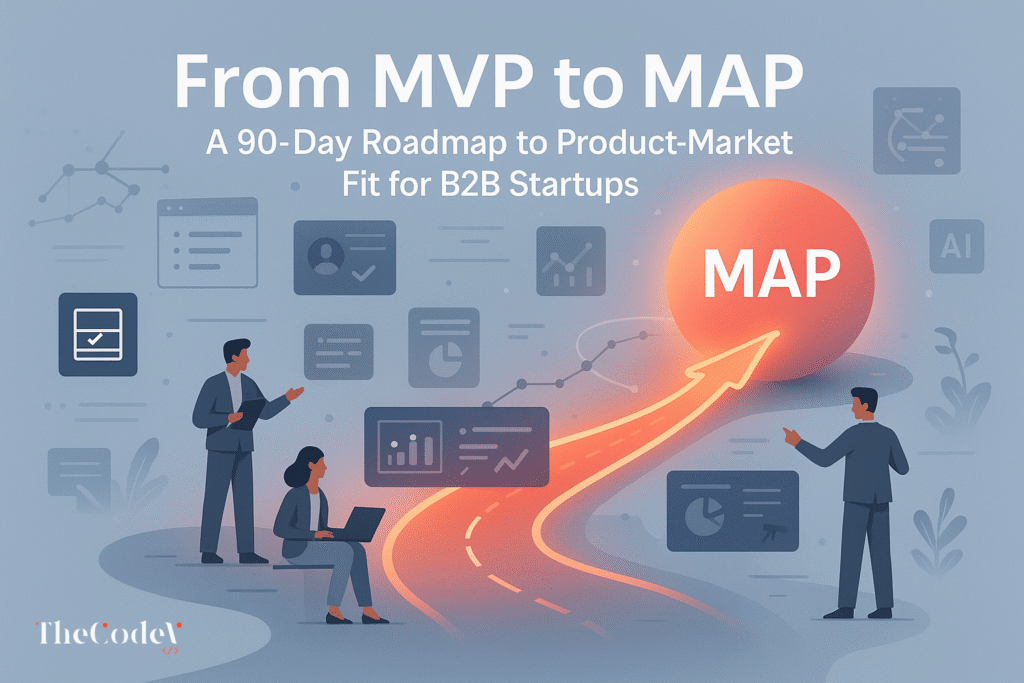
The MVP-to-MAP Journey: Why Product-Market Fit Defines Startup Survival
Every startup begins with an idea — but only a small fraction make it beyond the prototype stage. According to CB Insights, nearly 35% of startups fail because they never achieve product-market fit, meaning their offering doesn’t truly solve a real market problem or attract sustained customer demand. In today’s fast-paced B2B ecosystem, having a great idea or even a functional product isn’t enough — you need a strategic product-market fit roadmap that transforms your concept into something the market genuinely wants.
Understanding Why Product-Market Fit Matters
So, what is product-market fit? It’s the point where your product satisfies a strong market need, creating measurable traction, user retention, and customer advocacy. Startups that hit this stage experience faster growth, higher valuation potential, and easier scalability. But reaching this point isn’t accidental — it’s engineered through a deliberate process that aligns product vision, user insights, and business goals.
This is where the product-market fit roadmap comes in. It’s a structured path that helps founders systematically test, validate, and refine their product until it perfectly resonates with its audience. The product-market fit roadmap meaning extends beyond simple development; it’s a strategic framework that connects early innovation with long-term sustainability — bridging the gap between ideation and adoption.
If your startup’s trajectory currently feels uncertain, you’re not alone. Many teams focus on development velocity instead of validation, releasing features without understanding if they truly serve their audience. The result? Wasted resources, delayed traction, and a disjointed product vision.
At TheCodeV, our approach helps B2B startups transition from building fast to building smart, ensuring every feature contributes to market alignment and user satisfaction.
MVP vs MAP: The Evolution from Idea to Market Alignment
Most founders start with an MVP (Minimum Viable Product) — a simplified version of the product designed to test core hypotheses. The MVP’s purpose is experimentation: validating assumptions about customer pain points, willingness to pay, and usability. It’s a crucial first step, but it’s not the destination.
A MAP (Market-Aligned Product), on the other hand, represents the evolved form of your MVP — one that has been iterated, refined, and validated against real market feedback. The transition from MVP to MAP isn’t linear; it’s a cyclical process of learning, testing, and adapting. A well-defined product-market fit roadmap guides this evolution, ensuring that by the time your product reaches scale, it is optimised for both user adoption and business growth.
The Purpose of a Product Roadmap in the Fit Journey
The purpose of a product roadmap isn’t merely to plan feature releases — it’s to align your product vision with customer reality. It serves as a living document that connects strategic objectives to execution milestones, helping teams prioritise what delivers the most impact.
For B2B startups, a clear roadmap acts as both a navigation system and a risk mitigation tool, ensuring every development sprint is anchored in validated learning. This roadmap-driven approach not only accelerates time to market but also sharpens focus, preventing teams from chasing unvalidated ideas.
At TheCodeV, our product strategy experts help startups build actionable roadmaps that balance innovation with iteration, transforming MVPs into scalable, market-ready solutions that investors and customers trust.
Key Takeaway
Achieving product-market fit isn’t luck — it’s a disciplined process. By understanding the difference between MVP and MAP, and by using a robust product-market fit roadmap, startups can bridge the gap between product vision and market validation.
Understanding the Product-Market Fit Roadmap
Every successful startup shares one common trait — clarity of direction. Without it, even great ideas lose momentum. This is where a product-market fit roadmap becomes indispensable. It serves as the strategic compass that transforms uncertainty into action, helping early-stage ventures progress from concept to consistent customer demand.
What Is a Product-Market Fit Roadmap?
A product-market fit roadmap is a structured plan that defines how a startup will test, validate, and optimise its product to achieve alignment with market needs. It’s not a static document — it evolves as feedback, data, and user insights refine the path forward.
In simple terms, it’s the bridge between vision and validation. While most startups focus on launching an MVP, a roadmap ensures they don’t stop there. It guides teams to continuously measure customer reactions, improve features, and adapt the product until it fully resonates with its audience.
This approach minimises wasted effort, improves resource allocation, and helps startups stay responsive in competitive markets. As McKinsey highlights, companies that integrate structured learning loops into their product planning are twice as likely to achieve sustainable growth within their first two years.
The Purpose of a Product Roadmap
Before delving deeper into frameworks, it’s important to understand what is a product roadmap and its role in shaping startup success.
A product roadmap is more than a project timeline — it’s a strategic communication tool that connects your team’s efforts to long-term objectives. Its purpose is to ensure that every sprint, iteration, and release contributes directly to achieving product-market fit.
For B2B startups, this clarity is essential. It helps investors, stakeholders, and teams understand how short-term deliverables feed into the larger business goal. A strong roadmap answers key questions like:
What problems are we solving first?
Which features deliver the most customer value?
How do we measure success at each stage?
At TheCodeV, our product strategy consultants design roadmaps that balance vision, validation, and velocity, ensuring startups stay agile while keeping long-term goals intact.
What’s Included in a Product Roadmap for Early-Stage Ventures
For new ventures, a product-market fit roadmap framework usually includes five core components:
Vision & Goals – Defining the mission, target market, and measurable objectives.
Customer Insights – Understanding pain points through interviews, surveys, and analytics.
Feature Prioritisation – Listing features based on impact and feasibility.
Validation Strategy – Outlining how each assumption will be tested.
Feedback Loops & Metrics – Establishing KPIs like churn rate, activation, and NPS to track progress.
Each component ensures the startup learns continuously while staying aligned with its audience. Using a product-market fit roadmap template helps teams visualise dependencies and milestones, reducing confusion and ensuring accountability across departments.
For example, Y Combinator’s Startup Playbook and Eric Ries’s Lean Startup methodology both stress iterative development — build, measure, learn. This iterative approach is the foundation of every effective roadmap, transforming assumptions into evidence and ideas into results.
Why Every B2B Startup Needs a Roadmap
Without a roadmap, startups risk developing in isolation, often drifting away from what customers actually need. A well-structured roadmap empowers founders to say “no” to distractions and focus on validated opportunities. It helps them anticipate challenges and pivot early, instead of reacting too late.
At TheCodeV, we’ve helped global B2B startups implement custom roadmap frameworks that shorten time-to-market and accelerate user adoption. Whether you’re refining your MVP or scaling your MAP (Market-Aligned Product), a tailored product-market fit roadmap framework ensures every decision leads you closer to measurable traction.
As TechCrunch notes, startups that follow data-driven roadmaps “outperform their peers by achieving market traction 30% faster.” The message is clear — when you plan with purpose, product-market fit isn’t a milestone; it’s a momentum builder.
The 90-Day Framework: From Hypothesis to Validation
Achieving product-market fit isn’t a one-time event — it’s a structured journey that unfolds through consistent learning, testing, and iteration. To help B2B startups reach this milestone efficiently, TheCodeV’s experts recommend a 90-day product-market fit roadmap framework built on three core phases: Discovery, MVP Testing, and MAP Adaptation.
This systematic approach ensures that founders validate their assumptions early, reduce costly missteps, and evolve their products into truly market-aligned solutions.
Why a 90-Day Roadmap Works
Time is a critical factor for startups. A focused 90-day cycle creates urgency without overwhelming teams. It enforces rapid learning, structured experimentation, and measurable outcomes — aligning with proven frameworks like Lean Startup and First Round Review’s “Build Measure Learn” loop.
A product-market fit roadmap template provides the structure for this journey, helping teams map activities, milestones, and deliverables across each phase. It translates ambition into actionable steps, ensuring that insights drive progress rather than guesswork.
Phase 1: Discovery (Days 1–30)
Objective: Identify the market need and validate the core problem your product aims to solve.
In this first phase, the goal is to understand your customer’s world — their pain points, behaviour, and buying triggers. Startups that rush into development often miss this critical foundation.
Key Deliverables:
Customer Segmentation: Define your ideal B2B customer profiles and target industries.
Problem Hypothesis: Document your main assumption about the pain point your product solves.
Competitor & Market Analysis: Benchmark your idea against current market offerings.
Initial Feedback Loop: Conduct interviews or surveys to confirm demand signals.
According to Forbes, over 70% of successful startups cite early customer validation as the main reason they achieved sustainable growth. The Discovery phase ensures you start building with confidence, not assumptions.
Phase 2: MVP Testing (Days 31–60)
Objective: Build and launch a Minimum Viable Product to test real-world usage and gather feedback.
This phase moves your idea from theory to execution. The MVP doesn’t need to be perfect — it just needs to validate your hypotheses with real users.
Key Deliverables:
Prototype or MVP Build: Focus on 2–3 high-impact features.
Beta Testing: Engage a small set of users for closed testing and usability feedback.
KPIs Setup: Define measurable success criteria — adoption rate, churn, retention, or engagement.
Iterative Feedback: Capture data and adjust based on insights.
A product-market fit roadmap definition in this phase is to verify whether your solution genuinely resonates with the market and generates repeatable traction. As First Round Review emphasises, “real validation comes not from surveys but from user behaviour.”
At this stage, using internal collaboration tools and structured questionnaires — such as TheCodeV’s tailored startup questionnaire — can guide founders to uncover critical insights that shape their next iteration.
Phase 3: MAP Adaptation (Days 61–90)
Objective: Refine your product into a Market-Aligned Product (MAP) based on verified data.
This final stage is where insights turn into growth. You shift from MVP mode to strategic scalability, guided by clear metrics and user retention signals.
Key Deliverables:
Refinement Sprint: Optimise features that drive satisfaction and retention.
Market Positioning: Align messaging and pricing with validated customer expectations.
Retention & Feedback Analysis: Use real-time data to identify long-term user value.
Scalability Assessment: Prepare infrastructure for expansion and investment readiness.
A product-market fit roadmap example of success might include startups that continuously iterate post-MVP — adjusting pricing models or user experiences to sustain engagement.
To plan resources efficiently for this phase, explore TheCodeV’s flexible pricing plans, designed to help startups evolve from prototype to production-grade applications without losing strategic focus.
Phase 1 (Days 1–30): Discovery & Alignment
Every successful startup begins not with a product, but with a problem worth solving. The Discovery & Alignment phase of the 90-day product-market fit roadmap is where this journey truly begins. It’s about slowing down before speeding up — validating assumptions, learning from your market, and aligning your product vision with genuine customer pain points.
Defining Discovery & Alignment
The product-market fit roadmap definition for this stage is clear: to uncover whether your business idea addresses a real, monetisable problem and whether your target audience is ready for your solution. Founders often fall into the trap of building products based on inspiration, not validation. Discovery & Alignment ensures your startup builds on verified insights, not intuition.
This phase combines research, empathy, and experimentation. By deeply understanding the market and your audience, you set a foundation that guides every subsequent sprint in your roadmap — from MVP development to eventual scale.
Step 1: Identify Market Pain Points
The first task in discovery is identifying your customer’s pain points — the problems that disrupt their workflows or limit their growth. For B2B startups, this means getting close to the user environment: talk to decision-makers, analyse inefficiencies, and observe existing solutions in action.
Tools and approaches include:
User interviews: Conduct qualitative interviews with at least 10–15 potential users to uncover recurring challenges.
Problem validation surveys: Use lightweight online forms to confirm whether users prioritise the problem you aim to solve.
Industry data mining: Analyse reports and case studies from trusted sources to spot emerging gaps or underserved segments.
As a Harvard Business School case study on product validation highlights, “startups that systematically validate market demand before building are 60% more likely to achieve sustainable traction.” Discovery ensures that every future decision — from design to pricing — is anchored in verified user pain.
Step 2: Build and Test Hypotheses
Once you’ve mapped out the problems, the next step is to form clear hypotheses. These are structured guesses about your audience, the problem’s scope, and potential value propositions.
For example:
“If small B2B SaaS founders struggle with onboarding analytics, then introducing an AI-powered onboarding dashboard will reduce churn by 20%.”
Testing these hypotheses early prevents months of wasted development. This is where tools powered by AI can play a transformative role. A product-market fit roadmap AI approach uses machine learning-driven insights (e.g., user sentiment analysis or predictive trend tracking) to identify the strongest product directions. These insights can shorten the discovery cycle dramatically.
At TheCodeV, our digital transformation specialists employ both data-driven and human-led validation techniques to help founders uncover market truths faster.
Step 3: Align Product Vision with Audience Needs
Discovery is meaningless without alignment. This stage ensures that your internal vision — your product goals, features, and positioning — syncs perfectly with what your customers actually value.
Ask yourself:
Are our core features solving high-priority problems?
Does our value proposition communicate measurable impact?
Is our roadmap shaped by user feedback or internal preference?
Alignment involves continuous dialogue between founders, developers, and early users. By maintaining this loop, you ensure that every decision moves you closer to true product-market fit.
A well-structured Discovery phase helps clarify what is included in a product roadmap — not just timelines or features, but validated goals, measurable hypotheses, and clear success indicators.
From Insights to Implementation
By the end of the first 30 days, you should have:
A validated problem statement.
Defined target personas.
Evidence of early demand.
A prioritised list of hypotheses to test in the MVP stage.
This clarity allows teams to build smarter, iterate faster, and pitch investors with confidence. And if new questions arise or your assumptions need refinement, our experts at TheCodeV can help you refine your roadmap through structured consultation and technical validation services.
Phase 2 (Days 31–60): MVP Launch & Feedback Loops
Once your startup has validated its market problem and aligned its vision, it’s time to turn insights into something tangible — the Minimum Viable Product (MVP). This is where the real-world testing begins. The MVP phase is designed to gather actionable feedback, uncover real user behaviour, and move you closer to true product-market fit.
A well-executed MVP launch lies at the heart of every successful product-market fit roadmap. It’s not about building the most advanced version of your product — it’s about learning as fast as possible, validating hypotheses, and discovering what truly resonates with your target audience.
Building and Launching the MVP
The goal of an MVP isn’t perfection; it’s validation. By focusing on your product’s core functionality, you can deliver value to early adopters while saving time and resources.
A great product-market fit roadmap example often includes three essentials at this stage:
Rapid Prototyping: Create clickable prototypes or limited-feature builds using tools like Figma or Bubble. Keep it lightweight but realistic.
Early Access Launch: Invite a small group of beta users or clients who match your ideal customer profile.
Usability Testing: Observe how users interact with your MVP and identify friction points.
As Product School highlights, “The MVP is not the end — it’s a feedback engine. The faster you learn, the closer you get to product-market fit.”
For B2B startups, this phase is especially crucial. Buyers expect clarity of value from day one. A structured MVP process lets you prove that value early while positioning your brand as agile and customer-centric.
At TheCodeV, our development specialists help startups design and deploy MVPs that combine clean UX, technical scalability, and validation-first strategies — ensuring your roadmap leads to measurable traction, not just a launch milestone.
Creating Feedback Loops That Drive Improvement
Launching is only half the story; learning is the other half. After the MVP is in users’ hands, your priority is to establish feedback loops that capture insights and transform them into improvement cycles.
Effective feedback strategies include:
In-app analytics: Track behavioural metrics like click-throughs, drop-offs, and retention.
User interviews: Gather qualitative feedback to understand motivations behind user actions.
Surveys and polls: Identify user satisfaction levels and feature requests.
Customer support logs: Analyse recurring queries or pain points that indicate friction.
By combining quantitative and qualitative insights, founders can prioritise the most impactful iterations. This process embodies the build–measure–learn cycle, popularised by the Lean Startup methodology.
Leveraging AI for Smarter Insights
Modern startups increasingly rely on AI-powered analysis to interpret user data efficiently. A well-integrated product-market fit roadmap AI system can help analyse sentiment, cluster feedback, and detect emerging patterns long before they’re visible manually.
For example, using AI-driven analytics platforms, founders can identify the most requested features, common drop-off points, or high-conversion touchpoints across user segments. These insights enable faster iteration cycles — empowering teams to pivot or refine features in near real-time.
At TheCodeV, our data engineers and product-market fit roadmap developers use automation and AI to help startups make informed decisions, turning raw user feedback into scalable growth strategies. For instance, our eCommerce SEO solutions leverage AI data insights to refine customer journeys — the same logic that drives smart MVP iteration in SaaS and B2B models.
Iteration: Turning Feedback into Roadmap Decisions
Each improvement cycle should feed directly into your roadmap. Prioritise features based on impact and evidence, not opinion. Use metrics like activation rate, retention, and customer satisfaction to decide what to build next.
The best product-market fit roadmap examples show that continuous iteration — guided by data — transforms MVPs into market-ready solutions faster than traditional development models. Andreessen Horowitz reinforces this point: startups that “listen aggressively to customers and act fast” consistently outperform those relying on rigid, long-term planning.
Phase 3 (Days 61–90): Metrics, Market Signals & Adaptation Plan (MAP)
The final stage of the product-market fit roadmap is where analysis meets action. After weeks of discovery, validation, and MVP testing, it’s time to interpret what the market is telling you — and evolve your product into a Market-Aligned Product (MAP). This is the phase where data confirms whether you’ve achieved traction or need further refinement.
In simple terms, this phase defines the product-market fit roadmap meaning — transforming a functional prototype into a validated, market-ready solution that consistently attracts, retains, and delights users.
Measuring What Matters: The Key Metrics
Metrics are the pulse of your product. They reveal whether your solution resonates with users and whether your market is large and engaged enough to sustain long-term growth.
Here are the core KPIs every startup should monitor during this phase:
Retention Rate: The percentage of users who continue using your product over time. Retention signals stickiness — the true indicator of product-market fit. According to Mixpanel, companies with strong retention in the first 90 days are 3x more likely to achieve sustainable growth within their first year.
Net Promoter Score (NPS): This measures user satisfaction and loyalty by asking one simple question: “How likely are you to recommend this product to a friend or colleague?” A high NPS means your product isn’t just solving a problem — it’s delighting users enough to inspire referrals.
Activation Rate: This measures how many users complete key actions that define success (e.g., completing onboarding, uploading data, or inviting teammates). A high activation rate suggests users understand your product’s value quickly.
Churn Rate: This metric indicates how many users stop using your product. Reducing churn through improved onboarding, support, and product UX often leads to faster attainment of product-market fit.
Revenue Growth & CAC/LTV Ratio: For B2B startups, financial metrics like Customer Acquisition Cost (CAC) and Lifetime Value (LTV) reveal how sustainable your growth model is.
Together, these metrics create a product-market fit roadmap graphic — a visual representation of your progress from initial adoption to market validation.
Analysing Market Signals
Numbers alone don’t tell the whole story. It’s equally important to monitor market signals — indicators that your product is gaining traction beyond user activity. These include:
Inbound interest: An increase in demo requests, newsletter sign-ups, or partnership inquiries.
Organic mentions: Growing discussions about your product on LinkedIn, X (Twitter), or industry forums.
Customer advocacy: Users sharing case studies, testimonials, or integrations.
These signals show that your brand narrative is resonating in the ecosystem — a sign that you’re approaching true product-market fit.
At TheCodeV, we help startups interpret these metrics through advanced analytics dashboards and growth audits, enabling founders to make confident, data-backed product decisions.
From Metrics to Market-Aligned Product (MAP)
Once key metrics are benchmarked, it’s time to act on insights. Refinement means iterating your product, pricing, and positioning based on what’s working — and eliminating what isn’t.
Actions to focus on during MAP adaptation include:
Enhancing high-impact features and removing underperforming ones.
Re-aligning your pricing model with customer-perceived value.
Automating data collection to fuel predictive insights through AI tools.
Strengthening onboarding and customer support systems.
A well-optimised MAP is not just functional — it’s scalable. It reflects real-world validation, operational readiness, and user alignment. As McKinsey Growth Studies emphasise, “Startups that operationalise data-driven decision-making achieve 30–50% faster growth trajectories post-launch.”
For startups ready to scale strategically, TheCodeV offers tailored growth packages through its pricing plans, ensuring the right balance between budget, analytics, and performance.
Product-Market Fit Roadmap to Success
Reaching MAP status signifies the transition from startup experimentation to predictable growth. Your product-market fit roadmap to success isn’t about perfection — it’s about precision. By tracking metrics, listening to users, and adapting intelligently, your product becomes a reflection of your market’s evolving needs.
Building Your Product-Market Fit Culture
Achieving product-market fit is not a one-time milestone — it’s a continuous process of learning, measuring, and evolving. For B2B startups, the challenge isn’t just reaching fit, but maintaining it as markets shift, competitors emerge, and customer expectations evolve. The most successful companies don’t just follow a product-market fit roadmap framework — they embed it into their organisational culture.
Making Product-Market Fit a Company-Wide Discipline
Many founders view product-market fit as a function of the product team, but in reality, it’s an organisation-wide responsibility. Every department — from engineering to marketing to customer success — plays a critical role in maintaining alignment between the product and the market.
A culture of continuous validation means that:
Developers focus not only on code but also on how users experience their features.
Marketers craft campaigns that test positioning hypotheses and gather feedback loops.
Customer success teams become frontline researchers, collecting insights that feed directly into product iteration.
As Harvard Business Review notes, “Companies that foster cross-functional collaboration achieve product-market alignment 2.5 times faster than siloed teams.” This principle lies at the core of a sustainable product-market fit roadmap framework.
At TheCodeV, we’ve seen this in practice across multiple B2B engagements — where collaboration between product managers, engineers, and marketers transforms scattered data into coordinated decisions that drive measurable results.
Building Cross-Functional Feedback Systems
True alignment emerges when every team has visibility into customer insights and performance metrics. Startups can achieve this by using collaborative tools that centralise feedback and project tracking:
Notion: Ideal for managing documentation, feature requests, and retrospective learnings in one shared workspace.
Slack: Perfect for real-time communication between cross-functional teams, allowing feedback from customers or analytics tools to surface instantly.
Airtable: Enables structured tracking of customer feedback, user satisfaction metrics, and roadmap priorities through flexible relational databases.
By maintaining these live feedback systems, startups can react quickly to user signals and identify areas for improvement before they impact retention or satisfaction.
The best product-market fit roadmap examples often include “feedback ownership” — where each department is accountable for one segment of the customer journey. For example, the development team monitors activation rates, the marketing team analyses conversion insights, and the customer success team evaluates renewal intent.
Empowering the Product-Market Fit Roadmap Developer
Modern startups increasingly rely on technology to institutionalise product-market fit. A product-market fit roadmap developer — whether a dedicated role or a cross-functional responsibility — ensures that metrics, analytics, and feedback systems are interconnected. This person (or team) helps transform raw feedback into actionable insights, bridging the gap between business objectives and technical execution.
By integrating automation, analytics dashboards, and AI-driven user sentiment tracking, roadmap developers enable faster iteration cycles. They serve as the connective tissue between departments, ensuring that no customer insight goes unnoticed and no decision is made in isolation.
Institutionalising Adaptation as a Mindset
Adaptation must become a habit, not a reaction. Regular product reviews, customer success syncs, and data retrospectives should be part of the startup’s operational rhythm. At TheCodeV, we help B2B teams design adaptive frameworks that encourage agility — enabling products to evolve naturally with the market rather than chasing it.
MIT Sloan Management Review emphasises that “organisations that embed continuous experimentation into their DNA achieve sustained innovation and higher profitability.” This is precisely the mindset that converts startups into scalable, future-ready businesses.
Conclusion & Call-to-Action: Partner with TheCodeV to Accelerate Your MAP Journey
Every successful startup story shares one common pattern — a disciplined pursuit of product-market fit. It’s the invisible thread that connects early prototypes with thriving, scalable businesses. The journey from MVP to MAP (Market-Aligned Product) is not just about building software; it’s about building understanding — of your users, your market, and your long-term vision.
The 90-day product-market fit roadmap outlined in this guide is designed to turn that understanding into measurable progress. It breaks the chaotic world of startup building into structured, achievable steps — helping founders validate faster, iterate smarter, and scale stronger.
The Three Phases at a Glance
Phase 1: Discovery & Alignment (Days 1–30)
The foundation of every great product begins with insight. This phase focuses on identifying authentic market pain points, testing early hypotheses, and ensuring that your vision aligns with your audience’s reality. Through user interviews, problem validation, and competitive research, startups develop the clarity needed to move confidently toward MVP development.
Phase 2: MVP Launch & Feedback Loops (Days 31–60)
The second phase is where ideas take shape. It’s about executing the MVP launch, gathering user feedback, and implementing rapid iteration cycles. Here, tools like AI-driven analytics, beta testing, and feedback systems help you fine-tune your product’s core value. This stage turns your MVP into a responsive feedback engine — one that learns and improves continuously.
Phase 3: Metrics, Market Signals & Adaptation Plan (Days 61–90)
The final phase transforms your validated MVP into a Market-Aligned Product (MAP). By analysing key metrics such as retention rates, NPS, and activation metrics, startups can identify their strongest growth levers. This data-driven refinement ensures that your product evolves from a minimal version into a market-ready solution built for real users and sustainable traction.
Together, these three phases define the product-market fit roadmap to success — a structured approach to achieving what many startups spend years chasing: clarity, confidence, and consistent growth.
From MVPs to MAPs: The Power of Frameworks and Focus
The transition from MVP to MAP is not about adding features; it’s about removing uncertainty. A well-defined roadmap, supported by validated learning and data insights, enables founders to make confident, evidence-based decisions.
This process transforms chaos into clarity — giving startups a repeatable playbook for success. With the right strategy, founders can reach product-market fit in just 90 days, armed with actionable data, loyal early users, and a scalable foundation for future growth.
At TheCodeV, we’ve guided numerous B2B startups across the UK, Europe, and the Middle East through this transformation. From fintech and SaaS innovators to AI-driven marketplaces, our teams have engineered success stories where technology meets market precision. We pair deep technical expertise with strategic insight — helping startups navigate every phase of their product evolution.
Why Partner with TheCodeV and EmporionSoft
As part of our global ecosystem, EmporionSoft Pvt Ltd complements TheCodeV’s strategy-driven approach with robust technical execution and AI-powered product validation. Together, we’ve helped founders:
Design scalable MVP architectures that validate faster and deploy smarter.
Use AI and analytics tools to interpret feedback and predict market demand.
Build cross-functional product teams that maintain alignment between innovation, design, and customer success.
Both firms bring real-world experience from hundreds of projects — ensuring that your journey through the product-market fit roadmap is not theoretical but tactical, measurable, and results-driven.
Let’s Build Your Roadmap to Success
Your vision deserves more than just development — it deserves strategic execution, validation, and sustained growth. Whether you’re refining your MVP, scaling your MAP, or seeking expert guidance on market alignment, TheCodeV is ready to help.
🌍 Here’s how you can take the next step:
Book a consultation: https://thecodev.co.uk/consultation/ — Discuss your startup goals with our experts.
Explore our digital services: https://thecodev.co.uk/digital-services/ — Discover how our product strategy, AI, and cloud teams can accelerate your journey.
Contact TheCodeV directly: https://thecodev.co.uk/contact/ — Start a conversation about building your roadmap today.
The Road Ahead
The path to product-market fit is not a guessing game — it’s a guided journey. With the right roadmap, you can transform uncertainty into clarity and ambition into traction. TheCodeV’s experts are here to help you chart that path — from MVP creation to MAP evolution — ensuring that every decision you make drives sustainable success.
The 90-day product-market fit roadmap is more than a framework; it’s your blueprint for growth, innovation, and impact. Now it’s your turn — let’s build your roadmap to success, together.



One Comment
good