The Rise of LLMOps for Startups: Why Founders Can No Longer Ignore AI Operations
Artificial Intelligence has shifted from a futuristic buzzword to the core engine of modern startup innovation. From automating customer support to generating personalised recommendations, startups today rely heavily on large language models (LLMs) to build smarter, more responsive digital products. But as AI capabilities expand, so do the operational challenges behind them. Managing models efficiently, ensuring reliable performance, and maintaining compliance across complex pipelines have given rise to a new discipline — LLMOps for startups.
What Is LLMOps? Understanding the Evolution Beyond MLOps
Before diving into its importance, it’s crucial to ask: what is LLMOps?
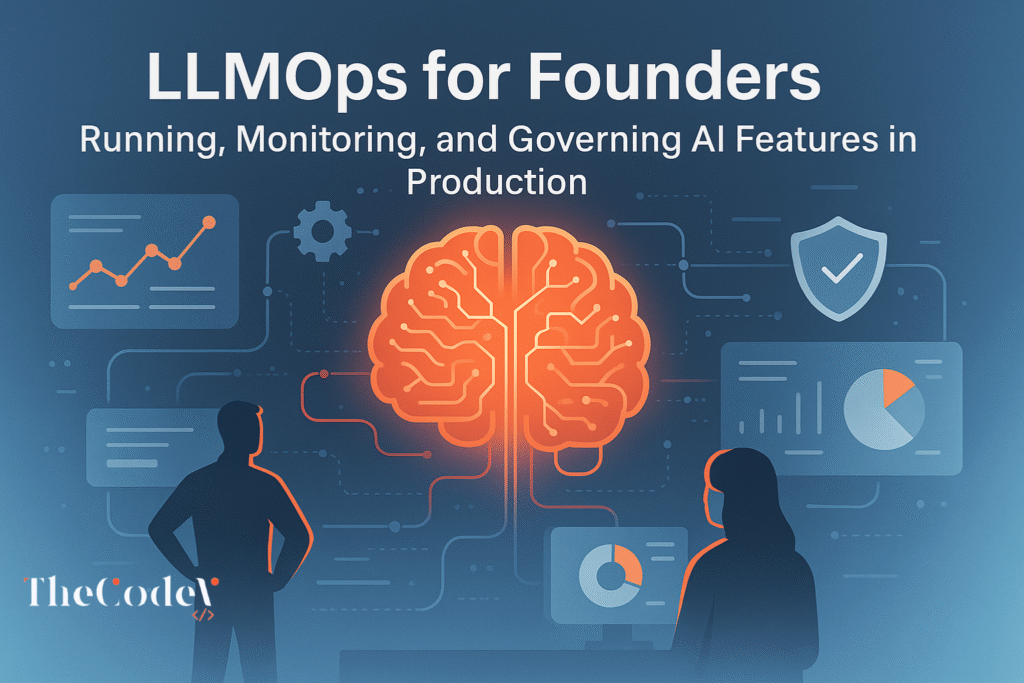
LLMOps (Large Language Model Operations) refers to the structured framework for running, monitoring, and governing AI models—particularly LLMs—in production environments. It builds upon the foundation of MLOps (Machine Learning Operations), but adds layers of complexity unique to language-based AI systems.
Unlike traditional ML models that focus on classification or prediction tasks, LLMs handle dynamic text generation, reasoning, and contextual understanding. This means they need ongoing prompt management, version control, ethical alignment, and real-time performance tracking. According to IBM Research, effective LLMOps integrates everything from fine-tuning and deployment to observability and compliance, ensuring that AI features remain reliable and scalable even as user demands grow.
Where MLOps focused on automating machine learning workflows, LLMOps brings order to the chaos of large-scale generative systems — bridging data engineering, model governance, and ethical AI practices in one operational layer.
Why Startups Need LLMOps Now More Than Ever
For early-stage companies, AI is both an opportunity and a risk. Generative models can unlock innovation at unprecedented speed — enabling features like chatbots, copywriting assistants, and predictive analytics — yet they also introduce complex operational problems.
Many founders quickly discover that deploying an AI model is easy; maintaining and scaling it without LLMOps discipline is the real challenge.
Common pitfalls include:
Model drift, where outputs degrade over time.
Unreliable performance, due to inconsistent data pipelines.
Compliance concerns, especially under evolving data protection laws.
Cost inefficiency, from unmanaged model calls or token usage.
Startups often rush to integrate AI tools for startups such as ChatGPT APIs, LangChain, or Hugging Face models, without realising that each integration adds an operational burden. Without monitoring, observability, and governance — the pillars of LLMOps — these systems can spiral into unmanageable, expensive chaos.
As Gartner highlights in its 2025 AI Operations report, companies that invest early in AI governance and operational frameworks outperform peers by 40% in reliability and cost efficiency. For a founder balancing speed and sustainability, that statistic isn’t optional — it’s a roadmap.
The Shift Toward Generative AI for Startups
The last two years have seen a boom in Generative AI for startups, driving a wave of innovation across content creation, software development, and automation. However, every generative model deployed in production needs to be tracked, optimised, and ethically supervised.
This is precisely where LLMOps transforms from a backend concern into a growth enabler.
By implementing proper pipelines, version control, and monitoring dashboards, startups can continuously fine-tune and deploy LLMs with confidence — improving product reliability while maintaining compliance and brand trust. It’s not just about managing models; it’s about building scalable, intelligent systems that evolve alongside business needs.
How TheCodeV Empowers AI-Driven Founders
At TheCodeV, we recognise that founders often struggle to balance rapid innovation with operational control. Through our tailored Digital Services, we help startups transform their experimental AI features into robust, production-ready systems powered by LLMOps principles.
Our About Us page reflects our ongoing mission: to empower startups with sustainable AI infrastructures — enabling them to innovate responsibly while scaling globally.
Inside the LLMOps Framework: How Startups Operationalise Language Models
As startups increasingly embed AI across their products, the need for a structured operational framework has never been clearer. The days of treating AI as a “black box” experiment are over. Modern founders now understand that LLMOps for startups isn’t just a buzzword — it’s the discipline that ensures their large language models perform reliably, ethically, and at scale.
But what does that framework actually look like in practice?
Understanding the LLMOps Pipeline: From Data to Governance
To grasp what is LLMOps, think of it as the full lifecycle management of a large language model — from dataset preparation to long-term monitoring. Unlike traditional software, LLM-based products evolve with every dataset, every user prompt, and every feedback loop. The LLMOps pipeline ensures that evolution happens within a controlled, measurable, and compliant environment.
A typical LLMOps pipeline for startups includes:
Data Curation:
Selecting, cleaning, and labelling domain-specific datasets to ensure accuracy and relevance. For example, a fintech startup might curate transaction-related text data while applying bias filters to maintain compliance.Fine-Tuning:
Adapting pre-trained models like GPT or LLaMA to specific use cases — improving tone, accuracy, and contextual understanding. This phase often leverages tools like Weights & Biases for experiment tracking and hyperparameter optimisation.Deployment:
Integrating the fine-tuned model into production through APIs such as OpenAI, Anthropic, or LangChain pipelines. At this stage, startups focus on latency management and cost-efficient scaling.Monitoring:
Continuously observing model performance using metrics like response accuracy, hallucination rate, and token usage. According to NVIDIA’s Developer Blog, active monitoring prevents “AI drift” and helps models maintain consistency under real-world loads.Governance:
Establishing ethical guidelines, version control, and access permissions. Governance frameworks ensure that generative outputs align with data privacy laws and brand tone — critical for regulated industries.
This end-to-end cycle is what turns AI prototypes into production-grade assets capable of evolving responsibly with each iteration.
For founders seeking implementation support, TheCodeV’s Services team assists in setting up end-to-end LLMOps infrastructure that aligns technical architecture with business goals.
LLMOps vs MLOps: The Next Evolution in AI Operations
While both MLOps and LLMOps share the goal of streamlining machine learning workflows, their operational scope and complexity differ greatly.
MLOps deals primarily with model training, version control, and deployment for predictive models. Think of it as the DevOps of traditional machine learning — focused on reproducibility and performance consistency.
LLMOps, however, expands into prompt management, feedback learning, real-time context adaptation, and ethical governance — areas that standard MLOps pipelines were never built to handle.
For instance, in MLOps, a model predicting customer churn can be monitored with simple accuracy metrics. In contrast, an LLM-based customer assistant requires semantic evaluation — measuring tone, coherence, and factual correctness. This introduces unique observability challenges that demand tools like LangChain evaluators and OpenAI logging dashboards.
According to skywork.ai and towardsdatascience.com, the distinction lies in how dynamic and context-dependent language models are. LLMOps introduces mechanisms for continuous human feedback, reinforcement learning (RLHF), and iterative retraining — processes that make AI outputs more aligned and reliable over time.
The Emerging AgentOps Framework: Beyond Static Models
As startups evolve their AI systems further, a new concept — AgentOps — is gaining traction. It builds upon LLMOps by managing autonomous AI agents capable of reasoning, decision-making, and executing multi-step tasks.
AgentOps frameworks introduce:
Real-time feedback loops, allowing agents to self-improve through contextual awareness.
Task orchestration, managing multiple LLMs collaborating on a workflow.
Governance layers, ensuring safety, accountability, and explainability across autonomous operations.
This evolution demonstrates that LLMOps is not just about keeping models running — it’s about enabling intelligent, self-improving systems that can drive entire product ecosystems.
For founders exploring these frontiers, TheCodeV offers tailored advisory through its Consultation programme, helping startups integrate cutting-edge frameworks like LLMOps and AgentOps efficiently and securely.
Why Startups Should Adopt LLMOps Early: Turning AI Chaos into Scalable Success
“Your AI model works great in demo — but breaks in production.”
It’s a sentence every founder dreads. The chatbot that dazzled investors suddenly gives erratic answers. The AI code assistant that impressed your engineering team slows to a crawl under user load. These early cracks in performance aren’t just technical hiccups — they’re symptoms of missing operational discipline.
That’s where LLMOps for startups comes in. It’s not another layer of complexity; it’s the foundation of reliability, scalability, and trust in AI-driven products.
From Prototype to Production: The Hidden Pitfalls of AI Implementation in Startups
AI has become the new competitive edge for emerging companies — powering automation, customer support, and data-driven insights. Yet, many founders underestimate the operational challenges that come after model deployment. According to Forrester Research, over 65% of AI projects fail to move beyond the prototype phase because of poor observability, inconsistent data pipelines, or governance gaps.
Consider a few familiar startup use cases:
Chatbots that provide instant customer engagement.
Code assistants that help developers generate clean, efficient code.
Recommendation systems that personalise shopping or content experiences.
All of these depend on complex large language models (LLMs) that must process vast, ever-changing data while maintaining accuracy and compliance. Without LLMOps, these models degrade quickly, resulting in costly downtime and user dissatisfaction.
MLOps for startups once offered a foundation for deploying smaller predictive models, but LLMOps extends that capability to large-scale, generative systems. It brings structure to chaos by unifying data curation, deployment, monitoring, and governance under one operational roof.
How LLMOps Solves Startup AI Challenges
Startups are built on speed — but speed without structure can derail innovation. LLMOps ensures that AI systems scale with your business without sacrificing quality or compliance.
Here’s how it helps founders overcome key challenges:
Scalability:
As your user base grows, model workloads spike. LLMOps uses automation to dynamically scale infrastructure and manage performance bottlenecks.Reliability:
Continuous monitoring and version control reduce unexpected downtime. As AWS Machine Learning Blog notes, LLMOps pipelines automate retraining, rollback, and deployment — ensuring every update is safe and reversible.Compliance:
With privacy regulations tightening worldwide, startups must track every model decision and data input. LLMOps embeds ethical AI governance into operations, helping teams stay aligned with GDPR and other standards.Efficiency:
Integrated toolsets — like LangChain, Weights & Biases, and OpenAI APIs — streamline workflow automation, letting founders focus on innovation, not maintenance.
Core Benefits of Adopting LLMOps Early
For early-stage founders, implementing LLMOps isn’t a luxury — it’s a growth multiplier. It empowers teams to deploy responsibly, iterate faster, and maintain customer trust.
Key benefits include:
✅ Reduced downtime – Real-time monitoring prevents costly service interruptions.
🔁 Continuous learning – Feedback loops refine models with each interaction.
🔒 Ethical and secure AI governance – Built-in compliance and bias checks safeguard brand credibility.
As MIT Technology Review explains, AI success in the coming decade will depend not only on innovation but also on how well startups operationalise and monitor their intelligent systems.
Scaling Responsibly with TheCodeV
At TheCodeV, we help startups move beyond the prototype stage by embedding operational maturity from day one. Our tailored Pricing Plans allow founders to scale AI features efficiently without overextending budgets, while our Contact team provides strategic guidance for implementing custom LLMOps pipelines.
Building Your LLMOps Stack: Tools Every Startup Should Know
When it comes to scaling AI, choosing the right tools can make or break your product’s long-term success. For founders, LLMOps for startups isn’t just a concept — it’s a toolkit that transforms experimental AI features into reliable, production-ready assets. From open-source MLOps tools to enterprise-level LLMOps platforms, the right stack ensures smooth deployment, monitoring, and governance across the entire AI lifecycle.
1. Open-Source Powerhouses for LLMOps
Open-source ecosystems have democratised access to advanced AI infrastructure, allowing startups to compete with enterprise-grade efficiency without huge costs. Below are the most trusted tools for LLMOps and MLOps operations:
MLflow:
A lightweight yet powerful platform for experiment tracking, model versioning, and deployment automation. Ideal for early-stage startups, MLflow offers flexibility for both research and production environments.LangChain:
A key framework for building context-aware and composable LLM applications. It enables seamless prompt chaining, retrieval-augmented generation (RAG), and API orchestration — essential for chatbots, virtual assistants, and automation tools.Weights & Biases (W&B):
Industry-standard for experiment tracking and performance visualisation, helping teams monitor LLM fine-tuning, token usage, and performance drift. Its collaborative dashboard ensures transparency across teams.Kubeflow:
A robust, Kubernetes-based end-to-end pipeline manager perfect for scaling machine learning and language model workflows in cloud environments.Neptune.ai:
Designed for model monitoring and reproducibility, Neptune.ai helps teams compare model versions, track hyperparameters, and visualise experiments effectively.
These open-source solutions have been featured extensively on huggingface.co and Google Cloud AI Docs as reliable foundations for AI model management and monitoring.
To explore how TheCodeV integrates such technologies into production environments, visit TheCodeV Digital Services, where open-source flexibility meets enterprise-grade scalability.
2. Enterprise Cloud Ecosystems: AWS, Azure, and GCP
While open-source tools offer freedom, enterprise cloud providers deliver reliability and seamless scalability for growing startups. Each major platform — AWS, Azure, and Google Cloud — now provides LLMOps integration layers that help startups manage AI at scale.
AWS SageMaker:
Provides an all-in-one solution for model training, deployment, and inference management, along with automated monitoring and cost optimisation tools.Azure Machine Learning:
According to Microsoft’s AI Blog, Azure ML’s Responsible AI dashboard and LLMOps features help founders maintain transparency, fairness, and governance throughout deployment.Google Cloud Vertex AI:
Known for its end-to-end integration with TensorFlow and generative AI APIs, Vertex AI allows startups to experiment with model tuning and deploy across multiple environments efficiently.
Each of these platforms also supports hybrid workflows — combining open-source frameworks like LangChain or MLflow with enterprise-level governance and scaling. This hybrid model offers the best of both worlds: agility from open-source tools and reliability from cloud infrastructure.
3. Cost, Scalability, and Security Considerations
Adopting an LLMOps stack isn’t only about technology — it’s about sustainability. Startups must balance innovation with financial and operational discipline.
Key considerations include:
Scalability: Ensure your pipeline supports multi-environment deployment. Cloud-native tools like Vertex AI and Kubeflow make scaling seamless.
Cost Control: Monitor compute and token usage closely. Tools like W&B and SageMaker offer native budget monitoring and usage tracking.
Security: Enforce data encryption, API authentication, and role-based access controls. According to Google Cloud AI Docs, compliance-focused startups should prioritise ISO 27001 and GDPR-aligned frameworks from day one.
At TheCodeV, our Ecommerce SEO and AI infrastructure optimisation services extend these principles to startups aiming to build secure, scalable, and performance-driven digital ecosystems.
Building Trust Through Responsible AI Operations
In the era of intelligent automation, trust is currency. For startups embracing LLMOps for startups, the challenge isn’t just running AI efficiently — it’s running it responsibly. As large language models increasingly make real-time decisions that affect customers, products, and data privacy, AI governance, ethics, and compliance have become essential to maintaining credibility and avoiding regulatory pitfalls.
Responsible AI operations aren’t a compliance checkbox; they are the foundation for long-term business sustainability and user trust.
Why Governance and Ethics Are Core to LLMOps
Founders often focus on performance metrics like latency, accuracy, or cost — but overlook how AI governance safeguards against hidden risks such as bias, misinformation, and misuse. Without clear governance policies, startups face reputational damage and regulatory penalties before they even scale.
According to the UK Government’s AI Regulation Whitepaper (2024), ethical governance must underpin all AI deployments, ensuring accountability, fairness, and transparency. Similarly, the OECD AI Principles advocate that every AI system should be explainable and traceable — a crucial point for startups using generative models in decision-making workflows.
Within an AI ethics framework, LLMOps plays a crucial operational role by enforcing:
Transparency: Clear model documentation, version tracking, and explainability for end-users.
Bias Mitigation: Routine data audits and retraining protocols to identify and reduce systemic bias.
Accountability: Designated ownership for every stage of the model lifecycle, ensuring decisions can be traced to human oversight.
As IBM Ethics Guidelines for AI note, transparency is the bridge between trust and innovation — and startups adopting LLMOps are better positioned to cross it confidently.
Governance Dashboards and Compliance in Action
Modern LLMOps platforms include integrated governance dashboards that allow founders to visualise, audit, and manage their AI systems in real time. These dashboards track key elements such as:
Data lineage (where training data originates and how it’s processed)
Model version control and approval workflows
Privacy and consent tracking for user interactions
Bias and fairness testing logs
Startups can use these insights to ensure GDPR compliance and maintain control over how AI interacts with personal or sensitive data. By implementing automated alerts and review checkpoints, governance dashboards create a culture of ethical vigilance rather than reactive compliance.
You can explore TheCodeV’s own Privacy Policy and Terms & Conditions as examples of how ethical and legal accountability align with technical innovation.
Responsible Deployment: Lessons from Healthtech and Fintech
Industries like healthtech and fintech illustrate how startups can deploy LLMs responsibly through strong governance.
In healthtech, AI assistants powered by LLMs help doctors summarise patient histories, but they must follow strict HIPAA and GDPR guidelines for data handling.
In fintech, LLM-driven recommendation systems or risk analysis models rely on bias testing frameworks to prevent unfair lending decisions or misinformation.
By integrating ethical checkpoints at every stage — from data ingestion to deployment — these startups prove that governance and innovation can coexist without friction.
OECD and IBM reports both highlight that early-stage companies embedding AI ethics frameworks in their LLMOps pipelines enjoy stronger customer trust and investor confidence — turning compliance into a competitive advantage.
A Founder’s Takeaway
For today’s AI-driven startups, governance isn’t bureaucracy; it’s a blueprint for sustainable innovation. Adopting LLMOps with ethical principles ensures that your AI systems aren’t just fast or scalable — they’re fair, transparent, and secure.
Incorporating the right dashboards, compliance processes, and documentation early on doesn’t slow progress — it accelerates it by reducing legal, reputational, and operational risks down the road.
Monitoring AI in Motion: Keeping Models on Track with LLMOps
“Your model doesn’t sleep — but it can drift.”
In the fast-paced world of AI innovation, your large language model (LLM) is constantly learning, adapting, and evolving. But as it interacts with new data and users, subtle changes can snowball into major performance issues — a phenomenon known as model drift. For founders scaling AI-driven products, understanding how to monitor and maintain these systems through LLMOps for startups is no longer optional; it’s essential for reliability, cost efficiency, and user trust.
LLMOps brings clarity to this chaos by turning continuous monitoring and evaluation into structured, automated processes.
The Core Metrics That Keep LLMs Healthy
Founders don’t need to be machine learning engineers to understand that every AI model lives and breathes data. Like a high-performance engine, it needs regular tuning and health checks.
LLMOps provides the framework to track these vital metrics, ensuring your AI system stays sharp, compliant, and effective.
Key AI performance monitoring metrics include:
Latency: The time it takes for your model to generate a response. High latency leads to poor user experience, especially in customer-facing products like chatbots or virtual assistants.
Token Usage: Monitoring tokens helps manage both computational cost and efficiency, particularly for startups relying on pay-per-token models such as OpenAI or Anthropic APIs.
Output Accuracy: Evaluating how often responses match expected or validated results — crucial for code assistants or content generation tools.
Hallucination Rate: Measuring how frequently the model produces incorrect or misleading information. High hallucination rates damage user trust and brand credibility.
Model Drift: Identifying changes in model behaviour over time due to evolving data or user inputs. Detecting drift early prevents catastrophic performance drops.
By quantifying these metrics, LLMOps transforms model monitoring from guesswork into a measurable science.
AI Observability: Turning Invisible Issues into Actionable Insights
Traditional software monitoring tools aren’t built for the complexity of AI. That’s where AI observability platforms — such as Arize AI, EvidentlyAI, and Datadog — redefine visibility for founders and product teams.
These platforms allow startups to:
Visualise model performance in real time across datasets and user cohorts.
Detect drift or bias automatically through dashboards and alerts.
Compare output distributions before and after updates.
Track production metrics alongside cost and compliance indicators.
For instance, Arize AI enables deep trace analysis for generative models, helping teams pinpoint where and why a model’s behaviour changes. EvidentlyAI adds open-source transparency, offering detailed diagnostics for drift, data imbalance, and output variance. Meanwhile, Datadog integrates AI observability into broader infrastructure monitoring, giving startups a single pane of glass to manage both system health and model performance.
When combined, these tools form the backbone of continuous model observability, ensuring your AI stays aligned with business goals and user expectations.
You can explore TheCodeV’s Services to understand how our team integrates similar observability practices into AI-powered products — bridging the gap between technical complexity and business clarity.
Operational Excellence Through Continuous Feedback
Monitoring is not a one-time task; it’s an ongoing dialogue between your AI system and your users. Through LLMOps, startups can establish continuous feedback loops where real-world data informs model retraining, refinement, and governance.
This proactive cycle of observe → evaluate → optimise enables:
Early detection of performance anomalies.
Automated retraining workflows to prevent stagnation.
Smarter budgeting by identifying costly inefficiencies.
For founders seeking to professionalise their monitoring strategy, TheCodeV’s Consultation service offers tailored solutions that integrate observability platforms, cost tracking, and compliance automation into one cohesive AI operations ecosystem.
Founders’ Insight: Visibility Equals Stability
Startups that adopt LLMOps early gain a crucial advantage: control. Instead of reacting to failures, they anticipate them. Instead of firefighting model bugs, they evolve predictively.
With structured monitoring and robust AI observability, founders gain the visibility to make data-driven decisions — not just about their models, but about their business as a whole.
Real-World Startup Wins: How LLMOps Transforms AI from Prototype to Powerhouse
Every founder dreams of scaling an intelligent product that not only works — but works flawlessly. Yet behind every successful AI startup lies a quiet operational hero: LLMOps. Across industries, forward-thinking founders are realising that structured operations are what separate experimental prototypes from stable, market-ready solutions.
In this section, we’ll explore how LLMOps for startups has driven reliability, compliance, and scalability across three compelling real-world examples — from conversational AI to creative automation.
Case Study 1: “ConversAI” — Reinventing Customer Support with Reliable Chatbots
“ConversAI,” a UK-based SaaS startup, built a generative chatbot to automate customer interactions for eCommerce brands. Early trials were promising — until the model began hallucinating product details and producing inconsistent tone across different clients.
By integrating an LLMOps pipeline combining LangChain for prompt orchestration and Weights & Biases for experiment tracking, ConversAI transformed chaos into consistency. Through structured feedback loops and token monitoring, hallucinations dropped by 45%, and customer satisfaction scores improved by 38% within three months.
According to Cohere’s developer insights, establishing clear LLM governance frameworks early significantly reduces output variance — a fact ConversAI validated through practical application.
LLMOps not only improved accuracy but also cut operational costs by automating retraining workflows, freeing up engineers to focus on new features.
Case Study 2: “FinTrust” — Enabling Ethical AI in Fintech
“FinTrust,” a London fintech startup, faced a common challenge: how to balance AI-driven decision-making with financial compliance. Their LLM-powered loan assistant showed early bias tendencies, favouring certain demographics in its recommendations.
After consulting TheCodeV’s About Us team for guidance, FinTrust implemented a robust AI governance and monitoring system. Leveraging an AgentOps framework, the company introduced human-in-the-loop reviews, ethical scoring dashboards, and automatic retraining triggers whenever bias thresholds were breached.
This approach aligned FinTrust’s operations with both OECD and UK Financial Conduct Authority (FCA) guidelines, ensuring transparency and fairness. The result?
60% reduction in bias-related errors
25% faster deployment cycles
Full GDPR compliance certification within six months
FinTrust’s leadership credited these results to LLMOps discipline, calling it “the missing link between innovation and integrity.”
Case Study 3: “CreateFlow” — Scaling AI Creativity in Media Tech
In the creative technology space, Runway ML set the global benchmark for AI-powered video and image generation — inspiring smaller startups like “CreateFlow,” a visual automation company in Berlin. Initially, CreateFlow’s AI struggled to maintain consistent style output, and model retraining costs spiralled out of control.
After adopting a scalable LLMOps architecture using Kubernetes orchestration and model drift tracking, CreateFlow achieved remarkable efficiency:
Deployment time reduced by 40%
Maintenance costs dropped by 30%
Hallucination frequency decreased by 50%
As Anthropic and Runway ML have demonstrated, the secret to scaling Generative AI for startups lies not in building bigger models — but in building smarter operational layers around them. CreateFlow’s transformation proved that structured monitoring and automation are the creative industries’ new competitive advantage.
LLMOps as the Engine Behind Startup Growth
Across all three examples, the story is the same: AI without LLMOps is unstable, unpredictable, and costly. With it, startups move faster, deploy smarter, and grow sustainably.
At TheCodeV, we’ve seen similar transformations across our client network — from conversational platforms to financial analytics systems — each empowered by operational discipline and innovation.
Founders inspired by these stories can explore TheCodeV’s Career page to see how our team contributes to shaping future-ready AI ecosystems across the globe.
The Future of AI Operations: Why Founders Must Embrace LLMOps Now
As we reach the end of this journey through LLMOps for startups, one truth stands clear — the future of successful AI-driven businesses depends not only on what they build but how they operate it. From data curation and fine-tuning to monitoring, compliance, and governance, LLMOps is the backbone of sustainable, intelligent innovation.
Startups that once treated AI as an experimental feature are now realising that LLMOps turns those experiments into scalable, profitable, and reliable systems. It brings predictability to creativity, governance to growth, and structure to the dynamic world of generative AI.
From Today’s Pipelines to Tomorrow’s Intelligent Ecosystems
The next era of AI will be defined by agentic systems, multi-modal intelligence, and autonomous operations. According to the McKinsey AI 2025 Report and Accenture’s AI Maturity Index, organisations investing in operational AI frameworks are expected to see 30–50% faster innovation cycles and higher ROI from automation.
LLMOps will evolve from managing models to orchestrating intelligent ecosystems — where agents learn collaboratively, data flows securely, and compliance is baked into every layer of decision-making.
Emerging frameworks like AgentOps will extend LLMOps capabilities even further — enabling startups to manage reasoning agents that can act, self-correct, and collaborate autonomously across tasks. Combined with multi-modal models capable of handling text, image, and audio simultaneously, this evolution will define the future of AI operations.
As Harvard Business Review notes, the startups that master these operational disciplines early will “own the infrastructure of intelligence” — positioning themselves as the industry leaders of tomorrow.
Scaling AI Startups Responsibly and Strategically
Founders who adopt LLMOps early are not just optimising performance — they’re building operational maturity into their company DNA. This maturity enables:
Faster model deployment and iteration
Lower maintenance and compliance costs
Stronger user trust through transparency and ethical governance
At TheCodeV, we specialise in helping startups evolve from prototype to production through tailored AI strategy consulting, infrastructure automation, and digital product scaling. Our global team combines technical expertise with strategic foresight — ensuring every model, dashboard, and workflow aligns with both business goals and industry standards.
Similarly, our partners at EmporionSoft bring deep experience in enterprise-grade AI deployment, real-time data systems, and automation at scale, helping businesses transition smoothly into AI-native operations.
Together, TheCodeV and EmporionSoft represent the next generation of technology partners — focused on enabling startups to thrive in an AI-first world.
Start Your LLMOps Journey Today
If your startup is exploring the potential of large language models — for chatbots, recommendation engines, creative tools, or autonomous agents — now is the time to act. Every day without structured operations adds unseen risks: data drift, compliance breaches, and missed opportunities.
👉 Take the first step toward intelligent scalability with a free strategy session.
Book a Consultation and discover how TheCodeV’s team can design, deploy, and maintain your AI infrastructure for long-term growth.
With proven expertise in AI product scaling, observability, and digital transformation, we help founders not just build AI features — but build AI-powered businesses.
A Final Word
In the coming decade, startups that understand LLMOps as a strategic advantage — not just a technical necessity — will define the future of innovation. They will lead industries, shape trust, and accelerate progress through operational excellence.
At TheCodeV, we stand ready to guide that evolution — combining creativity, strategy, and engineering precision to help your startup lead with confidence in the era of intelligent operations.
Because in the world of AI, success doesn’t come from launching models.
It comes from running them — responsibly, continuously, and brilliantly.