
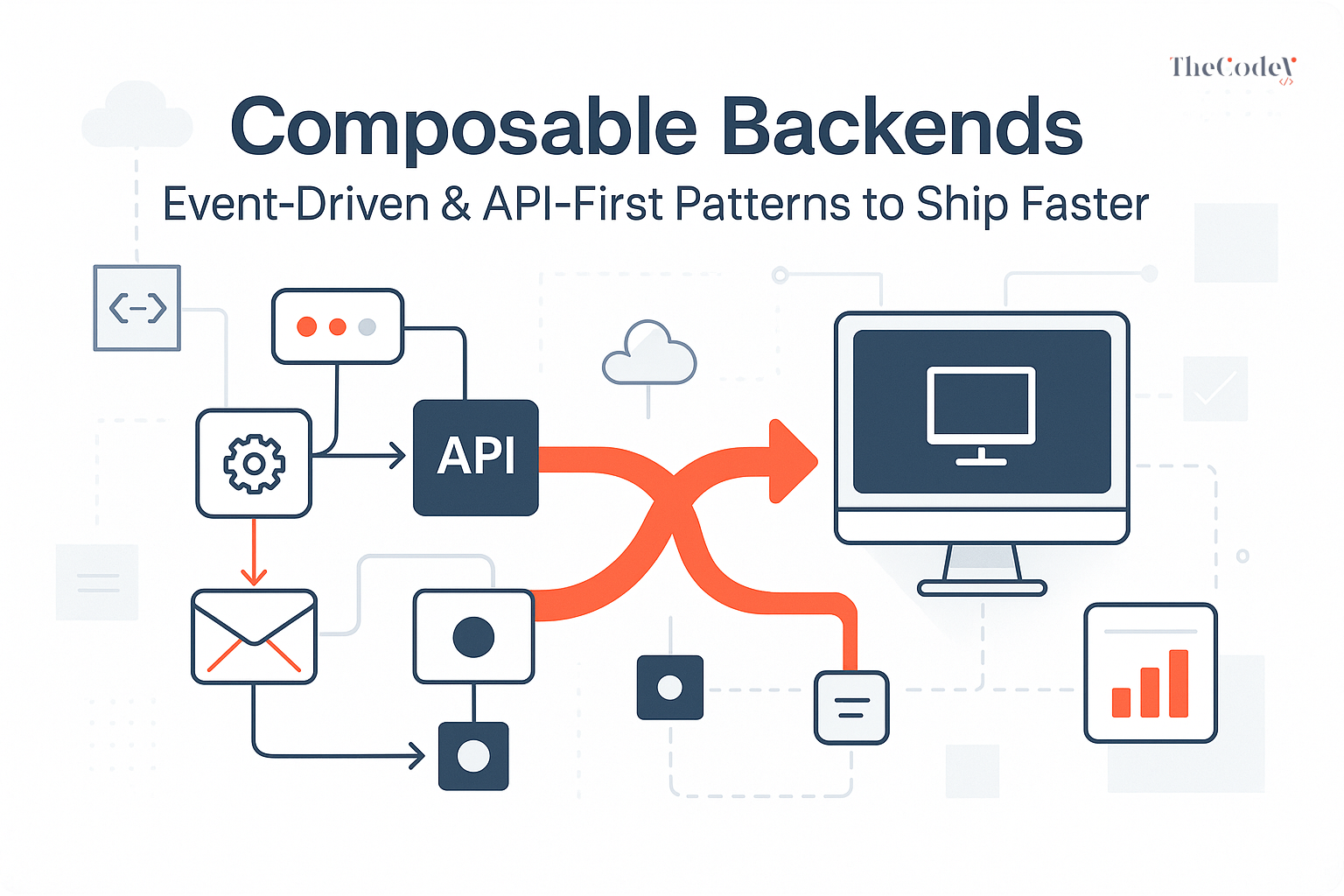
The Rise of Composable Architecture for Startups
Speed has become the single biggest advantage a young business can hold. In a market shaped by economic pressure, tightening investor expectations, and the rapid acceleration of AI-driven products, founders are searching for ways to move faster without sacrificing stability. This is where composable architecture for startups steps in: a development approach built on modular, replaceable components that can evolve independently as your product grows.
Instead of building everything inside one rigid codebase, composable architecture breaks systems into small, purposeful services connected through APIs. For early-stage teams, especially across the UK tech scene, this shift represents more than a technical upgrade—it’s a strategic advantage. As more startups adopt composable architecture for startups UK, the old idea of a single monolithic backend is fading out faster than expected.
Why UK Startups Are Moving Beyond Monolithic Backends
Over the past five years, the UK startup environment has changed dramatically. Funding rounds have become more selective, investors demand evidence of traction earlier, and the rise of AI tools has squeezed product timelines. Building slow is no longer an option.
Modular and API-first systems give founders breathing room. A team can ship a new feature without rewriting half the product. A service can scale without pulling the entire backend down. This is exactly why API-first architecture UK startups is now trending across industries—fintech, healthtech, ecommerce, and even education platforms built by companies like EmporionSoft.
The MACH movement—Microservices, API-first, Cloud-native, and Headless—is also gaining momentum among MACH architecture startups UK, thanks to its flexibility and future-proof approach. When a business can swap components instead of rebuilding an entire platform, iteration becomes a strength rather than a burden.
From MVP to Scale: Why Composable Wins Early
Startups do not only need to build fast—they need to validate even faster. A composable backend makes this easier because each piece of the system is designed to stand alone. If one service fails or needs updating, the rest keeps moving.
For a small team trying to validate an MVP, this is gold.
A startup can launch core features first, then plug in more capabilities later. Payment systems, authentication modules, CMS content blocks, and recommendation engines can be integrated or replaced without tearing down the architecture. This modular approach is especially valuable for founder-led teams where engineering resources are thin.
With cloud native architecture UK small business adoption rising, infrastructure has never been more affordable or accessible. Platforms like AWS and Azure now provide serverless environments that scale automatically, letting startups pay only for what they use—a significant advantage when runway is limited. A study by Gartner supports this shift, noting that modular and API-first ecosystems can reduce integration time by up to 50% (source: Gartner).
The UK Tech Environment Favouring Composable Backends
The UK is becoming a hub for modular software development, not just because the technology is better, but because the business climate demands it. Startups face pressure to:
validate ideas early
reduce development costs
respond quickly to changing user expectations
integrate AI tools and real-time analytics
A monolithic system simply cannot keep up with the speed and uncertainty of the current landscape.
Composable architecture offers a path forward. It supports rapid iteration cycles, independent deployments, and a structure designed for long-term adaptability. The shift happening among UK-based founders, SaaS companies, and digital agencies reflects one truth: flexibility is no longer optional.
For businesses working with expert teams such as those at TheCodeV, adopting a modular backend becomes easier through access to modern engineering practices, personalised development strategies, and a deep understanding of event-driven systems. Founders exploring digital transformation can start reviewing the process through TheCodeV’s resources at https://thecodev.co.uk/ and explore technical capabilities at https://thecodev.co.uk/digital-services/.
As the startup ecosystem continues to evolve, composable systems are emerging as the backbone of fast-moving, resilient, and AI-ready UK businesses.
Understanding Event-Driven Architecture in Modern Startups
Event-driven architecture is becoming a defining pattern in the way fast-moving digital products operate. Instead of relying on a chain of tightly connected processes, event-driven systems respond to “events” — actions or triggers that occur across different parts of an application. When something happens, such as a user making a purchase or a sensor sending new data, an event is fired and individual services react independently.
This structure brings a natural flexibility. Services activate only when needed. Workloads scale automatically. Systems remain resilient even under unpredictable usage patterns. For early-stage companies, this means fewer bottlenecks and more room to experiment. Event-driven thinking is becoming embedded in microservices API-first architecture UK startups, where each component behaves as an autonomous function rather than a piece of a rigid chain.
Why Startups Prefer API-First Systems
API-first systems give startups room to move quickly. Every feature is built with a clear public interface from day one, making communication between services simple and predictable. For new products navigating uncertain markets, this offers a real advantage: you can replace, update, or extend any part of the system without rewriting the entire backend.
This is why founders are leaning toward API-first composable architecture UK tech stack designs. Instead of building a backend and “adding APIs later,” the API becomes the foundation around which all services operate. It’s a mindset shift that prioritises integration, interoperability, and future-proofing.
API-first approaches also help teams collaborate efficiently. Different developers can work on separate services without stepping on each other’s code. Mobile apps, web dashboards, IoT devices, and third-party partners can all interact with the system through a unified contract. In the UK’s increasingly competitive software landscape, this level of clarity speeds up development and lowers long-term maintenance costs.
The Power of Microservices, Modularity, and PBCs
Microservices break down an application into small, independent services with a single purpose. When combined with modular design, this creates systems that can evolve in several directions at once. For startups, it means new features can be built, deployed, and scaled without touching the rest of the product. Microservices naturally support experimentation — something young companies depend on.
Packaged Business Capabilities (PBCs) extend this idea by bundling microservices into business-focused units. A PBC might include payment handling, product recommendations, or customer profiles. These units can be reused across multiple applications or replaced with new vendors without massive reengineering. The Packaged Business Capabilities (PBCs) UK market is expanding quickly as ecommerce platforms, SaaS products, and digital service providers look for agility.
This approach fits neatly within composable backends. Instead of building one giant system, startups assemble a set of capabilities that work together but can change independently. It’s modularity with a business-aligned framework.
How Event-Driven and API-First Patterns Shape Composable Backends
When event-driven systems and API-first philosophy combine with microservices, you get the foundation of a true composable backend. Each service communicates through clear interfaces. Events circulate freely across the system. Workloads scale on demand. Every part of the system is designed to evolve separately and survive independently.
Composable backends also allow teams to test new ideas with fewer risks. If a recommendation engine experiment fails, the rest of the system stays healthy. If a payments provider becomes too expensive, it can be swapped for another. This flexibility is a major reason UK founders are rapidly replacing traditional monoliths with modular, event-driven platforms.
The UK Ecosystem Shift Toward Serverless, Integrations, and Cloud-Native Commerce
A growing number of UK-based companies are embracing serverless technology to reduce infrastructure overhead and speed up deployments. Serverless platforms such as AWS Lambda, Azure Functions, and Google Cloud Run give startups instant scalability without managing servers manually. Their rise aligns perfectly with the growth of cloud-native modular architecture UK e-commerce, where platforms need to scale quickly during traffic spikes and personalise experiences in real time.
This trend is strengthened by a wider cultural shift in the UK startup ecosystem: integrations-first development. Payment gateways, CRM systems, headless commerce engines, analytics tools, and AI services can now be added through lightweight APIs rather than complex custom builds.
As more businesses explore composability, organisations like TheCodeV help founders design modular backend strategies that support this new wave of event-driven and API-first thinking. Readers can explore solutions at https://thecodev.co.uk/ or discover technical services at https://thecodev.co.uk/digital-services/.
According to an analysis by Google Cloud, microservices and event-driven systems significantly reduce deployment risk and enable faster iteration cycles for cloud-native teams (Google Cloud, 2024). This reinforces the growing momentum behind composable systems in the UK market.
The Shift Toward Headless and Composable Commerce
Ecommerce is evolving faster than almost any other digital sector, and UK-based startups are feeling the impact. Customers expect seamless experiences across mobile, desktop, apps, marketplaces, and even social shopping platforms. To keep up, founders are turning to composable commerce architecture UK solutions that break rigid ecommerce systems into flexible, interchangeable parts.
Headless commerce plays a major role in this shift. In a headless setup, the frontend is separated from the backend, giving teams freedom to design fast, responsive experiences without relying on a tightly coupled system. When headless meets full composability, startups gain a retail stack that can grow with their brand and integrate new tools without major rebuilds. This combination is becoming a defining feature of headless ecommerce UK startup launch strategies across the country.
Understanding MACH Architecture for Modern Retail
MACH architecture—Microservices, API-first, Cloud-native, and Headless—is shaping the next generation of digital commerce. Each part of MACH contributes something critical:
Microservices provide modularity and independence.
API-first ensures clean communication between all components.
Cloud-native architecture enables elasticity and rapid scaling.
Headless systems separate content delivery from business logic.
UK startups are adopting MACH for one simple reason: it gives them speed without locking them into specific vendors. This flexibility is essential in competitive markets where new payment methods, personalised shopping journeys, or AI-driven recommendations must be added quickly. For many digital retailers, MACH isn’t just a technical preference—it’s becoming a business advantage.
The MACH Alliance, an industry group promoting these principles, highlights that composable and headless systems outperform traditional monoliths in long-term agility and innovation (MACH Alliance, 2024).
Why UK Founders Prefer Composable Commerce Over Traditional Stacks
Old ecommerce platforms were built as all-in-one systems. They worked well for predictable markets, but today’s retail environment demands adaptability. Composable commerce vs headless commerce UK discussions are becoming common among founders deciding between different levels of flexibility.
Headless solves the frontend problem, but composable goes further. It allows each backend capability—payments, catalogue management, authentication, cart logic, fulfilment, reviews—to become replaceable. If a startup wants to test a new checkout provider, switch to a smarter product recommendation engine, or add subscriptions, composable commerce makes it easy.
This matters in the UK’s fast-changing consumer landscape, where digital-first buyers expect fast load times, personalisation, and frictionless transactions. Founders exploring modern stacks often consult teams like TheCodeV to build a resilient architecture that evolves as their online store grows. Readers can explore capabilities at https://thecodev.co.uk/ and discover ecommerce-focused development services at https://thecodev.co.uk/digital-services/.
Examples of Scalable Online Retail Stacks
A well-designed modular retail architecture might look like this:
A headless CMS for content
A dedicated product information management (PIM) system
Independent cart and checkout services
Third-party or custom recommendation engines
A microservices-based order pipeline
API-first payment gateways
Serverless backend functions for bursts of traffic
This setup allows a UK startup to introduce new features without downtime. For example, adding a loyalty engine or integrating a new shipping provider becomes a lightweight change rather than a heavy, months-long rebuild.
This approach also supports experimentation. If a founder wants to A/B test a new search provider, the rest of the stack stays untouched. If a different service offers better pricing or performance, switching becomes straightforward.
Rapid Deployment Advantages for UK Startup Founders
Speed-to-market is everything for ecommerce founders, especially those operating with limited runway or targeting competitive niches. With scalable ecommerce architecture for UK startups, teams can build a functioning store in weeks, not months, and continue adding new modules as they validate customer behaviour.
Serverless technology also boosts this advantage by handling unpredictable traffic patterns automatically. Whether a brand goes viral on TikTok or receives a Sunday surge of shoppers, the infrastructure scales instantly. This reliability helps startups avoid major outages during critical sales moments.
Platforms like Shopify and BigCommerce have also published research showing that merchants who adopt composable and headless systems innovate faster and outperform traditional ecommerce builds in long-term cost efficiency (Shopify, 2024). This aligns strongly with the growing movement toward composability within the UK startup ecosystem.
As the demand for flexible, future-ready ecommerce systems increases, UK founders are recognising composable commerce as the key to faster launches, smarter integrations, and long-term scalability.
Why Composable Architecture Gives Startups a Competitive Edge
Startups operating in the UK face a mix of opportunity and pressure. Markets shift quickly, customer expectations rise faster than ever, and funding rounds demand clearer evidence of progress at every stage. In this environment, the benefits of composable architecture for new businesses UK go beyond technical elegance—they directly support survival and long-term growth.
Composable systems break applications into modular, replaceable components. Each service stands alone, communicates through APIs, and scales independently. For a founder navigating uncertainty, this setup becomes a strategic safety net. Instead of committing to a rigid platform, the product evolves piece by piece, at a pace that matches customer needs.
Cost Efficiency for Both Bootstrapped and Funded Teams
Startups often operate with tight budgets, especially during the pre-seed and seed stages. Composable systems help reduce infrastructure costs because each service only consumes resources when it’s used. This means new features or modules can launch without the burden of maintaining an oversized server environment.
For bootstrapped founders, this is a lifeline. By adopting cloud-native composable infrastructure UK companies, small teams only pay for what they need. Serverless functions, autoscaling, and microservices ensure resources are used efficiently. Even funded startups benefit: the money saved on infrastructure can be redirected to marketing, hiring, or product expansion.
Accenture’s research highlights that modular and composable platforms reduce long-term operational costs while improving innovation speed (Accenture, 2023). This validates the growing interest in composability among UK-based startups building lean but resilient digital products.
Pivot Faster Without Breaking the System
Most startups pivot at least once. Markets move, user preferences change, and early hypotheses often need revision. Traditional monolithic systems make this difficult because everything is tightly connected. Changing one feature risks breaking several more.
Composable systems turn pivoting into a manageable process. A single service—such as onboarding, checkout, or analytics—can be redesigned or replaced without affecting the rest of the product. This agility is one of the most recognised flexible backend architecture UK startup environment advantages.
Being able to pivot without pausing user activity or restructuring the entire codebase gives teams the freedom to respond to real data rather than guesses.
Faster Feature Releases and Iteration Cycles
Feature velocity is one of the strongest selling points for composable systems. When each module operates independently, engineers can push updates without waiting for full-system deployments. This keeps innovation flowing quicker and reduces downtime risks.
A monolithic model requires heavy coordination for any meaningful update, often slowing progress to a crawl. By contrast, composable architecture supports continuous deployment, rapid iteration, and frequent experimentation—all crucial in early product discovery phases.
Founders working with TheCodeV often use this advantage to roll out new capabilities in small increments, validating ideas through real-world user behaviour. Readers can explore the development capabilities at https://thecodev.co.uk/ or explore tailored digital solutions at https://thecodev.co.uk/digital-services/.
Independent Scaling for Growth Moments
Startups rarely grow in a straight line. Some features experience sudden spikes—checkout, search, notifications, or content delivery. Composable architecture allows each of these services to scale independently, preventing the need for heavy upgrades across the entire platform.
This granular scaling protects performance during high-traffic events, viral moments, or seasonal peaks. It also keeps costs under control since only the stressed components scale, not the whole system.
Resilience, Reliability, and Fail-Safe Architecture
Because microservices operate independently, issues remain isolated. If one module fails, the rest of the system continues functioning. For UK startups where uptime is critical, this reliability becomes a strategic asset.
Monoliths often suffer from “cascade failures,” where one issue crashes the entire platform. Composable architecture avoids this by design, giving founders more confidence during product launches, marketing campaigns, or investor showcases.
Vendor Flexibility Without Lock-In
Vendor lock-in has been a silent concern for UK digital businesses for years. Composable systems solve this by allowing startups to swap providers or tools without major reengineering. Whether it’s payments, search, authentication, or analytics, each module can be replaced with a better option.
This adaptability supports both early experimentation and long-term optimisation.
Composable Architecture vs Monolithic: What UK Startups Need to Know
The composable architecture vs monolithic UK startup comparison is becoming increasingly relevant. Monolithic systems centralise all logic, making them harder to scale, update, or modify. Composable systems, on the other hand, treat every feature as a plug-and-play component.
For new businesses trying to find market fit, composable architecture provides speed, resilience, and flexibility. Monolithic backends still work for small, tightly scoped projects, but once growth begins, they quickly create bottlenecks.
This shift is why more UK founders—from small ecommerce brands to AI-driven platforms—are choosing composability as their core approach to digital product development.
Challenges Startups Face When Adopting Composable Backends
While composability offers clear advantages, the journey to adoption isn’t always straightforward. Many startups in the UK discover early that modernising their backend requires more than enthusiasm—it demands planning, capability, and the right engineering culture. As composable architecture adoption UK market accelerates, three core challenges consistently surface: technical debt, team capability, and integration complexity.
Technical debt often slows the shift because legacy codebases are tightly coupled and difficult to break into modular components. Teams may find it hard to disentangle features or restructure outdated APIs. Similarly, founders working with small engineering teams face capability challenges. Not every developer is familiar with distributed systems, event-driven workflows, or microservices orchestration.
Integration complexity is another major hurdle. A composable backend relies on several independent services communicating cleanly, often in real time. If APIs are poorly structured or events fire inconsistently, the system becomes unstable. These concerns are common among startups exploring API-first architecture UK startups, where integration is the backbone of every feature.
Practical Solutions and Best Practices for UK Startups
The good news is that these challenges are solvable with a disciplined approach. Startups adopting modular and composable systems can follow a set of proven practices to reduce risk and maintain steady progress.
One effective method is to begin with a “strangler pattern”—gradually replacing pieces of the monolith with microservices rather than attempting a full migration. This keeps the product stable while enabling the team to experiment with new architecture patterns.
Another best practice is to document every API endpoint clearly and enforce a consistent communication standard. API-first development thrives when all services speak the same language, follow predictable contracts, and use shared authentication rules.
Founders should also consider small, high-impact microservices first: authentication, payment gateways, or search modules. These pieces tend to offer quick wins, giving teams confidence before tackling more complex areas like fulfilment or analytics.
This gradual refactor aligns with modular software architecture UK startup best practices, enabling a smooth transition that minimises risk and maximises learning for early engineering teams.
Readers exploring modern backend and modular development workflows can review TheCodeV’s capabilities at https://thecodev.co.uk/ and discover additional system design expertise at https://thecodev.co.uk/digital-services/.
Growing UK Adoption Trends in Composable and Modular Backends
Across the UK, startups and SMEs are adopting composable backends at a faster pace. This shift is driven by several factors: the growth of SaaS ecosystems, venture pressure for rapid innovation, and the ease of integrating cloud-native tools.
Fintech, ecommerce, healthtech, education platforms, and AI-powered products now view composability as a default approach rather than an emerging trend. The rising popularity of microservices, event-driven design, and API-first systems is influencing how digital products are built from day one.
Analysts note that the composable architecture adoption UK market has grown significantly as companies move away from generic all-in-one platforms to more adaptable ecosystems. Startups want independence, faster iteration cycles, and the freedom to mix and match tools based on performance and pricing.
An external report from Deloitte confirms that modular and cloud-native architectures accelerate innovation cycles while reducing operational friction, especially in fast-growing digital businesses (Deloitte, 2024).
Cloud-Native Tooling and Its Role in Composability
Cloud-native ecosystems make composable architecture far easier to adopt. Serverless functions, managed databases, event buses, container orchestration platforms, and automated pipelines now reduce the engineering overhead traditionally required to build distributed systems.
This rise of cloud-native tooling fuels cloud-native composable infrastructure UK companies, enabling them to scale individual components with ease. Developers can deploy microservices rapidly, automate testing, and optimise costs through autoscaling.
The ability to mix vendors—AWS Lambda for compute, Firebase for authentication, or a headless CMS for content—creates an environment where startups build more by composing than reinventing.
These tools also simplify monitoring and observability, both critical when moving from a monolith to a distributed architecture.
Managing Organisational Change During the Shift to Composable Backends
Adopting composability is not just a technical shift—it’s a cultural one. Teams must learn to collaborate around services rather than monoliths. Product managers and engineers need clearer boundaries between features. Leadership must understand that composable adoption is iterative, not instantaneous.
Startups typically succeed when they adopt a service-oriented mindset early: small deployments, clean API documentation, regular refactoring, and cross-team communication. Building internal capability is crucial. As teams grow more comfortable with service isolation, they gain confidence to expand modularity across the entire product.
For UK founders, this mindset shift is becoming a core requirement as the digital ecosystem matures. Composability ultimately becomes a framework for innovation—allowing startups to build products that evolve at the same pace as the market.
The Future of Composable Backends for Fast-Growing Startups
The next decade of digital product development will be shaped by flexibility, speed, and the ability to integrate technologies without friction. This is why composable architecture for startups is moving from an emerging trend to a default engineering philosophy. As markets shift rapidly, founders need technology that adapts just as quickly. Composable systems empower teams to assemble backends using independent services, avoid lock-in, and scale with precision.
The future belongs to businesses that can adopt new tools, experiment confidently, and deploy changes without disrupting the entire system. That foundation is built on composability.
Event-Driven, Headless, and API Ecosystems Becoming the New Standard
Across the UK and beyond, startups are adopting event-driven backends as their core engine. Event streaming, asynchronous workflows, and real-time data triggers enable products to respond instantly to customer behaviour. This responsiveness is especially important in AI-driven products, ecommerce platforms, and SaaS dashboards where instant feedback loops shape user experience.
Headless systems and API ecosystems are accelerating this shift. Headless gives teams creative freedom across channels—from mobile apps to kiosks to web dashboards—while API ecosystems allow companies to integrate best-in-class third-party tools. Together, these patterns strengthen the case for rapid deployment composable architecture UK, where features can be replaced or upgraded without costly rebuilds.
External research from McKinsey confirms that companies adopting composable and modular architectures outperform competitors by reacting to market changes up to five times faster (McKinsey, 2024). This reinforces why the UK startup scene is rapidly embracing these principles.
The UK Startup Ecosystem Is Perfectly Positioned for Composability
The UK has become one of the most dynamic startup environments in Europe. Founders face both pressure and opportunity: fast-moving competitors, demanding investors, and customers expecting seamless digital experiences. For many, traditional monolithic backends simply cannot deliver the speed or resilience required to survive in this landscape.
This is where composable infrastructure for SaaS UK startups enters the picture. SaaS businesses rely on rapid iteration, robust integrations, and the ability to roll out new features weekly or even daily. Ecommerce startups require modular checkout flows, flexible product systems, and scalable catalogues. AI startups need real-time processing, microservices for inference workloads, and cloud-native orchestration.
A composable backend supports all of these needs while keeping costs predictable and development velocity high. Even companies like EmporionSoft have demonstrated how modular, API-first systems reduce deployment risk while enabling faster experimentation across different industries.
How Founders Can Plan Their Migration Roadmap
Transitioning from a monolithic backend to a composable one does not need to be overwhelming. With the right roadmap, founders can make progress steadily while maintaining product stability. The journey usually follows four phases:
Discovery and architecture mapping
Identify core domains, high-value services, and existing bottlenecks.
Strangler migration
Gradually replace monolithic components with microservices or modularised capabilities.
Early transformations often include authentication, payments, search, or content delivery.
Adopt event-driven and API-first workflows
Shift communication away from tightly bound calls and toward events, queues, and standardised APIs.
Expand composability across the entire stack
Introduce modular e-commerce features, AI inference microservices, reporting engines, or automated workflows.
This roadmap supports predictable growth. Each migrated component strengthens the system, reduces complexity, and prepares the foundation for scalable product development.
Founders working with TheCodeV gain access to hands-on specialists who architect, refactor, and deploy modular systems aligned with modern UK startup demands. Interested readers can explore capabilities at https://thecodev.co.uk/ and study deeper technical service offerings at https://thecodev.co.uk/digital-services/. For consultation or direct engagement, the contact page at https://thecodev.co.uk/contact/ provides a direct route to expert guidance.
Why Composability Is the Best Fit for SaaS, Ecommerce, and AI Products
Composable systems shine brightest in businesses that evolve quickly and integrate several technologies simultaneously. SaaS startups can deploy new modules without interrupting existing users. Ecommerce brands enjoy headless storefronts, flexible product engines, and cloud-native scalability during traffic surges. AI-driven products benefit from microservices that isolate inference tasks, optimise performance, and scale independently.
Because composability accelerates innovation, reduces downtime, and enables consistent user experiences, it is becoming the architecture of choice for UK founders aiming to grow beyond MVP and into long-term success.
Final Conclusion: The Architecture Built for the Future
Startups that invest in composable backends today position themselves to innovate faster, scale with confidence, and outpace competitors who remain locked into monolithic systems. The future of product development—API-first, headless, event-driven, cloud-native—is already here. Composability simply gives founders the blueprint to use it effectively.
Work With TheCodeV — Build a Future-Proof, Composable Product
If you’re ready to modernise your digital product or migrate from a monolithic backend, now is the perfect time to act. TheCodeV specialises in designing and building composable, cloud-native, event-driven architectures tailored to fast-moving startups in the UK and around the world. Whether you’re launching a SaaS platform, scaling an ecommerce store, or building an AI-powered product, our team will architect a flexible system that grows with your vision.
Book a consultation today at https://thecodev.co.uk/contact/, explore our full range of digital services at https://thecodev.co.uk/digital-services/, or learn more about our approach at https://thecodev.co.uk/.
Your product deserves an architecture built for speed, resilience, and long-term success—partner with TheCodeV and build the future, one composable block at a time.



One Comment
I was more than happy to find this page. I want to to thank you for your time for this fantastic read!! I definitely loved every part of it and I have you book-marked to look at new stuff on your blog.