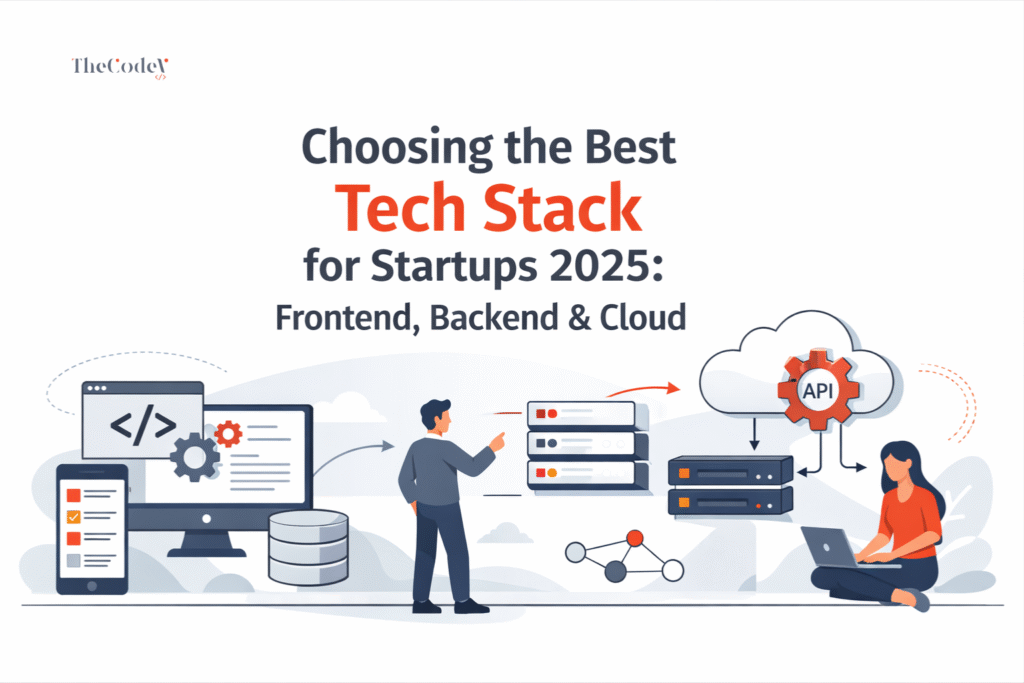
Why Choosing the Right Tech Stack in 2025 Is a Founder’s Defining Moment
Every startup begins with pressure. Limited time. Limited budget. Unlimited expectations. In 2025, choosing the wrong technology stack doesn’t just slow progress. It can quietly drain cash, delay launches, and block growth before momentum ever arrives.
Founders today are building in a market where users expect speed, reliability, and seamless experiences from day one. That makes selecting the best tech stack for startups 2025 a business decision, not a technical afterthought.
The technology you choose now determines how fast you move, how much you spend, and how easily you scale.
What Is a Startup Tech Stack?
A startup tech stack is the combination of tools, frameworks, programming languages, and cloud services used to build and run your product. It includes frontend technologies, backend systems, databases, APIs, and infrastructure.
In simple terms, it’s the foundation your entire product stands on.
A poorly chosen startup tech stack 2025 often leads to slow development, rising maintenance costs, and painful rebuilds. A well-chosen one allows teams to ship faster, adapt quickly, and grow without technical chaos.
This is why experienced founders rely on a clear startup software stack guide rather than chasing trends or copying competitors blindly.
Why Tech Stack Decisions Are Higher-Stakes in 2025
Technology moves faster in 2025 than ever before. New frameworks appear yearly. Cloud pricing models change constantly. Hiring markets reward familiar tools and punish obscure ones.
According to the Stack Overflow Developer Survey, technologies like JavaScript and Python continue to dominate adoption, while developer preference increasingly favours tools that improve productivity and long-term maintainability.
Source: https://survey.stackoverflow.co/2024/technology/
This matters because popularity affects hiring speed, community support, and future upgrades. Choosing widely adopted technologies reduces risk and protects your runway.
At the same time, industry trends show startups shifting towards cloud-native architectures, API-first development, and scalable platforms designed for rapid experimentation. These patterns define the modern tech stack for startups, where flexibility is as important as performance.
How Your Tech Stack Impacts Speed, Cost, and Scalability
Speed to Market
The right stack shortens development cycles. Proven frameworks and managed services reduce setup time and help teams release features faster.
Startups that move quickly learn faster. Learning faster means surviving longer.
Cost Control
Every technical choice has a financial consequence. Your stack influences hosting bills, development hours, and long-term maintenance costs.
A lean, well-planned architecture supports a lower burn rate without sacrificing quality.
Scalability Without Rewrites
Growth should feel exciting, not fragile. A scalable stack allows your product to handle more users without complete system overhauls.
This is where early guidance matters. Many founders work with experienced teams like TheCodeV, who help startups align technology decisions with real business goals from day one. You can explore how this approach works on the TheCodeV homepage or review tailored development offerings on the TheCodeV services page.
The Foundation of a Sustainable Startup
Choosing the best tech stack for startups 2025 is not about picking the newest tools. It’s about selecting technologies that support speed today and stability tomorrow.
The sections ahead break down frontend, backend, databases, cloud platforms, and startup-specific stacks. Each layer plays a role in building software that grows with confidence rather than constraint.
Your technology foundation is being set whether you plan it or not. The difference is whether it’s built deliberately or by accident.
Frontend Technologies That Shape First Impressions in 2025
Your frontend is where trust is won or lost. In 2025, users judge products in seconds. If your interface feels slow, clunky, or confusing, they leave. That’s why frontend decisions sit at the heart of the best tech stack for startups 2025.
A strong frontend is not just about visuals. It affects performance, SEO, user retention, and how quickly your team can ship improvements.
Best Frontend Frameworks 2025 for Startups
The frontend ecosystem has matured, but only a few frameworks consistently deliver real value for startups. These tools form the backbone of a modern startup web development stack.
React: The Industry Standard
React remains the most widely used frontend framework in the world. Its massive ecosystem, long-term stability, and large hiring pool make it a safe choice for startups planning to scale.
React works especially well for products with complex interfaces, dashboards, or frequent feature updates.
Next.js: Performance and SEO Combined
Next.js builds on React and adds server-side rendering and static generation. This improves load speed and search visibility.
For SaaS platforms, marketplaces, and content-driven products, Next.js is often one of the best frontend frameworks 2025 thanks to its performance and SEO advantages.
According to Vercel’s engineering insights, server-rendered frameworks significantly improve Core Web Vitals, which directly influence Google rankings.
Source: https://vercel.com/blog/nextjs-server-components
Vue: Simplicity and Speed
Vue offers clean syntax and a gentle learning curve. It allows teams to move fast without heavy configuration.
Startups with smaller teams often choose Vue to reduce development friction while maintaining solid performance.
Svelte: Lightweight and Fast
Svelte shifts work from the browser to build time, producing smaller bundles and faster load times.
It suits startups focused on highly interactive experiences where performance matters more than ecosystem size.
Quick Frontend Framework Comparison
React: Large talent pool, flexible, proven at scale
Next.js: Excellent SEO, fast performance, production-ready
Vue: Easy to learn, clean syntax, stable
Svelte: Lightweight output, high performance, modern approach
These frameworks consistently rank among the best frameworks for startup apps because they balance speed, flexibility, and long-term support.
Performance and SEO Are No Longer Optional
In 2025, frontend performance directly affects visibility and revenue. Google prioritises fast-loading, accessible websites that deliver strong user experiences.
Frameworks that support server-side rendering, code splitting, and modern build tooling help startups compete against larger brands with bigger budgets.
Choosing the right frontend early prevents costly rebuilds later.
Hiring Reality: Your Stack Affects Your Team
Frontend choices influence who you can hire and how fast. React and Next.js offer the largest hiring pools. Vue follows closely in many regions. Svelte requires more targeted recruitment.
Startups that align their frontend with realistic hiring markets reduce delays and onboarding costs.
This is why teams working with TheCodeV services focus on frontend stacks that match both product goals and talent availability. Founders seeking early clarity often benefit from structured discussions through a TheCodeV consultation before committing to long-term frontend decisions.
Speed vs Polish: What to Prioritise First
Early-stage startups should prioritise speed and usability over perfection. Clean, functional interfaces beat visually complex designs that slow development.
As traction grows, polish becomes strategic. A scalable frontend framework allows refinement without rewrites.
The right frontend stack gives you both. Speed when you need it, and flexibility when growth demands more.
Backend Technologies That Decide Whether You Scale or Stall
A startup can survive an average interface. It rarely survives a weak backend. In 2025, backend decisions carry real financial and operational risk. When traffic grows or features multiply, cracks appear fast. That’s why backend architecture sits at the core of the best technology stack for startups.
Your backend controls performance, security, data flow, and scalability. If it fails, growth turns into downtime.
Best Backend Technologies for Startups in 2025
The best backend technologies for startups prioritise speed, reliability, and developer availability. In 2025, a small group of technologies dominate real-world startup builds because they solve practical problems without overcomplication.
Node.js: Speed and Flexibility
Node.js is one of the most popular backend choices for startups. Its event-driven model handles concurrent requests efficiently, making it ideal for APIs and real-time applications.
Using JavaScript across frontend and backend also simplifies team structure and accelerates development.
Python: Productivity and Intelligence
Python is widely used for data-driven products, automation, and AI-powered platforms. Frameworks like Django and FastAPI help teams ship features quickly with clear structure.
While not always the fastest at runtime, Python excels in development speed and ecosystem depth.
Java: Stability at Scale
Java remains a strong option for startups operating in regulated industries or building enterprise-grade platforms.
It offers long-term stability and scalability, but requires experienced engineers and more upfront setup.
Go: Performance Without Complexity
Go is designed for speed and concurrency. It performs exceptionally well under high load and is often chosen for infrastructure-heavy services.
Startups select Go when performance and efficiency matter more than rapid experimentation.
PHP: Cost-Effective and Proven
PHP still powers a large portion of the web. Modern frameworks like Laravel have significantly improved developer experience.
It remains a cost-effective choice with a large hiring pool, especially for content and commerce platforms.
Backend Language Trade-Offs at a Glance
Node.js: Fast iteration, strong ecosystem, great for APIs
Python: Excellent for AI and data, slower raw performance
Java: Highly scalable, enterprise-ready, higher complexity
Go: High performance, efficient, smaller talent pool
PHP: Budget-friendly, mature, easy to hire
According to the GitHub State of the Octoverse, JavaScript and Python continue to lead global adoption, reinforcing their place among the top programming languages for startups.
Source: https://octoverse.github.com/
Monolith vs Microservices for Startup MVPs
Many founders believe microservices are a requirement for modern products. In reality, this is one of the most common early-stage mistakes.
Monolithic Architecture: The MVP Winner
For most startups, a well-structured monolith is faster to build and easier to manage. It reduces operational overhead and simplifies debugging.
Monoliths allow teams to iterate quickly, which is essential during product validation.
Microservices: Powerful but Premature
Microservices offer scalability and independent deployments, but they introduce complexity, infrastructure overhead, and higher costs.
They make sense later, not during MVP stages.
The fastest tech stack for startups usually begins as a modular monolith, designed with clean boundaries that allow future evolution into microservices when growth demands it.
Scalability Without Overengineering
Scalability is not about choosing the most complex tools. It’s about choosing technologies that grow with your product.
Clean architecture, widely supported languages, and sensible backend decisions reduce risk and hiring friction. This is where experience matters. Teams working through TheCodeV services help startups design backend systems that scale naturally, guided by practical delivery experience outlined on the TheCodeV about us page.
In 2025, backend choices are not just technical. They are strategic safeguards for your startup’s future.
When Databases and APIs Become Growth Blockers
Many startups don’t struggle because of weak ideas. They struggle because data becomes messy, APIs break, and integrations slow everything down. In a modern startup app development tech stack, databases and APIs quietly determine whether growth feels smooth or painful.
In 2025, users expect instant responses and connected experiences. That pressure lands directly on how you store data and how systems communicate.
Choosing the Best Database for Startups in 2025
The best database for startups is not the most complex option. It’s the one that supports reliability, flexibility, and future scale without heavy maintenance.
PostgreSQL: Reliable and Scalable
PostgreSQL is the default choice for many startups in 2025. It handles structured data, complex queries, and transactional workloads with ease.
For SaaS platforms and business-critical systems, PostgreSQL offers long-term stability without vendor lock-in.
MongoDB: Flexible and Fast to Adapt
MongoDB works well when data structures change frequently. Its document-based model reduces friction during early experimentation.
It’s commonly used for content platforms, analytics tools, and rapidly evolving products.
Firebase: Speed for Early MVPs
Firebase prioritises speed and simplicity. It combines real-time databases, authentication, and hosting into one ecosystem.
Startups often use Firebase to launch MVPs quickly, though long-term scalability may require migration later.
Database Comparison Snapshot
PostgreSQL: Strong consistency, scalable, production-ready
MongoDB: Flexible schema, fast iteration
Firebase: Rapid setup, minimal backend management
These tools consistently rank among the best database for startups because they solve real problems without unnecessary complexity.
API-First Architecture: Designing for Change
An API-first approach means designing APIs before building features. Every part of the system communicates through well-defined interfaces.
In 2025, this approach is essential. Products rarely exist in isolation. They connect web apps, mobile apps, third-party services, and partner platforms.
API-first architecture enables:
Parallel frontend and backend development
Easier mobile and third-party integrations
Cleaner transitions as systems scale
For lightweight tech stack startups, this reduces rewrites and future risk.
Best API Tools for Startups in 2025
Strong APIs require strong tooling. The best API tools for startups help teams design, test, document, and monitor integrations efficiently.
Widely Used API Tools
Postman: API testing, collaboration, and monitoring
OpenAPI (Swagger): Clear documentation and contracts
Stripe APIs: Industry benchmark for developer experience
According to Stripe’s engineering insights, clear API design reduces integration errors and support costs while accelerating partner adoption.
Source: https://stripe.com/blog/api-design
These tools help startups avoid brittle integrations that fail under growth.
Integration Without Overengineering
Modern startups depend on multiple services, from payments to analytics. Integration tools should simplify workflows, not increase complexity.
API gateways, webhooks, and managed services allow teams to connect systems without building everything from scratch. This keeps stacks lean and maintainable.
Startups working with experienced teams through TheCodeV services often design clean data and API layers early. When integration challenges arise, direct access to expert guidance via the TheCodeV contact page helps resolve issues before they impact growth.
In 2025, databases and APIs are no longer background infrastructure. They are core enablers of scale, speed, and stability.
When Growth Suddenly Starts Burning Cash
At first, cloud costs feel harmless. A few users, a small bill, no concerns. Then traction hits. Traffic grows, features expand, and cloud spending climbs faster than revenue. In 2025, this moment defines whether a startup scales confidently or panics.
Within the best scalable tech stack 2025, cloud infrastructure and DevOps decisions directly control burn rate, performance, and reliability.
Best Cloud Platforms for Startups in 2025
The best cloud platforms for startups offer flexibility, global reach, and pricing that grows with usage. Most startups choose from three major providers, each with clear strengths.
Amazon Web Services (AWS)
AWS is the most widely used cloud platform globally. It offers unmatched service depth and scalability.
Startups favour AWS for its flexibility and mature ecosystem, though cost management requires careful planning.
Google Cloud Platform (GCP)
GCP is popular with data-driven startups. It excels in analytics, machine learning, and performance optimisation.
Many teams find GCP easier to manage when workloads are predictable and cost efficiency matters.
Microsoft Azure
Azure integrates seamlessly with Microsoft products and enterprise environments. It’s often chosen by B2B startups targeting corporate clients.
Azure’s hybrid capabilities make it suitable for startups planning enterprise expansion.
Cloud Platform Comparison Snapshot
AWS: Most services, maximum flexibility
GCP: Strong data tools, transparent pricing
Azure: Enterprise-ready, Microsoft ecosystem
These providers consistently appear in discussions around the best cloud platforms for startups because they support real-world scaling, not just theory.
Best Cloud Hosting for Startups: Keep It Simple
In 2025, cloud hosting is less about managing servers and more about reducing operational burden. Startups increasingly rely on managed services to stay lean.
Common hosting choices include:
Managed databases
Serverless functions
Container platforms
According to Amazon Web Services, startups using managed services reduce infrastructure maintenance and focus more on product development.
Source: https://aws.amazon.com/startups/
This approach supports a low cost tech stack for startups, where spending grows only when usage grows.
DevOps Tools That Reduce Burn Rate
DevOps is no longer optional. But it doesn’t need to be complex. The best devops tools for startups automate repetitive tasks and prevent costly downtime.
High-Impact DevOps Tools in 2025
Docker: Consistent environments across teams
GitHub Actions: Automated testing and deployments
Terraform: Infrastructure management with fewer errors
These tools reduce manual work, speed up releases, and minimise mistakes. Faster deployments mean faster feedback and lower operational costs.
Cloud as a Strategic Advantage
Cloud infrastructure is no longer just a hosting choice. It’s a financial and operational strategy.
Founders who understand cloud trade-offs gain control over scaling and spend. Those who ignore them often face painful migrations later.
Resources like TheCodeV cloud providers comparison help founders evaluate platforms clearly, while hands-on support through TheCodeV services ensures cloud and DevOps decisions align with real business goals.
In 2025, the smartest startups treat cloud infrastructure as a growth enabler, not a background expense.
One Size Never Fits All in Startup Technology
Every startup wants to scale, but not every startup scales the same way. A SaaS platform, a mobile app, and a blockchain product face very different technical pressures. This is why copying another company’s setup often creates problems later.
In 2025, the smartest founders match technology to business model. The right stack supports how you build, sell, and grow.
Best Tech Stack for SaaS Startups
SaaS products depend on reliability, security, and continuous iteration. The best tech stack for SaaS startups supports frequent updates, stable performance, and predictable scaling.
Typical SaaS Tech Stack in 2025
Frontend: React or Next.js
Backend: Node.js or Python
Database: PostgreSQL
Cloud: AWS or Google Cloud
DevOps: Docker, CI/CD pipelines
This stack balances speed with long-term stability. It also aligns with common hiring markets, reducing friction as teams expand.
Founders building subscription platforms often explore tailored approaches through TheCodeV SaaS development services, where technology choices are aligned with revenue and growth goals.
Startup MVP Tech Stack: Validate First, Optimise Later
An MVP exists to test assumptions, not to support millions of users. The startup MVP tech stack should prioritise speed, simplicity, and low upfront cost.
Common MVP Stack Choices
Frontend: React or Vue
Backend: Node.js or Firebase
Database: Firebase or MongoDB
Hosting: Managed cloud services
This setup minimises configuration and allows fast pivots. Overengineering an MVP delays learning and increases burn rate without adding value.
For early-stage founders, a lightweight approach keeps focus on users, not infrastructure.
Best Mobile App Tech Stack 2025
Mobile-first startups must balance performance, development speed, and cost. The best mobile app tech stack 2025 often blends native power with cross-platform efficiency.
Popular Mobile App Stacks
Cross-platform: Flutter or React Native
Backend: Node.js or Python APIs
Database: PostgreSQL or Firebase
Cloud: AWS or Google Cloud
Cross-platform frameworks reduce development cost while reaching both iOS and Android users quickly. This approach suits most early-stage mobile products.
Founders planning mobile launches often review cost implications through TheCodeV mobile app development costs guide to align technical decisions with budget reality.
Best Tech Stack for Blockchain Startups
Blockchain startups prioritise security, transparency, and decentralisation. The best tech stack for blockchain startups reflects these needs while maintaining usability.
Common Blockchain Stack Components
Frontend: React or Next.js
Backend: Node.js or Go
Blockchain Network: Ethereum or Polygon
Smart Contracts: Solidity
Infrastructure: Cloud services plus decentralised nodes
Most blockchain products combine traditional cloud infrastructure with decentralised elements. This hybrid model keeps applications usable while preserving trustless principles.
Aligning Stack With Strategy
Choosing a stack is not about trends. It’s about fit.
SaaS startups need reliability. MVPs need speed. Mobile apps need performance. Blockchain platforms need security.
In 2025, founders who respect these differences build technology that supports growth instead of restricting it.
Choosing the Right Tech Partner in 2025
Technology alone does not guarantee success. In 2025, the startups that scale smoothly are those that choose the right people to guide their technical decisions. A strong tech partner helps you avoid costly mistakes before they slow growth.
The goal is not just to build software. It is to build software that lasts.
How Founders Should Evaluate a Tech Partner
A reliable tech partner understands both engineering and business outcomes. They do not push tools for convenience. They recommend solutions that fit your goals, budget, and growth plans.
When evaluating a partner, founders should look for:
Clear explanations of trade-offs, not buzzwords
Experience with startups at different growth stages
Honest advice on cost, scalability, and timelines
The ability to adapt the best full stack for startups to real needs
The right partner treats your product like a business asset, not a coding exercise.
Common Tech Stack Mistakes Startups Still Make
Even in 2025, many startups repeat the same avoidable errors.
Choosing Trends Over Fit
New frameworks appear every year. Not all of them belong in your product. Selecting tools without considering hiring, maintenance, and long-term support often leads to expensive rewrites.
Overengineering Too Early
Complex architectures, premature microservices, and heavy DevOps pipelines increase cost without delivering value at early stages.
Ignoring Future Hiring Reality
A brilliant stack is useless if you cannot hire developers to maintain it. Widely adopted tools reduce recruitment risk and speed up onboarding.
Avoiding these mistakes is often the difference between steady growth and constant technical firefighting.
How Expert Guidance Saves Time and Money
Expert guidance shortens learning curves. It replaces trial and error with proven decision-making.
Teams who understand the best programming stack for startups help founders:
Launch MVPs faster
Control cloud and development costs
Scale without disruptive migrations
Maintain clean, adaptable architecture
This is where experienced delivery teams make a measurable impact. At TheCodeV, global project experience is combined with startup-focused thinking to deliver practical startup technology solutions that evolve with your business.
In complex or specialised builds, collaboration with trusted partners such as EmporionSoft strengthens architectural depth and delivery capability without adding unnecessary overhead.
The Best Tech Stack for Startups 2025: A Clear Takeaway
There is no universal stack that fits every startup. The best choice is one that balances speed, cost, and scalability while remaining easy to hire for and maintain.
In 2025, the strongest tech stacks are:
Modern but proven
Scalable without overengineering
Cost-aware from day one
Aligned with real business goals
When technology supports strategy, growth feels natural instead of fragile.
Ready to Build With Confidence?
If you are planning an MVP, scaling a SaaS product, or rethinking your architecture, expert guidance can save months of effort and thousands in cost.
You can book a consultation to discuss your goals in detail, or contact TheCodeV to explore how a tailored tech stack strategy can support your startup’s growth.
The right tech stack is not just a foundation. It is a competitive advantage.