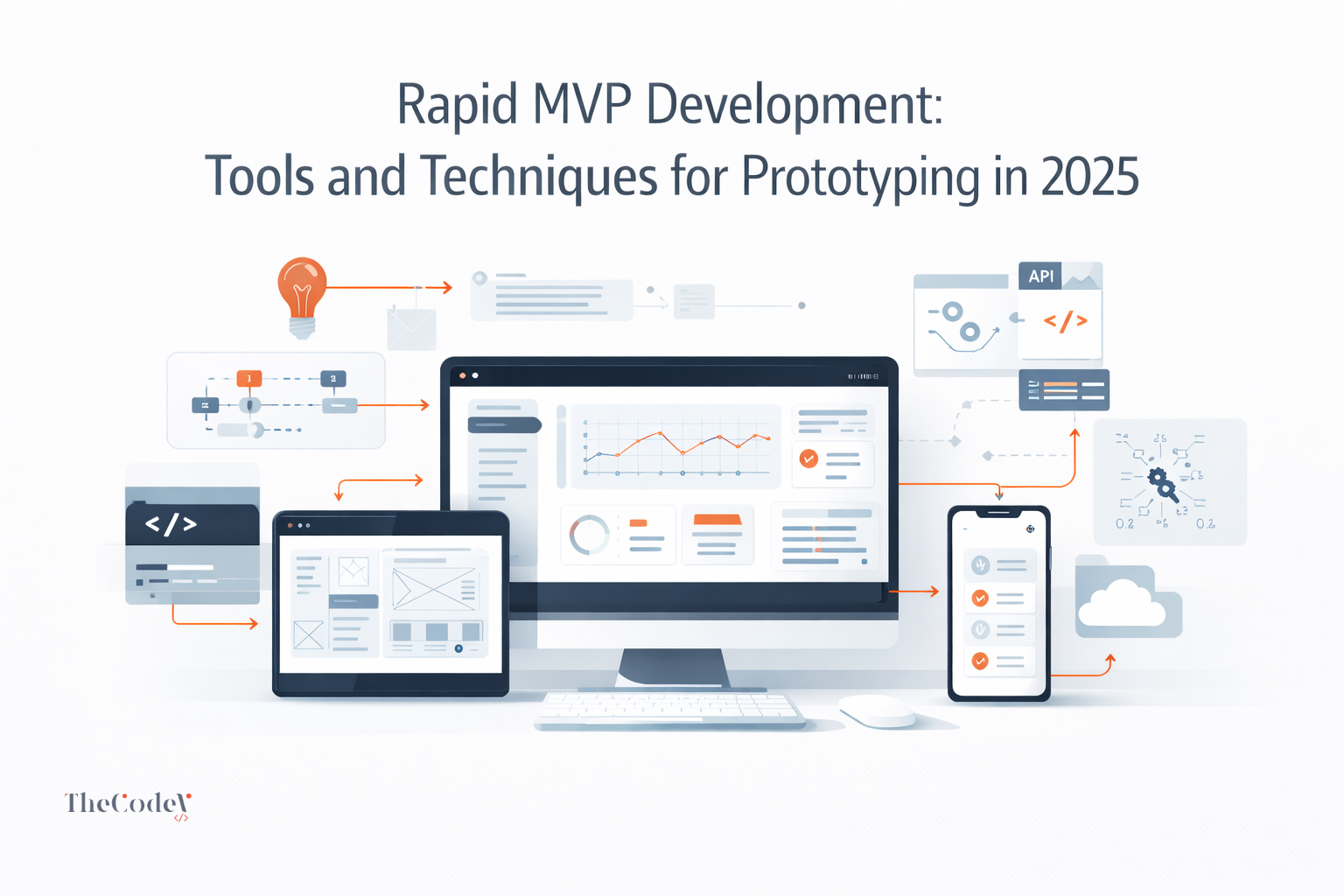
Rapid MVP Development in 2025: Why Speed Decides Survival
Speed now decides which startups survive, and validation decides which ones scale. In 2025, rapid mvp development has become the foundation of startup execution, not an optional strategy. Markets evolve faster than business plans, and users abandon products that take too long to prove value.
Founders no longer have the luxury of long build cycles. Capital is cautious, competition is global, and attention spans are short. A delayed launch often means losing relevance before learning anything meaningful.
Rapid MVP development helps teams test ideas early, reduce risk, and validate demand before heavy investment. For modern founders, speed is a competitive advantage that compounds over time.
What Is Rapid MVP Development?
Defining Rapid MVP Development
Rapid MVP development is the practice of building a functional product in the shortest possible time to validate an idea. The focus is learning, not perfection. Every decision prioritises speed, feedback, and measurable outcomes.
Unlike traditional development, fast MVP development strips away unnecessary features. Only the core value is built and tested. Everything else waits until the market proves it matters.
What Is Minimum Viable Product Development?
Minimum viable product development is the structured approach behind this speed. It delivers the smallest product that real users can interact with and evaluate. The goal is insight, not polish.
For startup MVP development, this means exposing assumptions early. Real usage replaces guesswork. Weak ideas fail quickly and cheaply, while strong ones gain traction.
Why Rapid MVP Development Matters More in 2025
AI Has Reset the Speed Benchmark
AI has permanently changed how quickly products can be built. Code generation, UI design, testing, and analytics now happen in parallel. What once took months can be achieved in weeks.
Rapid MVP development for startups now assumes AI assistance as standard. Teams that fail to adopt these tools fall behind immediately. Speed gaps in 2025 widen faster than ever.
Google for Startups highlights rapid validation as a key success factor. Startups that learn faster adapt faster. Time has become the most valuable resource.
https://startup.google.com/blog/
No-Code and Lean Culture Have Changed Expectations
No-Code Enables Faster Experimentation
No-code platforms allow founders to build and test without large engineering teams. Ideas can reach users in days rather than months. This has lowered the barrier to entry across industries.
Lean MVP development thrives in this environment. Small teams launch, learn, and refine continuously. Waste is eliminated early, before it becomes expensive.
The Y Combinator Startup Library reinforces this mindset. Early user feedback is essential before scaling any product. Validation now comes before expansion.
https://www.ycombinator.com/library
From Ideas to Market Validation, Faster Than Ever
Startup MVP development in 2025 is outcome-driven. Investors expect traction, not projections. Users expect solutions, not long roadmaps.
Rapid MVP development connects ideas directly to market feedback. This loop of build, test, and learn now defines how successful startups grow. Speed enables clarity, and clarity enables scale.
Many founders explore modern delivery models and digital capabilities through platforms like https://thecodev.co.uk/services/. Others refine their approach by studying proven SaaS paths such as
https://thecodev.co.uk/saas-development-for-entrepreneurs/.
Harvard Business Review consistently highlights validation-first product strategies. Their research shows early testing reduces failure rates and improves long-term outcomes.
https://hbr.org/
The New Baseline for Startup Execution
Rapid MVP development is no longer a shortcut. It is the baseline expectation in competitive markets. Founders who move slowly lose relevance before they gain insight.
In 2025, successful startups treat MVPs as living experiments. They build quickly, test honestly, and adapt relentlessly. This mindset now defines modern innovation.
For many teams, understanding the ecosystem is the first step. Exploring platforms like https://thecodev.co.uk/ helps frame what is possible. Execution, however, is what turns speed into survival.
The Rapid MVP Development Process Explained: From Idea to Validation
Rapid MVP development succeeds when structure meets speed. In 2025, moving fast without a clear process leads to wasted effort. A well-defined rapid MVP development process ensures teams learn quickly without losing focus.
This process is built around validation, not assumptions. Each step exists to answer one question. Does the market actually want this?
Step 1: Problem Discovery and Idea Validation
Every successful MVP starts with a real problem. Founders must understand user pain before writing a single line of code. Skipping this step leads to fast failure, not fast learning.
Rapid MVP development for startups begins with interviews, surveys, and competitor analysis. The goal is clarity, not confirmation. Strong ideas survive scrutiny.
Many teams validate early concepts using lean research frameworks. This aligns with lean MVP development principles. Evidence always beats intuition.
Step 2: Feature Prioritisation and Scope Control
Once the problem is clear, scope must shrink. MVPs fail when they try to do too much. Focus only on features that deliver core value.
This stage defines the MVP development framework. Teams list all ideas, then cut aggressively. Only must-have features remain.
Fast MVP development depends on discipline here. Every extra feature slows learning. Speed comes from saying no early.
Step 3: Rapid Prototyping and User Feedback
Prototyping turns ideas into something users can react to. In 2025, this often starts with low-fidelity designs or interactive mockups. The goal is feedback, not aesthetics.
Rapid product prototyping allows teams to test flows and usability before development. Mistakes surface early, when they are cheap to fix. This stage saves weeks later.
Many startups combine this step with usability testing. Early reactions guide smarter decisions. Feedback shapes the next move.
Step 4: Agile MVP Development and Build Phase
With validated designs, development begins. Agile MVP development dominates this phase. Work is broken into short sprints with constant review.
This MVP development methodology prioritises progress over perfection. Each sprint delivers something usable. Learning continues alongside building.
Teams often accelerate this stage by leveraging modern digital services. Exploring platforms like https://thecodev.co.uk/digital-services/ helps founders understand scalable delivery models.
Step 5: Launch, Measure, and Learn
Launching an MVP is not the finish line. It is the start of validation. Real users now decide what works.
Metrics guide decisions at this stage. Engagement, retention, and conversion matter more than opinions. Data replaces debate.
This feedback loop defines MVP development best practices. Build, measure, and learn repeats until product-market fit appears.
Step 6: Iterate or Pivot with Confidence
After launch, teams face a clear choice. Improve what works or pivot away from what does not. Rapid MVP development supports both paths.
Because the process is lean, changes happen quickly. Time and budget remain under control. Learning stays continuous.
Many founders refine this stage with professional support models seen in custom builds such as
https://thecodev.co.uk/custom-software-development-uk/.
Why This Process Works in 2025
The modern MVP development strategy is designed for uncertainty. Markets change quickly, and user expectations evolve faster. Structured speed protects teams from building the wrong product.
Rapid MVP development turns risk into insight. It shortens feedback loops and sharpens decisions. In 2025, this process is how startups move forward with confidence.
MVP Development Tools and Tech Stack for Rapid MVP Development in 2025
Choosing the right tools is the difference between moving fast and getting stuck. In 2025, rapid MVP development depends heavily on modern, flexible tech stacks. The goal is simple: build quickly, validate early, and scale without rebuilding everything.
Today’s tools prioritise speed, automation, and adaptability. Founders are no longer limited by heavy infrastructure or long setup times. The right stack removes friction at every stage.
No-Code MVP Development Tools
No-code platforms have transformed early-stage product building. They allow founders to launch functional MVPs without deep engineering resources. This approach works especially well for early validation.
Popular no-code tools support databases, workflows, and front-end logic. They are ideal for internal tools, marketplaces, and early SaaS concepts. For many startups, this is the fastest route to market.
No-code MVP development aligns perfectly with lean MVP development. Teams test assumptions quickly, then decide whether custom development is justified.
Low-Code Platforms for Scalable MVPs
Low-code platforms bridge the gap between speed and flexibility. They allow developers to customise while still moving fast. This makes them ideal for MVPs with future scaling plans.
Low-code MVP development supports APIs, third-party integrations, and cloud services. It reduces development time without locking teams into rigid systems. Scalability remains possible.
Many startups adopt low-code stacks for MVP development for web apps. They offer a balance between speed and control.
AI Powered MVP Development Tools
AI powered MVP development is now a standard expectation. Tools powered by AI accelerate coding, testing, and even product design. This dramatically improves MVP development speed.
AI copilots assist developers with code generation and debugging. Automated testing tools reduce quality risks without slowing delivery. Analytics tools surface insights faster.
Rapid software prototyping benefits heavily from AI. Feedback cycles shorten, and iteration becomes cheaper. In 2025, ignoring AI means falling behind.
For deeper insight into modern tooling trends, resources like
https://thecodev.co.uk/top-10-emerging-tools-for-developers/ provide useful context.
Core Tech Stack for Rapid MVP Development
A strong MVP development tools and tech stack usually includes several core components. These choices depend on the product type and target users.
For MVP development for web apps, teams often use modern JavaScript frameworks, serverless backends, and cloud hosting. These reduce setup time and maintenance.
For MVP development for mobile apps, cross-platform frameworks are common. They allow teams to launch on multiple platforms with one codebase. Speed improves without sacrificing reach.
Many teams explore architectural guidance through resources like
https://thecodev.co.uk/software-development-in-the-modern-era-transforming-businesses-with-innovative-solutions/.
Tools for Rapid Product Prototyping
Prototyping tools help teams validate ideas before development begins. Interactive mockups allow real users to test flows early. This reduces costly rework later.
Rapid product prototyping focuses on experience, not code. It answers usability questions fast. Strong prototypes lead to stronger MVPs.
According to GitHub’s developer ecosystem insights, faster iteration improves product quality over time. Modern tooling enables this feedback-driven approach.
https://github.com/
Choosing a Scalable MVP Stack
Scalable MVP development requires planning beyond launch. Tools must support growth without forcing a rebuild. This is a common mistake in fast MVP development.
Teams should prioritise modular architectures and cloud-native services. These adapt as user demand grows. Scalability starts with early decisions.
Vercel and similar platforms emphasise performance and speed for modern MVPs. Their ecosystems support rapid deployment and iteration.
https://vercel.com/
Tools Enable Speed, Strategy Drives Success
Tools alone do not guarantee success. They amplify the effectiveness of a clear MVP development strategy. The best stacks support learning, not complexity.
In 2025, rapid MVP development thrives on smart tooling choices. When technology removes friction, teams can focus on what matters most. Learning from real users, faster than competitors.
MVP Development Timeline: How to Build an MVP in Weeks, Not Months
Speed is the defining advantage in 2025. A clear MVP development timeline helps teams move fast without losing control. With the right approach, rapid mvp development can deliver real products in weeks, not quarters.
Traditional timelines no longer fit modern markets. Startups that wait too long lose momentum. Fast execution now separates leaders from followers.
Why Traditional MVP Timelines Fail Today
Older development models focused on long planning cycles. Features were locked early, and feedback came late. This approach increases risk and slows learning.
In contrast, quick MVP development prioritises early release. Products reach users while ideas are still flexible. Feedback arrives when it can still shape outcomes.
Modern startup MVP development demands speed with structure. Timelines must support experimentation, not delay it.
A Modern MVP Development Timeline Breakdown
Most fast MVP development projects follow a predictable rhythm. While every product is different, the structure remains consistent.
Week 1: Discovery and Validation
Teams define the problem and target users. Interviews and competitor analysis drive decisions. Assumptions are challenged early.
Week 2: Scope and Prototyping
Features are prioritised aggressively. Rapid product prototyping begins with wireframes or clickable mockups. Early user feedback shapes the build.
Weeks 3–4: Build and Test
Agile MVP development takes over. Core functionality is developed and tested in short cycles. Quality checks run alongside development.
Week 5: Launch and Measure
The MVP goes live to real users. Metrics guide decisions. Learning accelerates immediately.
This structure shows how to build an MVP quickly without cutting corners. Speed comes from focus, not shortcuts.
Factors That Influence MVP Development Speed
Several elements directly affect MVP development speed. Team experience, tooling, and clarity of scope matter most. Poor decisions early slow everything later.
Lean MVP development reduces delays by limiting features. Every added requirement extends timelines. Simplicity keeps momentum high.
Cloud-native infrastructure also plays a key role. Teams using modern hosting and deployment tools avoid setup bottlenecks. Resources like
https://thecodev.co.uk/cloud-providers-comparison-2025/ highlight these advantages.
Fast MVP Development vs Traditional Builds
Traditional builds aim for completeness. Fast MVP development aims for validation. The difference shapes timelines dramatically.
A traditional product might take six months before user feedback. A rapid MVP delivers insight within weeks. That gap often decides success.
According to McKinsey, faster time-to-market improves competitive positioning. Early movers learn and adapt sooner.
https://www.mckinsey.com/
CB Insights also reports that lack of market need is a top startup failure reason. Speedy validation reduces this risk.
https://www.cbinsights.com/
Managing Trade-Offs Without Sacrificing Quality
Building quickly does not mean ignoring quality. It means focusing quality on what matters most. Core flows must work well.
Agile MVP development supports this balance. Testing happens continuously, not at the end. Issues surface early and get fixed fast.
Many teams explore cost and timeline considerations together. Guides like
https://thecodev.co.uk/mobile-app-development-costs/ help founders plan realistically.
Why Weeks Matter More Than Ever
In 2025, markets reward fast learners. A shorter MVP development timeline means faster insight. Faster insight leads to better decisions.
Rapid MVP development turns time into leverage. Each week saved becomes an advantage competitors cannot easily match. Speed, when structured, becomes strategy.
MVP Development Cost in 2025: Building Fast Without Burning Budget
Cost pressure has never been higher for startups. In 2025, founders must balance speed, quality, and budget carefully. Rapid mvp development succeeds when costs stay controlled without slowing learning.
Understanding MVP development cost early prevents expensive surprises. The goal is not the cheapest product. It is the smartest investment for validation.
What Determines MVP Development Cost?
Several factors influence the cost of minimum viable product development. Scope is the biggest driver. More features mean more time, and more time increases spend.
Technology choices also matter. No-code and low-code stacks reduce early costs. Fully custom builds increase flexibility but require larger budgets.
Team structure plays a key role. In-house teams cost more upfront. Distributed or specialised teams often reduce expenses.
Typical MVP Development Cost Ranges
While every project is different, most MVPs fall into clear ranges. These estimates reflect modern startup MVP development in 2025.
No-code MVPs: £5,000 to £15,000
Web app MVPs: £15,000 to £40,000
Mobile app MVPs: £25,000 to £60,000
SaaS MVPs: £20,000 to £50,000
Low cost MVP development is achievable with focused scope. Costs rise quickly when teams chase perfection instead of validation.
For realistic pricing structures, founders often review plans like
https://thecodev.co.uk/pricing-plans/.
Lean MVP Development as a Cost Strategy
Lean MVP development reduces cost by design. It removes unnecessary features before development begins. This discipline protects both budget and timeline.
By validating assumptions early, teams avoid building unwanted functionality. Money is spent only where evidence supports it. Learning replaces guesswork.
This approach works especially well for rapid MVP development for startups. Early traction justifies future investment. Weak ideas fail without draining resources.
Cost-Saving Techniques That Actually Work
Several strategies consistently lower MVP development cost. These methods protect quality while preserving speed.
Using no-code or low-code tools reduces engineering hours. Reusable components and open-source libraries save time. Cloud services eliminate infrastructure overhead.
Many founders also reduce cost by starting with web-based MVPs. Web apps validate demand before mobile expansion. This staged approach lowers risk.
Guides such as
https://thecodev.co.uk/choose-the-right-software-development-company/
help teams avoid costly partner mistakes.
MVP Development for SaaS: Cost Considerations
MVP development for SaaS products requires careful planning. Subscription logic, user management, and analytics must work from day one. These add complexity.
However, SaaS MVPs benefit greatly from rapid MVP development frameworks. Modular architectures allow features to grow over time. Early versions stay lean.
Low cost MVP development for SaaS often starts with core workflows only. Advanced features wait until validation proves demand.
Balancing Speed, Cost, and Scalability
Cutting costs should never block growth. Scalable MVP development requires future thinking, even during lean builds. Early architectural choices matter.
Teams should prioritise flexibility over shortcuts. Saving money today should not require rebuilding tomorrow. Balance is key.
Platforms like Clutch and GoodFirms highlight this trade-off. Their research shows that cheap builds often fail to scale.
https://clutch.co/
https://www.goodfirms.co/
Smart Spending Accelerates Learning
MVP development cost is not just an expense. It is an investment in learning speed. Spending wisely accelerates insight and reduces long-term waste.
In 2025, rapid MVP development rewards founders who budget strategically. Those who spend with intention move faster and learn more.
Rapid MVP Development Services vs In-House Teams: What Works in 2025
Choosing how to build an MVP is a strategic decision. In 2025, founders must decide between internal teams and rapid MVP development services. Each option affects speed, cost, and long-term flexibility.
There is no universal answer. The right choice depends on goals, budget, and urgency. What matters most is how fast learning begins.
Building an MVP with an In-House Team
In-house teams offer direct control. Communication is immediate, and product knowledge stays internal. This suits companies with existing engineering capacity.
However, building internal teams takes time. Hiring delays MVP development speed. Salaries, onboarding, and tooling increase upfront costs.
For early-stage startup MVP development, this approach can slow validation. Speed often suffers before momentum builds.
Using Rapid MVP Development Services
Rapid MVP development services focus on speed and delivery. Teams are already assembled and experienced. Work starts immediately.
These services specialise in fast MVP development frameworks. They bring proven processes, tooling, and technical leadership. Risk reduces through repetition.
For rapid MVP development for startups, this model shortens timelines. Validation happens earlier, when pivots are still affordable.
Speed, Cost, and Expertise Compared
Speed is the clearest difference. External teams launch MVPs faster. Internal teams take longer to mobilise.
Cost structures also vary. In-house teams have fixed costs. Service providers offer predictable project pricing.
Expertise is another factor. Specialist teams have built many MVPs before. This experience helps avoid common mistakes.
Many founders explore company structures and talent paths through
https://thecodev.co.uk/about-us/
and career models at
https://thecodev.co.uk/career/.
When Outsourcing Makes Strategic Sense
Outsourcing works best when speed matters more than ownership. Early validation often outweighs long-term control. This is common in new markets.
Agile MVP development benefits from external momentum. Sprints move faster with dedicated teams. Learning accelerates.
Global delivery models also increase flexibility. Time zones extend productivity. Costs remain competitive without sacrificing quality.
In-House Teams for Long-Term Product Growth
Once product-market fit is clear, in-house teams shine. They own complexity and roadmap depth. Knowledge compounds internally.
Many startups transition after validation. Rapid MVP development services launch the product. Internal teams scale it.
This hybrid model balances speed and ownership. It is increasingly popular in 2025.
Industry Perspective on MVP Delivery Models
Consulting firms emphasise flexibility over rigidity. Deloitte Digital highlights adaptive delivery as a growth driver.
https://www.deloitte.com/
PwC research also supports modular product teams. They enable faster pivots and controlled scaling.
https://www.pwc.com/
These insights support modern MVP development strategy. Structure follows learning, not tradition.
Choosing What Fits Your Stage
The best MVP development methodology aligns with your stage. Early-stage startups need speed and validation. Later stages need depth and control.
Rapid MVP development succeeds when teams choose intentionally. Whether internal or external, clarity drives results. In 2025, execution models must serve learning first.
Rapid MVP Development in 2025: Turning Speed Into Sustainable Growth
In 2025, rapid MVP development is no longer about launching quickly for the sake of speed. It is about learning faster than competitors and acting on real evidence. Startups that master this approach reduce risk while increasing their chances of long-term success.
Modern minimum viable product development blends speed, structure, and strategy. AI, no-code tools, and agile workflows have reshaped what is possible. MVPs that once took months can now be built and validated in weeks.
Across every stage, the pattern remains clear. Lean scope, fast feedback, and continuous iteration outperform heavy planning. Rapid MVP development transforms uncertainty into insight and ideas into validated products.
This approach also supports smarter investment decisions. Teams spend less upfront, validate earlier, and scale with confidence. Whether building SaaS platforms, web apps, or mobile products, speed paired with discipline wins.
For startups and businesses ready to move decisively, working with experienced delivery teams accelerates outcomes. UK-based companies with global delivery experience bring structure to speed and clarity to execution. This is where proven frameworks, modern tooling, and real-world expertise matter most.
If you are planning to validate an idea, launch a new product, or reduce time to market, now is the moment to act. A focused MVP can unlock traction faster than a perfect product ever will.
To explore how your idea can move from concept to validation efficiently, start with a tailored discussion. You can book a session at
https://thecodev.co.uk/consultation/
or reach out directly through
https://thecodev.co.uk/contact/.
For a more structured starting point, completing a short project outline helps align goals early. You can do that here:
https://thecodev.co.uk/questionnaire/
In 2025, rapid MVP development is not just a methodology. It is a mindset. Those who build, test, and adapt quickly are the ones who shape what comes next.