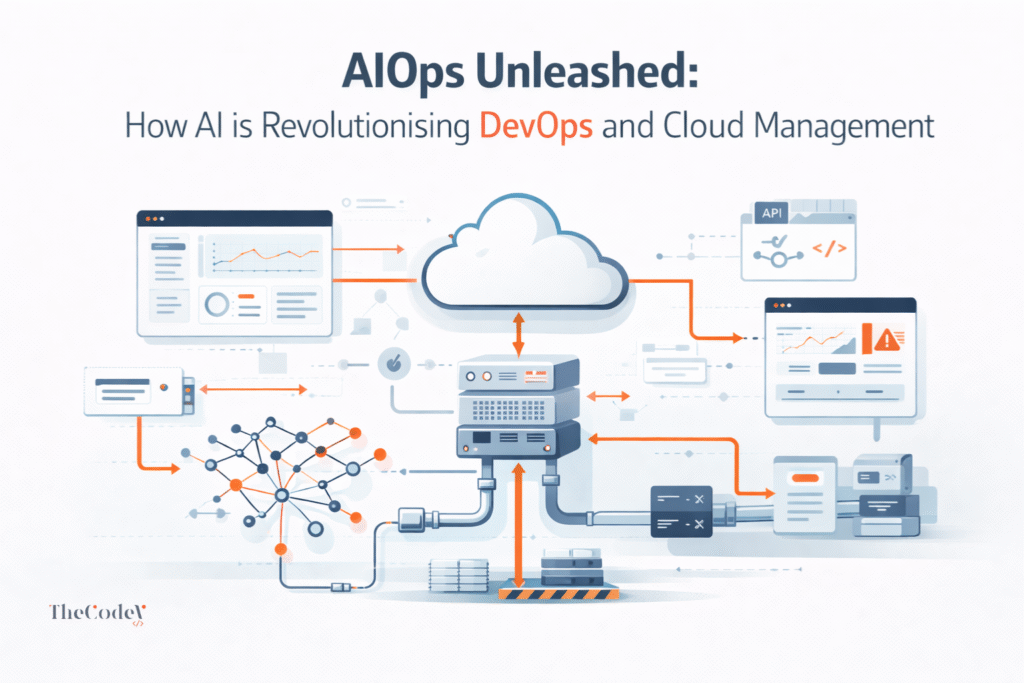
AIOps in DevOps: Why Intelligent Operations Are No Longer Optional
Cloud systems were meant to simplify operations. Instead, they’ve created a maze of tools, alerts, and data streams.
Modern DevOps teams are drowning in metrics, logs, and events. Speed has improved, but clarity has not.
This is where aiops in devops steps in.
AIOps brings machine intelligence into DevOps workflows. It turns raw operational noise into insight.
Rather than reacting to failures, teams can now predict, prevent, and optimise in real time.
For global software companies like TheCodeV, operating across regions and infrastructures, this shift is no longer optional. It’s foundational.
What Is AIOps in DevOps?
AIOps in DevOps refers to applying artificial intelligence and machine learning to operational data across the DevOps lifecycle.
It enables systems to observe, learn, and act without constant human intervention.
Unlike traditional monitoring tools, AIOps platforms analyse patterns across massive datasets.
They correlate logs, metrics, traces, and events into a single operational narrative.
This intelligence allows DevOps teams to move from reactive firefighting to proactive optimisation.
According to Gartner, AIOps reduces operational complexity and improves service availability in dynamic environments.
That’s why adoption has accelerated alongside cloud-native architectures and microservices.
The Role of AIOps in Modern DevOps Teams
Traditional DevOps relies heavily on predefined rules and manual thresholds.
These approaches break down at scale.
The role of AIOps in DevOps is to introduce adaptive intelligence into every operational layer.
Instead of static alerts, AIOps systems learn what “normal” looks like.
They adjust continuously as applications evolve.
This capability is especially critical in environments using containers, Kubernetes, and multi-cloud deployments.
AIOps also acts as a bridge between development and operations.
It provides shared visibility, faster feedback, and data-driven decisions across teams.
For organisations delivering complex systems worldwide, like those working with TheCodeV’s global clients, this intelligence ensures stability without slowing innovation.
Learn more about how AI enhances DevOps workflows on our page about artificial intelligence in DevOps.
Why DevOps Alone Is No Longer Enough
DevOps solved many problems. It broke down silos and accelerated delivery.
But it was never designed to manage today’s data volumes.
Cloud-native systems generate millions of events daily.
Human operators cannot process this manually.
This is where machine learning in DevOps becomes essential.
Machine learning models detect hidden patterns humans miss.
They identify anomalies before they escalate into outages.
This shift marks the rise of AI driven DevOps, where systems assist engineers rather than overwhelm them.
IBM highlights that AIOps enables faster incident response and improved system resilience by automating insight generation.
This aligns with how modern DevOps teams must operate at scale.
The Business Impact of AIOps in DevOps
AIOps is not just a technical upgrade.
It delivers measurable business value.
Teams experience reduced downtime, faster root cause identification, and improved customer experience.
Operational costs also decline as manual effort decreases.
For growing organisations, AIOps supports scalability without proportional team expansion.
That’s a competitive advantage in fast-moving markets.
If you’re exploring intelligent operational strategies, TheCodeV’s expertise across AI and cloud solutions can help you navigate this transition.
Discover how we support modern digital transformation on our homepage.
As cloud ecosystems grow more complex, DevOps must evolve.
AIOps is that evolution, and it’s already reshaping how high-performing teams operate.
AIOps vs DevOps: Why Automation Alone Can’t Keep Up Anymore
DevOps promised speed and stability.
At scale, it often delivers complexity instead.
As systems grow distributed and cloud-native, traditional DevOps practices begin to strain.
This is where the debate around AIOps vs DevOps becomes critical.
The truth is simple.
DevOps without intelligence cannot keep pace with modern infrastructure.
Understanding Traditional DevOps at Scale
DevOps focuses on collaboration, automation, and faster delivery.
It relies on CI/CD pipelines, monitoring tools, and predefined rules.
In smaller environments, this works well.
At enterprise scale, cracks start to appear.
Teams face alert fatigue from thousands of notifications.
Root cause analysis becomes slow and manual.
Static thresholds struggle with dynamic workloads.
Cloud elasticity breaks rule-based monitoring.
This is not a failure of DevOps philosophy.
It’s a limitation of human-led automation.
AIOps vs DevOps: The Core Difference
The key difference between AIOps vs DevOps lies in decision-making.
DevOps automates execution.
AIOps automates understanding.
AIOps introduces machine learning models that analyse behaviour across systems.
They detect patterns, correlations, and anomalies automatically.
Instead of asking engineers to interpret dashboards, AIOps surfaces insights directly.
This reduces noise and accelerates action.
With AIOps and DevOps integration, teams move from reactive operations to predictive control.
Problems are identified before users are impacted.
Red Hat notes that AIOps enables IT teams to manage complexity through continuous learning systems.
This capability is essential for cloud-first organisations.
Intelligent DevOps Automation in Practice
Traditional automation follows scripts.
Intelligent automation adapts.
Intelligent DevOps automation allows pipelines to respond dynamically to system conditions.
Deployments can pause, roll back, or reroute automatically.
For example, if performance degrades during a release, AIOps can detect abnormal behaviour.
It can trigger corrective actions without human input.
This intelligence transforms DevOps from a delivery engine into a self-correcting system.
It also improves collaboration.
Both developers and operations teams work from the same data-driven insights.
If you’re exploring scalable automation strategies, TheCodeV’s approach to cloud and DevOps services reflects this intelligent model.
You can explore our capabilities on the services page.
Predictive Analytics Changes the Game
One of the strongest advantages of AIOps is foresight.
Predictive analytics in DevOps allows teams to forecast incidents before they occur.
Capacity issues, latency spikes, and resource exhaustion become visible early.
This reduces downtime and improves customer trust.
It also supports better planning and cost control.
Instead of reacting to failures, teams prevent them.
That shift defines modern operational excellence.
Microsoft highlights that predictive analytics improves reliability in distributed cloud systems.
This is especially relevant in multi-cloud environments.
If you’re comparing infrastructure strategies, our guide on cloud providers comparison 2025 offers helpful insights.
DevOps Isn’t Replaced. It’s Enhanced.
AIOps does not replace DevOps.
It completes it.
DevOps provides speed and structure.
AIOps provides intelligence and resilience.
Together, they enable teams to scale confidently.
This combination defines the future of high-performing digital organisations.
As cloud complexity grows, DevOps must evolve.
AIOps is the catalyst driving that evolution forward.
AIOps in the DevOps Pipeline: Powering Smarter CI/CD and Continuous Delivery
Speed is the currency of modern software delivery.
Yet speed without insight often leads to failure.
As deployment frequency increases, so does risk.
This is where aiops in devops transforms the pipeline itself.
By embedding intelligence directly into delivery workflows, teams gain control without sacrificing velocity.
AIOps in the DevOps Pipeline Explained
The AIOps in DevOps pipeline approach brings machine learning into every stage of delivery.
From code commit to production release, systems observe and learn continuously.
Traditional pipelines follow predefined paths.
AIOps-enabled pipelines adapt in real time.
They analyse historical deployment data, system behaviour, and performance signals.
This allows smarter decisions during builds, tests, and releases.
Instead of relying solely on pass or fail signals, pipelines gain context.
That context reduces blind spots and late-stage surprises.
Smarter CI/CD with AIOps
AIOps in CI/CD pipelines enhances automation with intelligence.
During continuous integration, AIOps models detect abnormal test failures.
They distinguish between flaky tests and real defects.
In continuous delivery, AIOps evaluates deployment impact.
It correlates application changes with infrastructure performance.
If anomalies appear, the pipeline can automatically pause or rollback.
This reduces production incidents without slowing releases.
Teams also benefit from faster feedback loops.
Developers receive actionable insights, not raw logs.
Atlassian highlights that intelligent pipelines improve deployment reliability in high-velocity teams.
This aligns with the needs of cloud-native organisations.
AIOps for Continuous Delivery at Scale
As systems grow distributed, delivery complexity multiplies.
Microservices, APIs, and third-party integrations add uncertainty.
AIOps for continuous delivery brings predictability back.
Machine learning models analyse previous releases and outcomes.
They forecast the risk of new deployments.
High-risk releases can be flagged automatically.
Low-risk changes move forward without manual approval.
This risk-aware delivery model supports both speed and stability.
It’s especially valuable for teams managing global deployments.
If you’re modernising delivery workflows, TheCodeV explores automation strategies in depth in our guide on how to automate your workflows using n8n.
DevOps Automation Becomes Adaptive
Traditional AIOps for DevOps automation replaces rigid rules with learning systems.
Instead of static thresholds, pipelines adapt to real-world behaviour.
This reduces false positives and missed issues.
For example, performance benchmarks adjust automatically as usage grows.
Seasonal traffic patterns are recognised without manual tuning.
This adaptability improves release confidence.
It also reduces the operational burden on engineers.
GitLab notes that intelligent automation helps teams scale CI/CD without scaling complexity.
This is essential for organisations shipping frequently.
Connecting Delivery to Business Outcomes
AIOps doesn’t just protect infrastructure.
It aligns delivery with business goals.
By correlating releases with user experience and performance metrics, teams gain visibility.
They understand which changes drive value and which introduce risk.
This insight supports better prioritisation.
It also strengthens collaboration between engineering and leadership.
If you’re building resilient delivery pipelines, TheCodeV’s experience in modern software engineering can support your journey.
Explore our perspective on scalable development in software development in the modern era.
As CI/CD pipelines evolve, intelligence becomes essential.
AIOps ensures speed and safety grow together, not apart.
AIOps for Cloud Operations: Mastering Infrastructure at Scale
Cloud promised flexibility.
What it delivered was complexity.
Multi-cloud strategies, container orchestration, and microservices have multiplied operational data.
Without intelligence, visibility quickly collapses.
This is where AIOps for cloud operations becomes essential.
AIOps for Infrastructure Monitoring
Traditional monitoring tools rely on static thresholds.
In dynamic cloud environments, those thresholds fail.
AIOps for infrastructure monitoring uses machine learning to understand normal behaviour.
It continuously learns from metrics, logs, and events.
When patterns shift, AIOps detects meaningful anomalies.
Noise is filtered out automatically.
This approach reduces alert fatigue.
Engineers focus on real issues, not endless notifications.
Google Cloud explains that AI-driven observability improves reliability in elastic environments.
This capability is now critical for modern DevOps teams.
Kubernetes Monitoring with AIOps
Kubernetes introduces orchestration power.
It also introduces operational blind spots.
AIOps for Kubernetes monitoring provides deep visibility across clusters and namespaces.
It correlates pod behaviour with node performance and application health.
Instead of isolated alerts, teams see cause-and-effect relationships.
This shortens investigation time significantly.
AIOps also helps predict scaling issues.
It identifies resource contention before services degrade.
For organisations managing containerised workloads globally, this intelligence is invaluable.
It ensures Kubernetes remains an enabler, not a bottleneck.
AIOps for Microservices DevOps
Microservices increase agility.
They also increase failure points.
AIOps for microservices DevOps connects distributed components into a coherent picture.
It traces requests across services automatically.
When latency spikes, AIOps identifies the weakest link.
No manual correlation is required.
This visibility supports faster remediation.
It also improves system design over time.
Teams gain confidence to release frequently.
Operational risk decreases despite architectural complexity.
If you’re exploring modern cloud architectures, TheCodeV’s insights into distributed systems are covered in our article on edge computing and cloud transformation.
Supporting SRE Teams with AIOps
Site Reliability Engineering depends on data.
Too much data can overwhelm.
AIOps for SRE teams transforms raw telemetry into actionable signals.
Error budgets, SLOs, and SLIs become easier to manage.
AIOps predicts reliability risks.
It helps teams prioritise preventative work over reactive fixes.
This supports long-term system resilience.
It also aligns reliability goals with business objectives.
The CNCF highlights that intelligent observability is key to sustainable SRE practices.
AIOps plays a central role in this evolution.
Scaling Cloud Operations Globally
Operating across regions adds another layer of complexity.
Latency, compliance, and infrastructure variability must be managed carefully.
AIOps provides a unified operational view.
It normalises data across clouds and geographies.
For global software providers and partners like EmporionSoft, this intelligence ensures consistent performance worldwide.
It enables teams to scale without losing control.
If you’re evaluating cloud strategies, TheCodeV’s analysis of platforms and providers can help.
Explore our detailed guide on cloud providers comparison 2025.
As cloud ecosystems grow more complex, manual monitoring falls short.
AIOps brings clarity, control, and confidence back to cloud operations.
AIOps Use Cases in DevOps: From Incident Chaos to Predictive Control
Incidents rarely arrive quietly.
They surface as floods of alerts, confused dashboards, and delayed responses.
In high-velocity environments, every minute counts.
This is where AIOps use cases in DevOps deliver measurable impact.
By turning operational data into intelligence, teams move from chaos to control.
AIOps for Incident Management
Traditional incident management depends on human coordination.
Alerts trigger tickets. Tickets trigger investigation.
AIOps for incident management changes this flow.
Machine learning models correlate alerts across systems automatically.
Related events are grouped into a single incident.
This reduces noise dramatically.
Engineers focus on resolution, not triage.
AIOps also prioritises incidents based on impact.
Customer-facing issues surface first.
According to IBM, intelligent incident management can cut response times significantly.
That speed directly improves service reliability.
Root Cause Analysis Without Guesswork
Manual root cause analysis is slow and error-prone.
Complex systems hide causal relationships.
AIOps for root cause analysis uncovers those relationships automatically.
By analysing historical and real-time data, AIOps identifies probable causes.
It traces failures across applications, infrastructure, and networks.
This reduces mean time to resolution.
It also prevents repeat incidents.
Engineers spend less time diagnosing.
They spend more time improving systems.
If you’re exploring automation-driven reliability, TheCodeV covers this evolution in our article on the future of AI-powered automation in software development.
Detecting Anomalies Before Users Notice
Not all failures are obvious.
Some begin as subtle performance degradation.
AIOps for anomaly detection identifies these early warning signs.
It learns normal behaviour across time and conditions.
When deviations occur, alerts are raised intelligently.
False positives are reduced.
This proactive approach protects user experience.
It also supports service-level objectives.
Predictive detection is especially valuable in cloud-native systems.
Dynamic workloads make manual baselines unreliable.
Smarter Log Analysis in DevOps
Logs contain answers.
They also contain noise.
AIOps for log analysis in DevOps filters, clusters, and interprets logs automatically.
Patterns emerge that humans would miss.
Instead of searching endlessly, engineers receive insights.
Error trends and correlations are highlighted.
This speeds up investigations.
It also improves long-term observability.
As systems scale, automated log intelligence becomes essential.
Manual analysis simply doesn’t scale.
Performance Optimisation Through Intelligence
Performance issues often stem from complex interactions.
Finding them manually is difficult.
AIOps for performance optimization analyses end-to-end behaviour.
It identifies bottlenecks across services and infrastructure.
Recommendations are data-driven.
Optimisation becomes continuous, not reactive.
This improves application responsiveness.
It also reduces infrastructure costs.
Microsoft notes that AI-driven performance insights help maintain reliability in distributed systems.
That insight is increasingly valuable for digital-first organisations.
If you’re aligning operational excellence with business growth, TheCodeV’s perspective on AI adoption is explored in our guide on AI in business UK 2025.
From Reactive to Predictive Operations
Together, these AIOps benefits for DevOps teams redefine operations.
Incidents are predicted, not just resolved.
Performance is optimised continuously.
Teams regain control over complexity.
Systems become more resilient with every cycle.
AIOps doesn’t eliminate incidents entirely.
It ensures they no longer define your operations.
Implementing AIOps in DevOps: Tools, Strategy, and Best Practices
Adopting AIOps is not a plug-and-play exercise.
Success depends on preparation, alignment, and execution.
Many teams fail not because of technology, but because of approach.
Understanding AIOps implementation in DevOps is critical before investing.
Choosing the Right AIOps Tools for DevOps
The market offers a wide range of platforms.
Not all are suited to every organisation.
AIOps tools for DevOps typically focus on observability, incident intelligence, or automation.
Some specialise in cloud monitoring, others in CI/CD analytics.
Key capabilities to look for include data correlation, anomaly detection, and predictive insights.
Integration with existing toolchains is equally important.
Tools should support modern stacks.
This includes Kubernetes, microservices, and multi-cloud environments.
Vendor lock-in is a real concern.
Open APIs and flexible architectures reduce long-term risk.
Before selecting a platform, teams should assess maturity and goals.
This avoids overengineering early implementations.
AIOps Implementation in DevOps Environments
Successful AIOps implementation in DevOps starts with data readiness.
AIOps systems rely on high-quality telemetry.
Logs, metrics, and traces must be accessible and consistent.
Teams should begin with a focused use case.
Incident management or anomaly detection are common starting points.
Gradual rollout reduces disruption.
It also builds trust in AI-driven insights.
Cultural readiness matters as much as technical readiness.
Engineers must understand how to work alongside intelligent systems.
If you’re planning adoption, TheCodeV offers structured guidance through our consultation services.
Strategic planning reduces risk and accelerates value.
Best Practices for AIOps in DevOps
Following AIOps best practices for DevOps increases success rates.
Start with clear objectives.
Define what success looks like.
Ensure data quality early.
Poor data leads to poor outcomes.
Involve both development and operations teams.
Shared ownership drives better results.
Continuously train and refine models.
Systems must evolve with applications.
Below is a practical checklist to guide adoption:
Align AIOps goals with business outcomes
Integrate with existing CI/CD and monitoring tools
Start small and scale gradually
Monitor model performance regularly
Maintain human oversight during early stages
These practices help teams avoid common pitfalls.
Addressing Cost and Complexity
AIOps investments must be justified.
Costs extend beyond licensing.
Implementation effort, training, and change management matter.
Ignoring these leads to stalled projects.
However, long-term savings are significant.
Reduced downtime and faster resolution offset initial costs.
Transparent pricing and phased adoption help control budgets.
You can explore structured options on TheCodeV’s pricing plans.
Preparing for the Next Phase of DevOps
AIOps is not a one-time upgrade.
It’s an evolving capability.
As systems grow, models become more accurate.
Operational intelligence deepens over time.
Teams that invest thoughtfully gain a competitive edge.
They operate with confidence in complex environments.
Implementation done right sets the foundation.
AIOps in DevOps: Challenges, Future Outlook, and the Path Forward
AIOps is powerful, but it is not effortless.
Understanding its limitations is just as important as understanding its benefits.
As adoption accelerates, teams must approach aiops in devops with realism, strategy, and long-term vision.
AIOps Challenges in DevOps Environments
The biggest challenge is data.
AIOps systems depend on large volumes of high-quality data.
Inconsistent logs, missing metrics, and siloed tools weaken outcomes.
Another common issue is noise during early adoption.
Models need time to learn what “normal” looks like.
Teams may initially distrust AI-driven insights.
This is a cultural challenge, not a technical one.
There are also governance concerns.
Over-automation without human oversight can introduce risk.
Security, compliance, and explainability must be addressed early.
AIOps decisions should be transparent and auditable.
Despite these challenges, most failures come from rushed implementations.
Not from the technology itself.
The Future of AI Driven DevOps
The trajectory is clear.
DevOps is becoming increasingly autonomous.
Future AI driven DevOps systems will self-heal infrastructure.
They will optimise performance continuously.
Predictive analytics will extend beyond incidents.
Capacity planning, cost optimisation, and release strategy will all become data-driven.
We will also see deeper integration with business metrics.
Operational decisions will align directly with revenue and user experience.
As models mature, collaboration between humans and AI will improve.
Engineers will focus on design and innovation, not firefighting.
This evolution is already underway in forward-thinking organisations worldwide.
Why AIOps Benefits for DevOps Teams Are Compounding
The true value of AIOps grows over time.
Each incident resolved improves future predictions.
Each deployment analysed reduces future risk.
Key AIOps benefits for DevOps teams include:
Faster incident resolution
Proactive issue prevention
Reduced operational costs
Improved system reliability
Better developer experience
These benefits compound as systems scale.
That’s why early, thoughtful adoption matters.
Turning Strategy into Execution
Technology alone does not deliver transformation.
Execution does.
Successful teams align AIOps with clear goals.
They integrate it into existing workflows.
They invest in people as much as platforms.
Training and trust are essential.
This is where experienced partners make a difference.
TheCodeV works with organisations across the UK and globally to design intelligent DevOps strategies.
Our teams understand cloud complexity, AI systems, and real-world delivery.
You can learn more about our approach and values on our About Us page.
Work with TheCodeV to Build Intelligent DevOps
AIOps is redefining how modern systems are built and operated.
The question is no longer if it should be adopted, but how.
If you’re ready to move from reactive operations to predictive, intelligent DevOps, TheCodeV can help.
We partner with teams to design, implement, and scale AIOps-driven DevOps ecosystems.
Start a conversation with our experts today.
Reach out through our Contact page and explore how intelligent operations can future-proof your digital infrastructure.
The future of DevOps is intelligent.
Now is the time to build it right.



One Comment
I really enjoyed playing. wheelie life scratch has some interesting mechanics that keep you coming back for more.