
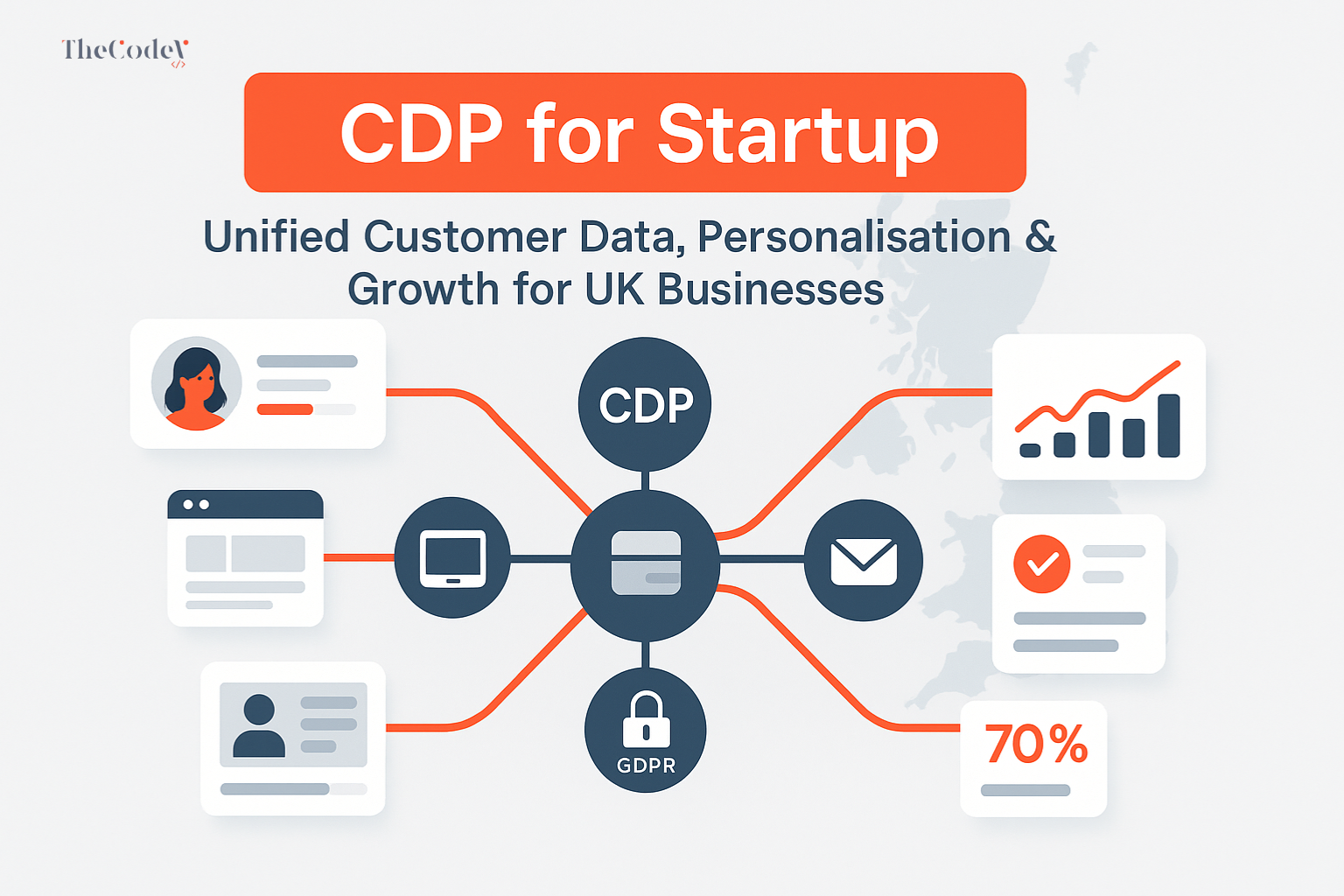
Why UK Startups Are Rethinking Customer Data in 2025
Customer data is scattered everywhere, and for many young companies, that chaos shows up in missed sales, weak personalisation, and poor decision-making. This is exactly why CDP for startup adoption is rising fast across the UK. Startups are realising they cannot scale on fragmented spreadsheets, disconnected SaaS tools, and unreliable tracking. They need a smarter, cleaner way to understand their users without inheriting the heavy cost and complexity of enterprise suites.
Today’s digital consumer interacts with brands across countless touchpoints. Email, mobile apps, websites, paid ads, chat widgets, and offline events all generate valuable signals. Yet most early-stage startups lack a system that pulls everything together. That gap becomes painful as teams grow and acquisition costs rise. According to Gartner, companies using unified data platforms experience higher customer retention and stronger long-term value because they identify behaviour patterns earlier and more accurately. For a startup, those gains can make the difference between slow survival and fast growth.
The Fragmentation Challenge Every UK Startup Faces
Most young businesses collect data by accident, not strategy. They adopt tools as problems appear—CRM for sales, email platforms for campaigns, analytics for behaviour, and spreadsheets for everything else. Each tool collects data differently. None of them agree with each other. The result is a messy data ecosystem that grows harder to manage every month.
This is why the demand for a customer data platform for startup UK has surged. Startups want reliable, real-time insights without dealing with complex implementation cycles. A CDP sits at the centre of the stack and creates a unified customer view UK startup teams can trust. It merges behavioural, transactional, and demographic data into one living profile that updates as users interact with the business. It removes guesswork. It gives teams clarity.
And for early-stage founders trying to move fast, clarity is cash.
Why First-Party Data Is Now Essential in the UK
The entire UK digital landscape has shifted towards stronger privacy protections and stricter consent requirements. Consumers expect transparency. Regulators expect compliance. Startups simply cannot afford weak tracking or loose data governance.
This is where a CDP becomes more than a marketing tool. It becomes a compliance partner.
With data privacy UK GDPR startup rules tightening and third-party cookies fading out, first-party data is the new competitive advantage. A CDP helps startups collect, store, and activate consented data confidently. It ensures every channel uses the same user permissions. It prevents costly mistakes that could lead to fines or reputational damage.
Statista reports that over 80% of UK consumers value privacy more than personalisation. Startups that build trust early grow faster later, and a CDP strengthens that foundation from day one.
Unified Profiles Without Enterprise Bloat
Large enterprise CDPs are powerful, but they’re also heavy, expensive, and slow to implement. Startups don’t need massive infrastructure or multi-quarter deployments. They need agility, fast integration, and predictable pricing. This is where modern CDP tools designed for smaller teams shine. They allow companies to unify their data, personalise experiences, and track performance without slowing the entire organisation or draining the budget.
This lighter approach fits perfectly within the evolving startup marketing stack UK CDP trend, where flexibility matters more than feature overload. Startups want modular tools that work with their existing software and grow as they grow.
The UK Startup Moment
The UK remains one of Europe’s strongest hubs for digital innovation. Whether it’s fintech, healthtech, e-commerce, or SaaS, every sector is pushing towards smarter customer understanding and better personalisation. That momentum sets the stage for wider CDP adoption.
For teams ready to harness unified data early, the journey often begins with partnering with a specialised digital product team. Startups exploring the right approach can learn more about tailored solutions through resources at TheCodeV or explore service options designed for fast-growing companies at TheCodeV Services. If needed, they can even open a conversation with strategic consultants via TheCodeV Contact.
As marketing, data, compliance, and product all collide, one truth becomes clear: unified data is no longer a luxury. For modern UK startups, it’s the foundation for sustainable and scalable growth.
What a Modern CDP Actually Does for Startups
Most founders hear the term “Customer Data Platform” and assume it’s an enterprise tool with hundreds of features they will never use. But a modern CDP, built for smaller and fast-moving teams, serves a very different purpose. It gives UK startups the ability to understand users with clarity, automate personalisation, and improve performance without adding complexity. This section breaks down what a CDP actually does—through a startup lens—so you can see how it fits naturally into a lean, modern growth stack.
Identity Resolution: Turning Fragmented Signals Into a Single Customer View
Every startup collects data from multiple tools. A user may visit the website on mobile, sign up on desktop, open an email, and later convert through an ad. Without identity resolution, these interactions look like different people. That weakens personalisation and leads to wasted spend.
A CDP solves this by stitching identifiers together. It matches emails, device IDs, cookies, transaction IDs, and behavioural events to build one reliable profile. This forms the backbone of any effective UK startup customer data strategy, allowing product, marketing, and analytics teams to work with clarity rather than assumptions.
The CDP Institute notes that identity resolution increases data accuracy and improves message relevance—two major advantages for small teams trying to scale quickly.
Unified Customer Profiles: One Place to Understand Every Interaction
A powerful CDP creates a unified customer profile that updates as soon as the user interacts with any touchpoint. These profiles combine demographic details, behavioural journeys, purchase history, channel preferences, and consent data—everything startups usually store in multiple places.
This unified view becomes especially important for teams adopting first-party data platform UK startup approaches. As third-party cookies fade and privacy rules tighten, startups rely more heavily on understanding their users through direct interactions rather than external tracking. A CDP helps collect, structure, and activate that data with confidence.
You can explore how modern digital systems integrate these components by reviewing TheCodeV’s work in Digital Services, where unified architecture is a recurring theme.
Event Streaming and Real-Time Behaviour Updates
The speed of insight matters more than ever. Traditional analytics platforms show what happened. A CDP shows what’s happening now. With real-time event streaming, startups can capture every click, scroll, purchase, and interaction as it occurs.
This enables:
Real-time personalisation
Trigger-based campaigns
Instant onboarding flows
Adaptive product journeys
For teams aiming to grow quickly, real-time customer data UK startup capabilities are a major strategic advantage. Segment’s research highlights that real-time activation increases engagement and conversion because users receive messages at the right moment—not after the opportunity has passed.
Cross-Channel Activation Without the Complexity
Startups often run campaigns across several channels—email, SMS, push notifications, ads, and website personalisation. Managing targeting separately in each system creates inconsistencies and errors.
A CDP removes this friction. Instead of syncing lists manually or writing custom automation, the CDP sends the right data to each channel in a controlled, organised way. This simplifies the operational overhead and keeps messaging aligned across platforms.
It also ensures that all channels honour GDPR permissions, even when data is flowing dynamically.
Built-In Consent and GDPR Controls
With UK GDPR regulations tightening, startups can’t afford sloppy data governance. Consent must be tracked, updated, and honoured across all systems. A well-implemented CDP ensures that consent metadata travels with each user profile, ensuring safe and compliant activation.
This is a central part of effective CDP implementation UK, giving teams confidence that every customer journey aligns with legal requirements. For clarity on how structured compliance fits into digital product development, founders can learn more about TheCodeV’s approach on the About Us page or book a technical consultation via TheCodeV Consultation.
Collecting First-Party Data as a Foundation for Growth
Startups that succeed in the next decade will rely heavily on first-party data. A CDP makes that possible by capturing data directly from owned channels—web, app, email, in-product events, and offline inputs. It ensures accuracy, control, and compliance from day one. Deloitte emphasises that first-party data is becoming one of the most valuable digital assets for businesses because it improves trust and reduces reliance on unstable external data ecosystems.
For a startup, this creates a durable growth engine. It builds resilience, improves targeting, strengthens personalisation, and enhances the long-term value of every customer relationship.
Through identity resolution, unified profiles, consent management, and real-time streaming, a CDP becomes the quiet powerhouse behind smarter, leaner, and more compliant UK startup operations.
Why Enterprise CDPs Fail Startups — and What Actually Works Instead
For many founders, the first instinct is to consider big-name Customer Data Platforms such as Salesforce, Adobe Experience Platform, or Oracle Unity. These enterprise tools dominate the global market and promise powerful features, deep integrations, and advanced analytics. But for early-stage and growth-stage teams, they often become the wrong choice at the wrong time. The reality is simple: enterprise CDPs aren’t designed for the speed, constraints, and flexibility a startup needs to thrive.
Below is a closer look at why these platforms frequently fail to deliver value for smaller teams — and why lightweight, agile CDP for startup alternatives are rapidly becoming the best CDP for UK startups.
High Cost: Enterprise Tools Demand Enterprise Budgets
The most immediate barrier is pricing. Enterprise CDPs often cost tens of thousands per year before custom work, add-ons, and specialist engineering support. Gartner reports that enterprise data platforms typically exceed their projected total cost of ownership due to complex customisation and high implementation overhead.
For startups trying to stretch their runway, those costs become a financial drain. Most early-stage teams only need a fraction of the features included, yet they’re charged for the entire ecosystem. This is especially problematic for UK SMEs, where budgets must prioritise product development and customer acquisition over enterprise-grade infrastructure.
Agile CDP solutions for small business UK avoid this trap by offering modular pricing, usage-based models, and configuration options that fit a startup’s actual needs. They allow founders to unify data without committing to long contracts or enterprise-level expense.
Slow Implementation: Startups Can’t Wait Months to Move
Enterprise CDPs were built for corporations with long planning cycles and large data teams. Implementation can take months — sometimes even a year. This includes data modelling, integration setup, internal approvals, and complex onboarding involving both marketing and IT departments.
Startups don’t have that luxury. They need insights now, not at the end of the next quarter. When a growth opportunity appears, the business must pivot quickly, test ideas, and adjust campaigns without waiting for a technical rollout to complete.
Modern small business CDP UK options solve this by offering plug-and-play SDKs, pre-built connectors, and drag-and-drop event tracking. A functional setup can often be completed in days rather than months, allowing teams to focus on growth instead of configuration.
Heavy Engineering: Enterprise CDPs Require Huge Technical Muscle
Salesforce, Oracle, and Adobe CDPs often require dedicated engineers to maintain pipelines, build custom integrations, and troubleshoot data ingestion. That workload is manageable for enterprise IT teams but unrealistic for many startups operating with two to five engineers.
Treasure Data research shows that over half of enterprise CDP projects require ongoing engineering involvement just to keep systems stable. For resource-constrained startups, that means diverting developers away from core product work — slowing innovation and weakening competitive advantage.
Lightweight CDPs remove that burden by focusing on simplicity:
Visual event tracking
Minimal custom code
Automated data enrichment
Native connectors
Simple identity resolution
This gives smaller teams the capabilities they need without pulling engineering into constant maintenance cycles.
Complex Governance: Enterprise Systems Are Built for Bureaucracy
Enterprise platforms prioritise governance, compliance workflows, permission layers, and multi-team approval processes — all essential for large organisations with multiple departments and data owners. But startups rarely operate that way. They need fast decision-making, simple access controls, and the ability to move without bureaucratic friction.
That’s why enterprise tools often feel overwhelming to UK SMEs. A typical UK SME customer data platform should empower lean teams, not overwhelm them with dashboards and governance structures they don’t yet require.
Smaller CDPs offer right-sized governance:
Easy consent tracking
Automatic GDPR compliance tools
Simple permission hierarchies
Clear audit trails
Everything is built for speed, clarity, and confidence — not enterprise politics.
Agile CDPs: Purpose-Built for Startup Innovation
The contrast is clear. Startups benefit from CDPs that are:
Lightweight
Affordable
Quick to implement
Easy to maintain
Flexible as the business evolves
These platforms give teams the unified data foundation they need without the cost or drag of enterprise solutions. They integrate neatly with existing tools, support rapid experimentation, and scale as the business grows.
Founders exploring modern data solutions can browse TheCodeV Services for examples of lean digital architectures or evaluate value-aligned build options via TheCodeV Pricing Plans. For clarity on technical fit, teams can even open a conversation through TheCodeV Contact.
When startups replace enterprise bloat with agile data tools, they gain something far more valuable than features — they gain speed, focus, and the power to act on insight instead of struggling to gather it.
How a CDP Fits Into a Lean, Modern UK Startup Marketing Stack
A modern UK startup can’t afford a bloated marketing stack. Every tool must deliver clear value, integrate smoothly with others, and support rapid experimentation. This is exactly where a Customer Data Platform becomes the quiet backbone of an efficient startup martech stack UK founders can scale with confidence. A CDP doesn’t replace your CRM, analytics tools, or email system — it enhances them by feeding accurate, unified, real-time data into each layer.
Below is a practical look at how a CDP strengthens a streamlined marketing setup designed for agility, growth, and tight budgets.
CDP + CRM: The Perfect Partnership for Startup Growth
A CRM captures sales interactions, but it doesn’t fully understand behaviour. It knows when a deal closes, but not why the user acted. That’s where a CDP steps in.
A CDP ingests behavioural data from websites, apps, onboarding flows, and support interactions. It builds a unified profile, then hands that intelligence to the CRM. This gives sales teams context-rich insights:
What features the user explored
How often they engaged
What channels they responded to
Their progression through onboarding
This data pairing transforms a basic CRM into a dynamic growth engine. Instead of guessing intent, teams respond to real signals — a major strength for UK startup analytics & CDP setups.
Email Automation Becomes Smarter With a CDP
Email tools like Mailchimp, Customer.io, or HubSpot are powerful but limited by the quality of data they receive. If the segmentation is wrong, the campaigns underperform.
A CDP changes this by sending enriched, real-time user data to your email automation platform. This unlocks:
Hyper-personalised onboarding
Behaviour-triggered email journeys
Segment updates in real time
Accurate lifecycle messaging
HubSpot’s research shows that businesses using highly-targeted email automation convert up to 3x more effectively. For startups, that uplift is significant — especially when every campaign must justify its spend.
Analytics: GA4, Mixpanel, and Product Insight Powered by CDP Data
Analytics tools tell you what users are doing. A CDP tells you who is doing it and why. When combined, product and marketing teams gain a complete understanding of user behaviour.
For example:
GA4 tracks broad events and conversions.
Mixpanel analyses product journeys and feature adoption.
A CDP stitches identities and merges behaviour across devices.
Mixpanel highlights that companies using unified identity models achieve deeper behavioural insight and more accurate retention analysis. UK startups that combine analytics tools with a CDP build data clarity early, rather than cleaning up chaos later.
This is a core part of the evolving CDP adoption in UK startups trend — founders want insight, not noise.
Paid Ads and Attribution: Making Every Pound Count
Startups often rely heavily on paid ads, but acquisition becomes expensive without accurate attribution. A CDP helps by sending consistent audience segments to Meta Ads, Google Ads, TikTok, and LinkedIn.
This enables:
Better lookalike audiences
Reduced wasted spend
Precise retargeting
Unified attribution insights
Because the CDP owns the identity layer, attribution becomes more reliable across devices and channels — essential for UK startup omnichannel customer data strategies.
Data Warehouse: Optional but CDP-Compatible
Many startups don’t need a data warehouse in the early stages. A CDP can store and activate the data they need. But when they grow, warehouses such as BigQuery or Snowflake can plug into the CDP effortlessly.
This offers a scalable path:
Start lean
Add depth later
Avoid over-engineering
Startups can explore more about scalable digital architecture via TheCodeV Digital Services or browse examples of modern system design on TheCodeV.
Highlight Box: Key Takeaways for UK Startups
A CDP becomes the centre of a modern startup marketing stack because it:
Unifies behavioural, transactional, and identity data
Feeds accurate insights into CRM, analytics, email, and ads
Improves targeting, personalisation, and tracking
Supports both early-stage agility and long-term scalability
It’s the single source of truth that brings the entire stack together.
CDP vs CRM vs DMP — What’s the Difference?
| Platform | Purpose | Best For | Limitation |
|---|---|---|---|
| CDP | Unified customer data + real-time activation | Startups needing personalised experiences and accurate profiles | Requires initial event tracking setup |
| CRM | Sales pipeline and customer communication | Teams managing leads and relationships | Limited behavioural insight |
| DMP | Anonymous audience data for ads | Large-scale ad targeting | Weak identity and no first-party focus |
A CDP doesn’t replace your existing tools — it amplifies them. By connecting data, identity, and activation, it becomes the strategic foundation for a lean, powerful, and future-ready UK startup marketing stack.
The Commercial Impact: How CDPs Drive Growth, Retention, and Efficiency for UK Startups
For early-stage and scaling companies, every percentage point matters — in conversion, retention, and return on ad spend. This is why the commercial value of a CDP for startup is becoming impossible to ignore. A well-implemented CDP transforms scattered data into action-ready insight, enabling smarter decisions across marketing, product, and customer success. When used correctly, it becomes one of the few tools that consistently multiplies a startup’s growth potential.
McKinsey’s research shows that companies delivering personalised experiences can increase revenue by up to 40%. For a startup with limited budget and tight runway, that kind of lift isn’t a luxury — it’s a competitive advantage. Below are the core CDP benefits for UK startups, explained with practical scenarios relevant to fast-moving digital teams.
Higher Conversion Rates Through Better Journey Understanding
Startups often rely on intuition when analysing user behaviour. They track sign-ups, clicks, and conversions but lack full visibility of the customer journey. A CDP changes that by unifying data from ads, onboarding flows, email, product usage, and support into one coherent picture.
This helps teams understand:
Which marketing channels drive high-intent users
Where users drop during onboarding
Which behaviours predict conversion
How product experiences influence buying decisions
With this clarity, founders can optimise journeys step by step. Instead of broad guesses, they target the exact friction points affecting conversion.
Real-Time Personalisation That Actually Moves Metrics
Today’s customers expect personalised experiences across websites, apps, and emails. But personalisation fails without real-time context. A CDP processes events as they happen, enabling product and marketing teams to respond instantly.
Examples include:
Highlighting relevant features during onboarding
Triggering personalised email messages after key behaviours
Recommending the right plan based on usage patterns
Showing tailored website content for returning users
This real-time capability is central to any UK startup personalised marketing platform. It turns personalised experiences from a buzzword into a real, measurable growth lever.
Braze’s benchmarks show that real-time cross-channel personalisation can increase engagement by over 27%. For a startup chasing early traction, those gains can significantly shift growth curves.
Better Retention and Higher Customer Lifetime Value (LTV)
It’s common for startups to over-focus on acquisition and under-invest in retention. But sustainable growth demands strong LTV. A CDP supports this by revealing patterns that drive user drop-off, long-term behaviour, and repeat engagement.
Teams can detect:
Early churn signals
Patterns linked to high-value customers
Friction inside product experiences
Habits that correlate with long-term retention
By understanding these dynamics, product teams refine onboarding, introduce targeted nudges, and design experiences that encourage long-term usage. Retention stops being guesswork and becomes a repeatable growth function.
This is a foundational principle in effective UK startup growth marketing CDP strategies.
More Efficient Ad Spend Through Accurate Attribution
Ad budgets get wasted quickly when data is scattered. A CDP provides cleaner attribution models by resolving identities and merging behavioural data across devices and channels.
Startups gain:
More accurate ROAS
Better lookalike audiences
Stronger retargeting lists
Less redundancy in ad spend
This improves both acquisition efficiency and overall profitability — especially when running campaigns across Google Ads, Meta, TikTok, and LinkedIn.
Iterable’s research shows that companies using unified customer data see up to 2.3x improvement in ad efficiency, purely from better segmentation and attribution.
Improved Segmentation and Targeting That Scales Easily
A CDP allows teams to build rich, dynamic segments using attributes from every touchpoint. This is far more powerful than basic list-building inside individual tools.
Startups can segment by:
Feature usage
Browsing behaviour
Purchase history
LTV potential
Engagement recency
Channel preference
These segments then sync automatically with email, CRM, ad platforms, and product systems. Targeting becomes precise instead of broad — delivering consistently higher engagement.
Before CDP vs After CDP — What Changes?
| Scenario | Before CDP | After CDP |
|---|---|---|
| Customer journeys | Fragmented and unclear | Fully mapped across touchpoints |
| Personalisation | Manual and generic | Automated and behaviour-driven |
| Attribution | Inaccurate and siloed | Unified across devices and channels |
| Segmentation | Static lists | Dynamic, real-time segments |
| Retention | Reactive | Predictive and proactive |
| Ad spend | Wasted on guesswork | Optimised based on clean data |
| Team insights | Disconnected | Shared, actionable, consistent |
The shift is dramatic. With unified profiles, real-time events, and smarter targeting, a CDP turns every part of the startup’s growth engine into a more efficient, more predictable, and more scalable system.
Founders wanting to explore how this applies to their digital product can review strategic offerings via TheCodeV Services, learn more about the company’s approach in About Us, or book a technical discussion through TheCodeV Consultation.
A CDP doesn’t just organise data — it transforms how startups grow.
A Practical Roadmap for Implementing a CDP in UK Startups
Building a Customer Data Platform may sound complex, but with the right approach, startups can deploy one in weeks—not months. The key is to follow a structured implementation roadmap that balances data quality, compliance, and speed. This section outlines a practical, UK-focused plan for CDP implementation UK teams can apply immediately, even with small engineering resources and lean marketing operations.
Step 1: Audit All Existing Data Sources
Before touching any tool or writing any event code, a startup must understand where customer data currently lives. This includes marketing platforms, product analytics, CRM, payment systems, and internal spreadsheets. Most teams underestimate how scattered their data is until they map it visually.
Checklist: Data Source Audit
Website tracking tools (GA4, Hotjar, Mixpanel)
Mobile app events
CRM and sales tools
Email marketing and automation systems
Payment systems (Stripe, PayPal)
Customer support tools (Intercom, Zendesk)
Offline channels (POS, events, phone orders)
This audit becomes the foundation of your UK startup data management platform, ensuring no channel is left behind when building unified profiles.
Step 2: Map Events and Define Data Structure
Event mapping is the process of listing the actions users take across your product or website. Startups typically map events such as “Sign Up”, “Viewed Feature”, “Added to Basket”, or “Plan Upgraded”. The goal is to capture high-value behaviour, not track every possible action.
Checklist: Event Mapping
Define key product milestones
Map conversion steps and drop-offs
Identify retention indicators
Standardise naming conventions
Align events with marketing use cases
This gives the CDP clear instructions on how to collect and interpret behavioural signals.
Step 3: Choose the Right CDP Approach
Startups do not need enterprise CDPs. They need simplicity, speed, and cost control. There are three main approaches:
1. Packaged CDP
Tools like Segment, mParticle, or RudderStack Cloud.
Quick setup
Pre-built connectors
Ideal for non-technical teams
2. Open-Source CDP
Tools like PostHog or RudderStack Open Source.
Developer-friendly
Flexible and customisable
Lower cost, more engineering involvement
3. Reverse ETL Approach
Tools like Hightouch or Census push warehouse data into marketing tools.
Ideal if you already use BigQuery or Snowflake
Strong for data-driven segments
Choosing the right option depends on team size, budget, and available engineering capacity. Startups can explore technical guidance through TheCodeV Digital Services or discuss architectural support via TheCodeV Services.
Step 4: Implement Identity Resolution
Identity resolution merges all user identifiers into a single customer profile. This step is essential for reliable insights and cross-channel personalisation.
It typically includes:
Email matching
Device ID unification
Cookie stitching
Logged-in session linking
Transactional ID matching
Without this layer, a CDP becomes just another analytics tool. With it, the system transforms into a real-time source of truth that powers personalised experiences.
Step 5: Activate Channels With Clean, Real-Time Data
Once the data model is ready, startups can begin activating insights across channels. This is where the CDP begins to deliver real commercial value.
Checklist: Activation Channels
Email automation platforms
Paid advertising platforms (Google Ads, Meta, LinkedIn)
CRM
Push notifications
Website personalisation systems
In-app messaging
Clean, unified data ensures every channel uses consistent and accurate signals, improving ROI and customer experience.
Step 6: Measure Impact, Iterate, and Scale
A CDP is not a “set and forget” system. Startups should continuously monitor how it affects acquisition, retention, activation, and revenue.
Key performance indicators include:
Conversion rates
Retention cohorts
LTV per segment
Cost per acquisition
Churn indicators
Campaign lift from personalisation
This iterative cycle is what turns a CDP from a data tool into a growth engine.
The Importance of GDPR-Aligned Tagging and Consent
Compliance cannot be an afterthought in the UK. A CDP must align with data privacy UK GDPR startup rules. That includes explicit consent tracking, lawful basis for processing, data minimisation, and cross-platform permission syncing.
The ICO (Information Commissioner’s Office) stresses that organisations must ensure user consent follows clear, specific, and documented standards. A CDP helps enforce these rules by storing consent metadata within user profiles and ensuring all downstream systems respect those permissions.
For founders needing guidance on compliant implementation, a conversation with specialists through TheCodeV Contact can clarify the best approach.
With clear steps, thoughtful mapping, and GDPR-aligned processes, UK startups can build a CDP that supports growth, improves decision-making, and protects user trust — all without enterprise-level complexity or cost.
Real UK Startup Stories: How CDPs Transform Growth Across Industries
To understand the real impact of a CDP for startup, it helps to see how unified data and real-time insight change outcomes in different sectors. The following fictionalised but realistic examples reflect trends seen across the UK tech ecosystem, illustrating how CDPs drive better onboarding, personalisation, retention, and cost efficiency. These stories show the power of a strong UK startup customer data strategy backed by a modern, lightweight CDP.
1. Fintech Startup: Seamless Onboarding and Lower CAC
Company: PayWave, a London-based fintech helping freelancers manage instant payouts.
Challenge: Users were signing up at a healthy rate, but only 42% completed KYC and setup. Paid ads were costly because the team couldn’t distinguish high-intent leads from casual visitors. Most ad spend went into broad targeting instead of behaviour-based segments.
PayWave adopted a lean first-party data platform UK startup approach and implemented a CDP to unify web, app, and marketing data. Within weeks, they gained visibility into onboarding friction points. They discovered that most users dropped off after linking their bank account — a step that wasn’t clearly explained.
The CDP powered real-time onboarding nudges through email and in-app messages, triggered exactly when users paused for too long. It also synced behaviour-based segments directly into their Google and Meta ad campaigns.
Results:
Onboarding completion jumped from 42% to 71%.
CAC dropped by 29% because retargeting became far more accurate.
High-intent segments improved click-through rates by 2.1x.
A report from Deloitte notes that fintech adoption improves significantly when user friction points are identified early. PayWave’s experience reflects this insight, showing how UK startup analytics & CDP design can drive measurable improvements.
Startups exploring similar solutions can explore modern integration models via TheCodeV Services or learn more about digital transformation examples through TheCodeV.
2. Retail Ecommerce Startup: Hyper-Personalised Product Journeys
Company: NovaBeauty, a Manchester-based vegan cosmetics brand scaling through social commerce.
Challenge: They relied heavily on influencer traffic, but conversions were inconsistent because users landed on generic pages. Their newsletter open rates were also low due to basic segmentation.
By implementing a CDP built for startups, NovaBeauty finally understood the full customer journey — from TikTok ad click to browsing behaviour to purchase. The CDP stitched together anonymous browsing behaviour with logged-in customer profiles using identity resolution. This revealed that users preferred specific product bundles instead of single items, something the team hadn’t tracked previously.
Using their CDP, NovaBeauty delivered personalised homepages, dynamic product recommendations, and real-time discount triggers for abandoned sessions. Email journeys shifted from broad newsletter blasts to segmented campaigns based on skin type, browsing patterns, and past purchases.
Results:
Conversion rate increased by 38% within two months.
Average order value grew by 22%.
Repeat purchase rate rose due to personalised post-purchase journeys.
HubSpot’s research shows that personalised ecommerce journeys significantly improve both loyalty and repeat engagement — and NovaBeauty’s transformation reflects this broader industry trend.
3. EdTech & SaaS: Predicting and Reducing Churn
Company: StudyLoop, a Birmingham-based EdTech SaaS helping students revise using bite-sized quizzes.
Challenge: They faced high churn around exam season. Students signed up, used the app for a few weeks, then stopped. Without unified data, StudyLoop couldn’t distinguish at-risk users from engaged ones.
A modern CDP allowed them to merge engagement metrics, quiz performance, subscription history, and device behaviour into a unified platform. This created clear churn indicators such as:
Decline in quiz attempts
Lower study streak consistency
Reduced login frequency
Drop in content engagement
Based on these patterns, StudyLoop introduced personalised study reminders, skill-based recommendations, and targeted help messages for users showing early signs of churn.
They also used dynamic segments to tailor subscription upgrade prompts, showing premium features to students most likely to benefit based on behaviour.
Results:
Churn reduced by 34% over the next academic cycle.
LTV increased by 19%.
Re-engagement messages boosted return sessions by 45%.
This mirrors insight from McKinsey, which notes that predictive retention strategies can drastically reduce churn for digital platforms when powered by unified customer profiles.
Founders exploring similar retention strategies can open technical conversations through TheCodeV Contact.
Across fintech, retail, SaaS, and EdTech, one pattern is consistent: startups that unify their data early gain a strategic advantage. Whether improving onboarding, reducing ad costs, driving personalisation, or predicting churn, a CDP becomes the practical engine behind sustainable, long-term growth.
The Future of Startup Growth: Why CDPs Are Now Essential for UK Innovators
As the UK tech landscape evolves, the ability to understand customers with accuracy, speed, and compliance has become a fundamental competitive edge. The rise of modern digital products, strict data regulations, and the shift toward first-party data have all accelerated the need for a more connected, intelligent infrastructure. This is why a CDP for startup is no longer a “nice-to-have” but a core foundation for any company aiming to scale sustainably.
Startups today operate in a world where data comes from everywhere — websites, mobile apps, social platforms, CRM tools, payment systems, and offline events. Without a unified approach, this becomes overwhelming. A CDP solves that by creating a single, reliable view of every customer. It merges behavioural and transactional data, aligns consent signals, and feeds activation channels with consistent information. This clarity fuels smarter decisions, better personalisation, and more efficient growth across every department.
Gartner highlights that businesses using unified customer profiles outperform competitors in retention and engagement. That insight holds especially true for early-stage companies, where every customer gained — and kept — has a meaningful impact. For UK founders working within tight timelines and budgets, the ability to act on real-time insight rather than fragmented guesswork is transformative.
Unified Data: The Backbone of Modern Startup Operations
A CDP gives startups what spreadsheets, CRMs, and standalone analytics tools cannot: a shared, trusted customer record. This unified foundation reduces friction between marketing, product, and sales teams. It also strengthens strategic decision-making, ensuring every team works from the same truth.
This matters deeply for early-stage operations, where misalignment creates wasted work and inconsistent customer experiences. Whether a founder is building a fintech tool, e-commerce platform, SaaS product, or EdTech application, unified profiles create clarity across the entire business.
GDPR Compliance Built Into the Core
Data privacy has become a defining factor in how UK companies operate. With data privacy UK GDPR startup requirements becoming more stringent, startups must protect user trust from day one. A CDP centralises consent data and ensures every email, ad, and product interaction respects the user’s permissions. This creates both legal security and brand confidence — two essential pillars for long-term success.
The UK ICO stresses that organisations must maintain clear, auditable consent records. A CDP automates this, helping founders avoid costly mistakes and maintain transparency even as their operations scale.
Activation and Personalisation That Fuel Growth
Once a CDP unifies customer data, the real magic begins. Marketing becomes more precise. Product journeys adapt in real time. Ads become more efficient. Lifecycle personalisation finally reaches the depth customers expect.
These capabilities shape the modern UK startup personalised marketing platform approach — one where startups deliver experiences that feel relevant, timely, and intuitive. From onboarding prompts to targeted re-engagement flows, activation becomes smarter and more connected.
This is also where modern analytics models, such as UK startup analytics & CDP systems, help founders unlock behavioural insights that guide product decisions and reveal growth opportunities hidden in the data.
TheCodeV as a Strategic Partner for CDP Transformation
Implementing a CDP is not just about choosing the right tool — it requires strategy, architecture, data modelling, governance alignment, and seamless channel activation. This is where TheCodeV brings deep value. With experience across large-scale digital systems, mobile products, and high-growth startup environments, TheCodeV helps founders design data frameworks that evolve with their business — not against it.
The team blends engineering, product strategy, and MarTech expertise to deliver CDP implementations that are fast, compliant, and genuinely useful from day one. TheCodeV’s partnerships extend across global clients and UK startups, supported by technical excellence from teams within EmporionSoft, making the process more robust and future-proof.
Founders can explore service capabilities through TheCodeV Services, understand the company’s strategic approach via TheCodeV, or initiate structured planning through TheCodeV Consultation. For deeper technical or integration-related discussions, TheCodeV encourages startups to reach out through TheCodeV Contact.
A Final Word — Build Your Growth Engine With Confidence
If your startup wants to increase conversions, deliver richer customer experiences, lower acquisition costs, and operate with GDPR-aligned confidence, building a CDP-powered infrastructure is the natural next step. The companies that unify their customer data early gain long-term advantages that competitors struggle to replicate later.
If you’re ready to build a smarter, more connected, and more scalable data foundation, TheCodeV is here to help. Book a consultation, start a conversation, or partner with us to design a bespoke CDP implementation that accelerates your growth and future-proofs your business.