
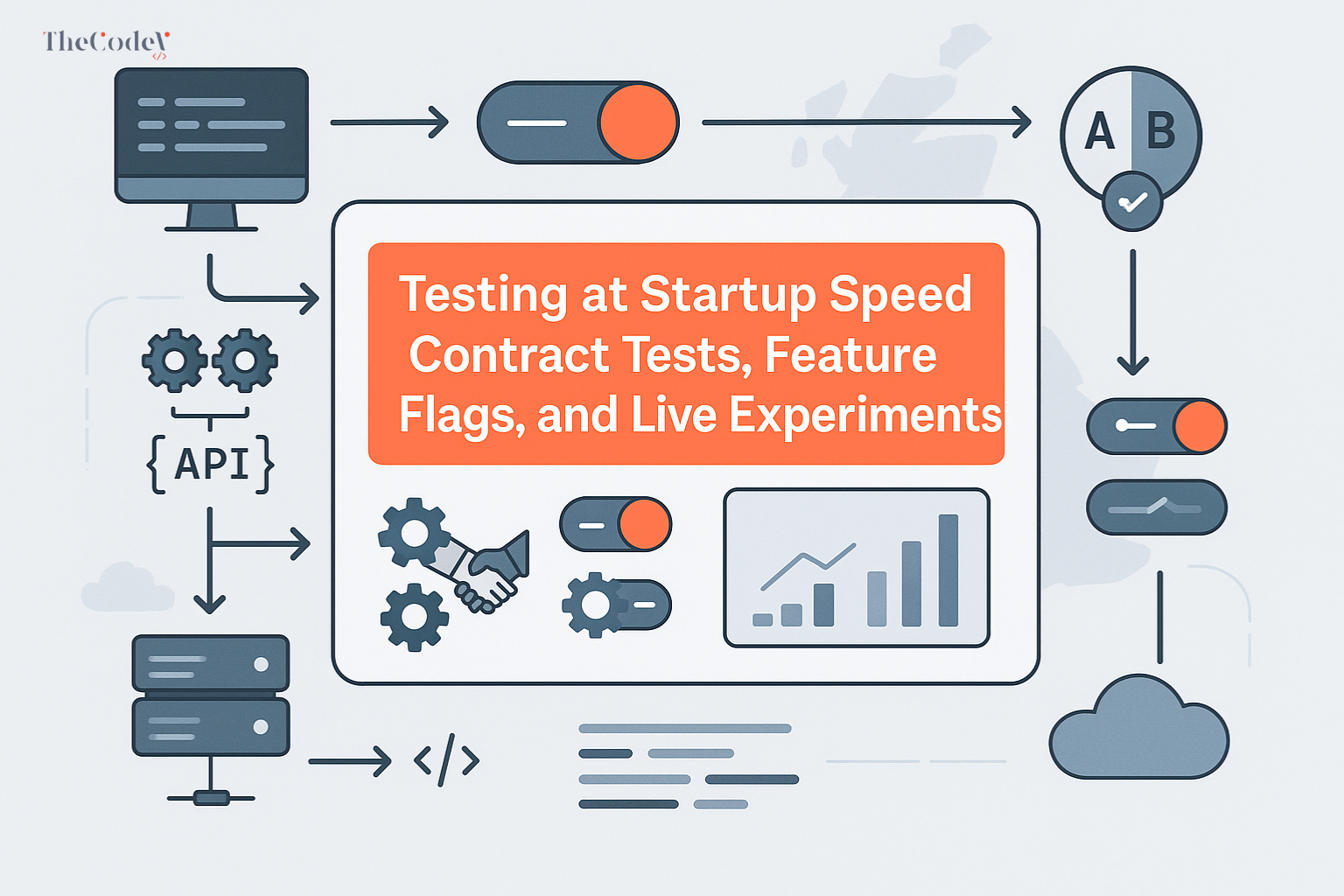
The Reality of Testing at Startup Speed
Startups don’t have the luxury of long test cycles. Products evolve weekly—sometimes daily—and engineering teams must ship features before competitors even know those ideas exist. In this environment, testing becomes a balancing act between speed, reliability, and innovation. When release velocity is high, traditional testing models struggle to keep up.
Modern teams across the UK have turned to flexible testing approaches that allow them to validate code incrementally while keeping users safe. This is where contract tests, live experiments, and especially feature flags step in. Together, they form a toolkit that supports rapid iteration without sacrificing quality.
Why Speed Demands a New Testing Mindset
Fast-moving product teams often discover that the bottleneck isn’t writing code—it’s everything that happens after. Integration checks, regression tests, and environment-specific behaviour quickly slow momentum. UK startups that rely on continuous shipping cycles need testing processes that adapt as quickly as they build.
Feature flags have become a pivotal part of that shift. They allow developers to ship dormant code, expose features to small user groups, and fix mistakes in minutes rather than hours. A well-structured feature flags testing strategy is now central to any modern QA workflow built for speed.
The Role of Feature Flags in the Modern Testing Stack
Feature flags do more than just enable or disable functionality. They give teams full control over how and when new behaviour reaches users. This flexibility supports the “test in production” mindset that many UK tech companies now embrace.
When combined with strong engineering discipline, feature flags achieve:
Fast, safe deployment
Gradual exposure to real users
Instant rollbacks
Controlled A/B experiments
Reduced pressure on release cycles
It’s no surprise that many organisations reference feature flags strategy UK practices when shaping their engineering pipelines. Major platforms like GitHub, Spotify, and Airbnb all use similar approaches to maintain release velocity and user trust.
Startups Face Unique Testing Pressures
UK engineering teams often operate in high-stakes environments. The market expects polished digital experiences, rapid iteration, and near-zero downtime—even from early-stage companies. The demand for continuous improvement places enormous pressure on QA and DevOps teams.
These pressures include:
Short feedback loops
Increasing dependency on microservices
Third-party integrations changing unexpectedly
Limited time for regression testing
Rapidly evolving feature sets
Testing strategies must evolve to match that pace. Tools like contract tests help catch integration failures early. Meanwhile, feature flag management UK practices introduce control and predictability, even when the codebase and customer needs shift fast.
Feature Flags Positioned at the Heart of Agile Testing
Feature flags sit at a powerful intersection between development, testing, and release management. They create a buffer between code deployment and user visibility, allowing teams to test functionality in real environments without risking widespread failure.
Reducing Risk With Controlled Rollouts
A typical UK SaaS team might push several updates a week. Instead of releasing everything to their full user base, they launch features behind flags and expose them only to internal staff, beta testers, or a fraction of their UK user base. This controlled approach reduces risk and increases insight.
Shortening Feedback Loops
Testing in lower environments is helpful, but nothing compares to real-world conditions. Feature flags give teams the confidence to gather feedback from live traffic without compromising the overall experience. This method aligns with practices recommended in industry insights such as the Thoughtworks Technology Radar, Martin Fowler’s writings on continuous delivery, and GitHub’s guidance on modern deployment workflows.
Why the UK Market Leads in Agile Testing Adoption
The UK tech ecosystem, especially London, Manchester, and Leeds, has embraced fast-release engineering more aggressively than many global markets. Local startups often compete with international players, pushing them to adopt efficient, low-risk testing structures early in their lifecycle.
Companies working with TheCodeV routinely request guidance on scalable testing architecture. Many start their journey with small deployments and quickly graduate to complex flag-based systems as product demand grows. Those seeking technical support can explore more about TheCodeV’s solutions via the homepage, services, or digital services pages for deeper insights into their engineering approach.
This shift shows a market that understands speed alone isn’t enough—quality must scale with it. And modern testing methods, powered by contract tests, smarter automation, and feature flag frameworks, make that possible.
Contract Testing: The Quiet Powerhouse Behind High-Velocity Engineering
Rapid development cycles can push even the strongest engineering teams to their limits. While feature flags, fast deployments, and continuous delivery enable speed, they also introduce a silent risk: broken integrations. In fast-moving UK software companies—where microservices, external APIs, and distributed systems dominate—contract testing has become one of the most reliable ways to maintain stability without slowing momentum.
Contract testing helps teams verify that services communicate correctly, even when they evolve independently. Instead of relying solely on end-to-end testing, teams use lightweight agreements (contracts) that guarantee compatibility between consumers and providers. It’s the missing link that keeps systems predictable while development accelerates.
Why Contract Testing Matters for UK Startups Under Pressure
UK startups often work with complex digital ecosystems. Payment processors, internal microservices, analytics tools, and legacy APIs all interact behind the scenes. A single breaking change can take down an entire product, especially during rapid rollouts.
Contract tests minimise this risk by validating assumptions early. They ensure that:
APIs remain backward compatible
Data formats match expected structures
Consumer expectations stay aligned with provider behaviour
Changes don’t break downstream services
This shift from reactive debugging to proactive validation allows UK engineering teams to ship faster with significantly fewer surprises. Many UK teams adopt contract testing while refining approaches such as feature flag testing UK, especially when toggles change behaviour across services.
Contract Testing and Rapid Deployment Work Hand-In-Hand
Continuous delivery creates intense pressure on integration points. When teams release code several times a week—or even daily—they cannot afford regressions caused by mismatched API behaviour.
Contract testing strengthens these pipelines by ensuring:
Providers know exactly what consumers rely on
Consumers test functionality without needing the full system
Deployments become safer and more predictable
Rollbacks become less common
Increased confidence when toggling features on or off
This is particularly important in environments where feature flags continuous delivery UK practices are already in place. Feature flags may expose or hide behaviour dynamically, and contract tests confirm that those behaviours follow agreed rules across the system.
How Contract Testing Supports Feature Flags and Staged Rollouts
A feature flag can change the shape or flow of data instantly. When teams activate a new flag that modifies payloads, workflows, or validation rules, they must ensure the surrounding services understand the new behaviour.
Contract tests play a crucial role in:
Validating Toggle-Driven Behaviour
Each flag-controlled path can generate different payload structures. Contract tests help verify that:
Old contracts still pass for users on the classic path
New contracts work for users exposed to the experimental path
Both versions remain compatible during gradual rollouts
This dual validation is essential when leveraging feature flags quality assurance UK strategies, especially for complex systems.
Supporting Staged Rollouts at Scale
When teams introduce a new feature behind a flag, it often starts with:
Internal users
Beta users
A small external segment
Gradual rollout to the entire UK user base
Contract testing ensures that each stage maintains stability. Providers know that consumer expectations remain met throughout the rollout, even when two feature versions run simultaneously.
Tools That Bring Contract Testing to Life
Contract testing has evolved rapidly, and today’s tools make it accessible even for early-stage teams.
Pact and Consumer-Driven Contracts
Pact is one of the most widely adopted frameworks for consumer-driven contract testing. It allows each consumer to define its expectations in a pact file. The provider then verifies these expectations during its own build.
(Pact documentation: https://docs.pact.io)
OpenAPI-Based Contracts
Teams using REST APIs often rely on OpenAPI specifications. These API definitions serve as shared contracts, enabling automatic checks across consumer and provider builds.
Tools from Redgate and JetBrains support automated validation and schema consistency checks at scale.
Contract Verification in CI Pipelines
Modern CI/CD tools integrate contract testing as a first-class citizen. GitHub Actions, GitLab CI, and CircleCI all support Pact-based workflows, ensuring contract validation happens before code reaches production.
How TheCodeV Supports Scalable Testing Architectures
Teams across the UK often need help designing a contract testing approach that works alongside their feature flag rollouts, deployment pipelines, and microservices. Many lean on TheCodeV’s technical expertise to structure robust automation that doesn’t slow product delivery.
Readers can learn more about TheCodeV’s engineering and QA methodologies through the homepage and digital services pages.
Contract testing is a subtle but transformative tool. When combined with feature toggles, continuous delivery, and modern deployment strategies, it becomes the backbone of reliable, high-speed software development.
Designing a Scalable Feature Flags Testing Strategy
Feature flags don’t just change how features are released—they change how teams test entirely. Instead of waiting for a full deployment cycle, developers can validate behaviour in isolation, expose new code paths to select users, and roll back instantly when something misbehaves. This shift demands a mature feature flags testing strategy that blends engineering discipline with flexible release orchestration.
A strong strategy ensures teams ship faster while keeping risk under control. It creates predictable environments in fast-moving UK software teams, even when multiple versions of a feature run simultaneously.
Why a Feature Flags Testing Strategy Matters
A well-engineered feature flags testing strategy sits at the centre of modern testing architecture. Without it, flags can introduce inconsistency, confusion, and brittle test flows. With it, they become a powerful safety net for product teams working at startup speed.
UK engineering teams adopt flags not just for releases, but to enable safer experimentation, QA-friendly workflows, and decoupled deployments. This is why many product and DevOps teams invest early in formalising their approach—especially when adopting a feature toggle testing strategy UK model.
Enabling Predictable Pre-Production Testing
Every feature flags testing strategy starts before code reaches production. Pre-production flows must verify:
Classic behaviour with flags off
New behaviour with flags on
Mixed states when flags apply to different user groups
Advanced pipelines include feature flags automated testing UK practices, where integration tests, unit tests, and service-level contracts all run against multiple flag states. CircleCI’s rollout guides and Google’s SRE best practices highlight how multi-state testing reduces uncertainty before deployment.
(External references: LaunchDarkly Blog; CircleCI Deployment Patterns; Google SRE Handbook.)
Staged Rollouts Backed by Strong Testing Logic
Once pre-production testing confirms stability, staged rollouts begin. This is where a thoughtful feature flags testing strategy becomes critical.
Canary Testing With Feature Flags
Canary testing introduces a new feature to a small percentage of users. It’s a safer alternative to big-bang releases. A strong testing strategy defines:
Canary metrics to monitor
Time windows for traffic exposure
Automated rollback triggers
Observability hooks for real-time feedback
Many UK SaaS teams follow feature flags release management UK practices, gradually increasing exposure while monitoring performance, conversion, and crash rates.
Multi-Stage Rollouts for UK Market Variations
A common UK-specific pattern is rolling out features in tiers:
Internal teams
Staging/beta testers
1–5% of UK users
25% of the user base
Full release
This approach reduces risk while enabling rapid learning cycles. Each stage aligns with formal feature flags best practices UK, ensuring the feature behaves as expected before scaling.
Kill-Switch Design as a Safety Net
No feature flags testing strategy is complete without reliable kill-switch design. A kill-switch is a high-priority flag that immediately disables functionality without requiring a redeploy.
A good kill-switch must:
Be globally accessible
Override all other flags
Trigger alerting when activated
Restore the system to a stable state instantly
Google’s SRE guidance emphasises immediate mitigation as a defining factor of operational excellence, and kill-switches embody that principle.
Maintaining Test Isolation in a Flag-Heavy System
Test isolation becomes increasingly important as teams adopt dozens—or sometimes hundreds—of flags. Poor isolation leads to inconsistent tests and unpredictable behaviour.
A mature feature flags testing strategy incorporates:
Environment-specific defaults
Test data that aligns with both old and new paths
Automation ensuring flags don’t “bleed” across tests
Guardrails for removing stale flags early
Many UK engineering teams combine contract tests with flag-aware integration tests to maintain clarity.
Building a Strategy That Scales With Your Product
A scalable approach blends automation, controlled exposure, and clear operational guidelines. For UK teams, a strong feature flags testing strategy often becomes the foundation of continuous delivery and safe experimentation. It protects velocity while offering fine-grained control over rollout behaviour.
Those exploring mature engineering models can learn more about TheCodeV’s technical approach through the homepage, services, and contact pages, where TheCodeV outlines how modern DevOps and release management underpin successful digital products.
Feature flags reshape how software is built, tested, and released. With a structured strategy, teams transform them from simple toggles into a sophisticated framework for reliable, high-speed innovation.
Designing a Scalable Feature Flags Testing Strategy
Feature flags don’t just change how features are released—they change how teams test entirely. Instead of waiting for a full deployment cycle, developers can validate behaviour in isolation, expose new code paths to select users, and roll back instantly when something misbehaves. This shift demands a mature feature flags testing strategy that blends engineering discipline with flexible release orchestration.
A strong strategy ensures teams ship faster while keeping risk under control. It creates predictable environments in fast-moving UK software teams, even when multiple versions of a feature run simultaneously.
Why a Feature Flags Testing Strategy Matters
A well-engineered feature flags testing strategy sits at the centre of modern testing architecture. Without it, flags can introduce inconsistency, confusion, and brittle test flows. With it, they become a powerful safety net for product teams working at startup speed.
UK engineering teams adopt flags not just for releases, but to enable safer experimentation, QA-friendly workflows, and decoupled deployments. This is why many product and DevOps teams invest early in formalising their approach—especially when adopting a feature toggle testing strategy UK model.
Enabling Predictable Pre-Production Testing
Every feature flags testing strategy starts before code reaches production. Pre-production flows must verify:
Classic behaviour with flags off
New behaviour with flags on
Mixed states when flags apply to different user groups
Advanced pipelines include feature flags automated testing UK practices, where integration tests, unit tests, and service-level contracts all run against multiple flag states. CircleCI’s rollout guides and Google’s SRE best practices highlight how multi-state testing reduces uncertainty before deployment.
(External references: LaunchDarkly Blog; CircleCI Deployment Patterns; Google SRE Handbook.)
Staged Rollouts Backed by Strong Testing Logic
Once pre-production testing confirms stability, staged rollouts begin. This is where a thoughtful feature flags testing strategy becomes critical.
Canary Testing With Feature Flags
Canary testing introduces a new feature to a small percentage of users. It’s a safer alternative to big-bang releases. A strong testing strategy defines:
Canary metrics to monitor
Time windows for traffic exposure
Automated rollback triggers
Observability hooks for real-time feedback
Many UK SaaS teams follow feature flags release management UK practices, gradually increasing exposure while monitoring performance, conversion, and crash rates.
Multi-Stage Rollouts for UK Market Variations
A common UK-specific pattern is rolling out features in tiers:
Internal teams
Staging/beta testers
1–5% of UK users
25% of the user base
Full release
This approach reduces risk while enabling rapid learning cycles. Each stage aligns with formal feature flags best practices UK, ensuring the feature behaves as expected before scaling.
Kill-Switch Design as a Safety Net
No feature flags testing strategy is complete without reliable kill-switch design. A kill-switch is a high-priority flag that immediately disables functionality without requiring a redeploy.
A good kill-switch must:
Be globally accessible
Override all other flags
Trigger alerting when activated
Restore the system to a stable state instantly
Google’s SRE guidance emphasises immediate mitigation as a defining factor of operational excellence, and kill-switches embody that principle.
Maintaining Test Isolation in a Flag-Heavy System
Test isolation becomes increasingly important as teams adopt dozens—or sometimes hundreds—of flags. Poor isolation leads to inconsistent tests and unpredictable behaviour.
A mature feature flags testing strategy incorporates:
Environment-specific defaults
Test data that aligns with both old and new paths
Automation ensuring flags don’t “bleed” across tests
Guardrails for removing stale flags early
Many UK engineering teams combine contract tests with flag-aware integration tests to maintain clarity.
Building a Strategy That Scales With Your Product
A scalable approach blends automation, controlled exposure, and clear operational guidelines. For UK teams, a strong feature flags testing strategy often becomes the foundation of continuous delivery and safe experimentation. It protects velocity while offering fine-grained control over rollout behaviour.
Those exploring mature engineering models can learn more about TheCodeV’s technical approach through the homepage, services, and contact pages, where TheCodeV outlines how modern DevOps and release management underpin successful digital products.
Feature flags reshape how software is built, tested, and released. With a structured strategy, teams transform them from simple toggles into a sophisticated framework for reliable, high-speed innovation.
Feature Flag Governance: The Discipline Behind Safe Rollouts
Feature flags introduce agility, but without proper governance they can quickly become a source of confusion, instability, and hidden technical debt. Many UK companies adopt flags to accelerate deployment, yet struggle to manage them responsibly over time. Strong governance ensures that each flag has a defined purpose, clear ownership, and an agreed retirement plan. Without this discipline, development speed slows, testing becomes unpredictable, and product behaviour fragments across environments.
Governance transforms feature flags from temporary fixes into reliable tools that support sustainable growth.
Why Governance Matters for UK Engineering Teams
The UK tech landscape is fast, competitive, and experimentation-heavy. Teams release new functionality weekly, sometimes daily. As a result, dozens of flags accumulate across codebases, each controlling different behaviours for different user segments. A lack of structure often leads to inconsistent flag usage, forgotten toggles, and misalignment between product and QA teams.
This is where feature flag governance UK practices become essential. Governance frameworks ensure that:
Every flag has an owner
Each flag’s purpose is documented
Removal timelines are approved
Behaviour is consistent across environments
Flags don’t become unmanageable technical debt
Tools like LaunchDarkly and Atlassian highlight governance as a key maturity marker for organisations using flag-driven release models.
Managing the Technical Debt of Long-Lived Flags
Flags are meant to be temporary. When they linger, they create branching logic that complicates the entire system. Long-lived flags are one of the biggest risks UK teams face when scaling their flag usage. They introduce:
Bloated code paths
Confusing outdated logic
Increased QA effort
Harder onboarding for new engineers
Reduced developer confidence
Academic studies on software quality, including work published through ACM Digital Library, show that unmanaged toggles degrade stability over time.
A sustainable model ensures flags are categorised, monitored, and retired promptly. UK teams that adopt structured retirement workflows often combine this with feature flag rollout UK processes, ensuring that a feature is fully validated before the flag is removed.
Quality Assurance Workflows Built Around Flag States
Modern QA teams must validate not just one version of a feature, but multiple states: flag on, flag off, and any staged rollout states. This expands the testing matrix significantly.
This is why feature flags quality assurance UK approaches prioritise:
Multi-state automated tests
Clear documentation of expected behaviour
QA sign-off for both legacy and experimental paths
Observability tools tied to flag states
LaunchDarkly and Thoughtworks stress the importance of testing flag-driven behaviour as separate test cases. When QA teams receive unclear instructions—or when flags aren’t labelled properly—bugs slip through environments easily.
The best UK teams solve this with shared dashboards, flag naming conventions, and dedicated QA workflows aligned with engineering sprints.
Aligning Product, Engineering, and QA Around Flag Behaviour
Feature flags affect more than just developers. They change how product managers plan experiments, how QA structures their test cases, and how engineering teams deploy and monitor features.
When alignment is weak, the consequences appear quickly:
Features activated at the wrong time
Miscommunication about rollout stages
Inconsistent behaviour across user segments
Increased pressure on support and operations teams
Strong cross-team alignment is a key pillar of feature flag governance UK frameworks. UK organisations that succeed with flag-driven development often hold short planning sessions where product, engineering, and QA agree on:
Rollout schedules
Success metrics
Test coverage
Kill-switch rules
Retirement dates
Atlassian’s engineering playbooks recommend this cross-functional clarity as a foundation of healthy release management.
Why UK Teams Struggle With Lifecycle Management
Many UK teams embrace rapid experimentation but lack processes to manage the increasing number of flags. Common challenges include:
No ownership assigned to flags
Poor documentation
Unclear deprecation timelines
Flags left active long after release
Inconsistent naming conventions
TheCodeV regularly observes these issues in rescue projects across the UK, where ungoverned flags create operational risk. Governance turns these risks into a structured workflow that supports clarity and stability.
To explore how modern engineering teams overcome these issues at scale, readers can visit TheCodeV’s homepage or learn more through the digital services page, where technical discipline and sustainable engineering practices are key priorities.
Feature Toggles as the Backbone of Continuous Delivery
Continuous delivery has become the standard for modern UK development teams aiming to release faster without compromising reliability. Feature toggles make this possible. They separate deployment from release, giving engineers freedom to push code early, test behaviour safely, and control exposure at scale. In fast-paced environments, toggles eliminate the risky “big bang” release and replace it with predictable, incremental rollout.
For UK teams embracing cloud-native development, microservices, and rapid experimentation, feature toggles are not just helpful—they’re essential.
Enabling Continuous Delivery in UK Engineering Teams
A well-structured toggle system empowers teams to ship updates multiple times a day. This supports the growing adoption of feature flags continuous delivery UK practices, where stability and speed coexist.
Toggles help teams:
Deploy unfinished code without exposing it
Run A/B experiments with minimal risk
Release features gradually to real UK traffic
Validate production behaviour safely
Reduce the need for emergency rollbacks
This flexibility is vital for SaaS companies competing in London, Manchester, and Edinburgh, where iteration speed is tightly linked to market success.
H3: Reducing Release Bottlenecks
Continuous delivery often stalls when teams wait for full QA cycles or stakeholder approval. Feature toggles remove these blockers. Teams can deploy code behind flags, test it internally, and enable it only when ready.
This allows developers, QA, and product managers to work asynchronously, improving release velocity and lowering deployment stress.
Automated Testing Pipelines for Flag-Driven Code
Testing becomes more complex when software must behave correctly across multiple flag states: on, off, staged, or partially enabled. This is where automated testing pipelines shine.
Modern UK DevOps teams use automation to test every possible configuration. Frameworks trigger tests for:
Unit-level behaviour under multiple flag states
Integration tests for new and legacy paths
Contract tests for API compatibility
End-to-end scenarios reflecting real-world rollouts
These pipelines often run on GitHub Actions, GitLab CI, or CircleCI.
(External references: GitHub Actions documentation; AWS DevOps Blog; Google Testing Blog.)
By incorporating flag-aware test suites, teams gain confidence that both old and new behaviours remain stable throughout feature evolution.
Ensuring Reliable Flag-Specific Coverage
Without automation, flag-heavy codebases quickly become unpredictable. Automated pipelines enforce consistency by:
Running parallel tests with flags toggled
Preventing regressions between flag states
Keeping deployment pipelines green even as complexity grows
This structured approach keeps releases smooth and predictable, especially for large-scale UK platforms.
Integrating Feature Flags With DevOps and GitOps
Feature toggles align perfectly with DevOps culture. They support frequent deployments, automated checks, and a shared responsibility model. UK DevOps teams increasingly rely on toggles to ensure deployments remain low-risk.
How Flags Fit Into GitOps
GitOps workflows rely on declarative configurations stored in version control. Feature flags enhance this by enabling configuration-based releases, where:
Flag states live in Git or a dedicated flag system
Rollout decisions become part of infrastructure-as-code
Environment changes are audited and reversible
Deployment becomes traceable and transparent
For teams adopting a feature flags dev-ops UK approach, GitOps and toggles reinforce each other. They bring discipline, accountability, and observability to every rollout.
Feature Flag Deployment Across Environments
Feature toggles must work consistently across every environment—from development to production.
A typical flow looks like this:
Development
Engineers build new logic behind flags to keep unfinished code hidden.Staging / Pre-Production
QA validates behaviour with flags on, off, and in hybrid states.Production Internal Testing
Teams enable the feature for internal users or specific IP ranges.Partial Rollout (Canary)
New behaviour reaches a small percentage of UK users first.Full Flag Activation
The feature is fully released, followed by flag retirement.
This staged model forms the backbone of mature feature flag deployment UK strategies.
Building a Culture of Safe, Fast Delivery
Toggles don’t just change how code is released—they change how teams think. They help UK organisations move from rigid release cycles to adaptive, safer deployment pipelines. This evolution is central to high-performing DevOps environments.
Teams exploring modern delivery frameworks can learn more about TheCodeV’s engineering expertise through the services page or connect via the contact page.
Live Experiments and Data-Driven Rollouts With Feature Flags
Feature flags have unlocked a new era of evidence-driven product development. Instead of assuming what users want, UK engineering teams can run live experiments, measure real behaviour, and deploy features confidently. This experimentation-led approach reduces risk, improves user satisfaction, and ensures each release aligns with genuine customer needs.
Live experiments aren’t just about shipping faster—they’re about learning faster. When combined with smart rollout patterns, feature flags support precise testing in real environments without jeopardising stability.
A/B Testing Powered by Feature Flags
Feature flags make A/B testing far more flexible than traditional experimentation frameworks. Teams can toggle features on for specific user groups, compare responses between versions, and make decisions based on reliable data rather than assumptions.
This is why many teams embrace feature flags A/B testing UK methods. Instead of maintaining two separate deployments, flags let developers run two variants from the same codebase. It simplifies both engineering and QA while improving experiment accuracy.
Faster Experimentation With Lower Overhead
A/B testing becomes practical even for smaller teams because flags handle:
Segmentation (e.g., region, device type, membership level)
Variant switching
Controlled exposure percentages
Real-time activation and rollback
Marketing, product, and engineering teams gain shared access to experiment results. This cross-functional visibility allows data-driven decisions without waiting for long release cycles.
External sources such as the LaunchDarkly documentation, Optimizely blog, and Google Developers experimentation guidelines highlight the importance of this flexible approach.
Controlled User Exposure Through Percentage Rollouts
Percentage rollouts allow teams to expose new functionality to a defined share of users. Instead of flipping a switch for everyone, they slowly increase traffic while monitoring real behaviour.
A standard rollout model follows stages like:
1% Exposure – Detect early issues using low-risk traffic.
5% Exposure – Validate performance under a wider sample.
25% Exposure – Analyse engagement and conversion.
50% Exposure – Observe stability at scale.
100% Exposure – Full rollout with confidence.
This staggered approach aligns with feature flags A/B testing and QA strategy UK market expectations, especially in competitive industries like finance, e-commerce, and healthcare.
Monitoring Key Signals During Rollouts
Teams track:
Error rates
Performance metrics
Conversion patterns
Funnel drop-offs
User complaints or spikes in support tickets
This data confirms whether the new feature improves the product or introduces friction. If issues appear, teams can roll the feature back instantly—one of the biggest advantages of flag-controlled experiments.
Real UK Examples of Data-Driven Feature Toggle Testing
UK digital brands frequently rely on feature toggles to validate product changes without destabilising the experience for millions of users.
Some examples include:
Fintech platforms (London) testing new payment flows behind flags to ensure compliance with FCA guidelines.
E-commerce brands (Manchester) trialling new checkout designs with 10% of users before a wider launch.
Healthcare SaaS platforms (Leeds) using flags to separate experimental user journeys from NHS-compliant defaults.
These scenarios demonstrate how a feature toggle testing strategy for UK dev teams requires both technical rigour and regulatory awareness.
Meeting UK Compliance and Data Privacy Standards
When experimenting with real users, UK teams must respect:
GDPR rules
FCA or NHS-specific guidelines
Accessibility standards
User consent expectations
Feature flags help align with these rules by enabling:
Precise audience targeting
Isolation of high-risk functionality
Clear rollback and audit trails
Experimentation without exposing sensitive workflows
External references, such as the UK Information Commissioner’s Office (ICO) guidelines and Google’s Responsible AI experimentation documentation, reinforce the importance of regulatory alignment.
Strengthening QA Through Data-Driven Testing
QA teams play a critical role in verifying both variants of an experiment. They focus on:
Behaviour parity across flag states
Performance differences between A and B variants
User segmentation accuracy
Consistency across browsers, devices, and regions
Feature-driven experimentation overlaps QA, engineering, and product strategy. It encourages teams to collaborate early, share insights, and validate assumptions before committing to large-scale releases.
Integrating Experiments Into TheCodeV’s Delivery Approach
Live experimentation is a core component of high-performing UK teams. It enhances decision-making, reduces risk, and turns the rollout process into a continuous learning cycle.
TheCodeV helps organisations adopt these practices by aligning experimentation frameworks with modern DevOps and product delivery. To learn more about how these approaches fit into broader engineering workflows, readers can explore the services and contact pages, where the company outlines its development and testing methodologies grounded in real-world experimentation and release control.
A Modern Testing Framework for High-Velocity Engineering
Testing at startup speed isn’t about cutting corners. It’s about building structures that keep pace with ambitious ideas. Over the course of this article, we explored the three pillars that now define high-performing engineering teams in the UK and beyond: contract tests that protect integrations, feature flags that enable safe and flexible releases, and live experiments that validate decisions with real data. Together, they create a robust and adaptive testing ecosystem—one that supports rapid delivery without compromising reliability.
Contract testing prevents surprises between microservices and APIs, ensuring teams move quickly without introducing integration failures. Feature flags sit at the heart of modern release workflows, enabling controlled exposure, instant rollback, and parallel behaviour validation. Live experiments turn real user behaviour into actionable evidence, helping teams make confident decisions backed by analytics. Each pillar plays its part, but it’s the combination that powers truly sustainable speed.
The Power of a Strong Feature Flags Testing Strategy
If there’s one theme that emerged across every section, it’s the central role of a well-designed feature flags testing strategy. Without clear governance, disciplined removal, automated test coverage, and structured rollout workflows, flags can introduce chaos rather than control. But with the right approach, they transform development into a predictable, data-driven process.
This strategy becomes even more important for global teams working across time zones, multiple codebases, and varied compliance requirements. Whether you’re deploying at scale in the UK, Europe, the Middle East, or North America, feature flags provide a universal safety net—making deployment safer, experimentation smarter, and product quality higher.
EmporionSoft, another respected name in the engineering space, embraces similar modern testing patterns—showing just how widespread and essential these practices have become across top-tier development environments.
Why UK Companies Need a Unified Approach Across Product, QA, and Engineering
UK companies often face unique pressures: fierce competition, user expectations shaped by global platforms, and evolving digital regulatory requirements. Testing models must accommodate this complexity. That means creating deeper alignment across product teams, engineering groups, and QA specialists. Feature flags, contract tests, and experiments only reach their full potential when all teams understand how they interact.
External research—such as Thoughtworks Technology Radar and Google’s DORA reports—continues to emphasise that the highest-performing organisations aren’t just fast. They’re structured. They’re disciplined. And they build testing frameworks that evolve alongside their products.
How TheCodeV Helps Teams Achieve High-Performance Engineering
TheCodeV has supported startups, enterprises, and global product teams across industries—from fintech to logistics, media, retail, and emerging AI applications. Whether a company needs a fully automated testing pipeline, feature flag rollout workflows, GitOps integration, or a complete DevOps transformation, TheCodeV brings practical, engineering-led expertise shaped by real-world challenges.
The team at TheCodeV understands that every business has its own rhythm. Some move quickly and break barriers; others scale carefully in regulated environments. The goal is the same: empower teams to deploy confidently, test intelligently, and learn continuously.
To explore how TheCodeV can support your next digital product or engineering overhaul, visit the homepage, review the full range of services, or reach out directly through the contact page.
Your Next Step Toward Smarter, Safer, Faster Development
If your organisation is ready to push past slow release cycles, inconsistent testing, or unpredictable deployments, now is the perfect moment to modernise your engineering foundations. Adopt contract tests to secure your integrations. Embrace feature flags for safe, flexible rollouts. Use live experiments to validate your ideas with confidence.
The teams that master these practices become the teams that innovate faster, reduce operational risk, and deliver the kinds of digital experiences users genuinely love.
TheCodeV is here to help you build that future. Whether you need DevOps architecture, a high-performance testing pipeline, or a complete digital product build, our engineers will help you move with clarity, confidence, and speed. Reach out today and take the first step toward building software the modern way—smarter, safer, and ready for scale.