The New Growth Dilemma: Why Sales-Led Alone No Longer Works
In the world of B2B SaaS, the ground is shifting fast. What once drove revenue—long sales cycles, account executives, and polished demos—is now being overtaken by something more direct, scalable, and data-driven: Product-Led Growth (PLG) for B2B startups. Buyers have changed. They want to experience the value before signing a contract, and no amount of outbound sales can replace a product that sells itself through real user impact.
Traditional sales-led growth models still have their place, but they’re no longer enough. In an era where software users are also decision-makers, PLG is rewriting the rulebook for how SaaS companies attract, convert, and retain customers.
For ambitious B2B startups looking to scale intelligently, mastering this transition has become a critical differentiator—and at TheCodeV, we help companies architect this hybrid future through product experience, automation, and customer intelligence.
Understanding the Shift from Sales-Led to Product-Led
Sales-led growth was once the undisputed champion of SaaS success. It relied on skilled sales teams, structured demos, and personal relationships to convert enterprise buyers. The strength of this model lies in its relationship depth, ability to tailor pricing, and control over the sales narrative.
But it also carries significant drawbacks: high Customer Acquisition Costs (CAC), slower time-to-value, and dependence on human scalability. As customer behaviour evolved—especially in the wake of the self-serve economy—these weaknesses became harder to ignore.
Product-led growth, by contrast, flips the funnel. Instead of pushing prospects through calls and proposals, PLG lets the product itself drive adoption. Users onboard themselves, discover value through hands-on use, and organically expand into paid tiers. It’s faster, leaner, and often more authentic. According to OpenView Partners, top-performing PLG companies grow nearly twice as fast as their sales-led counterparts while maintaining healthier margins.
The Pros and Cons of Each Approach
| Approach | Strengths | Limitations |
|---|---|---|
| Sales-Led Growth | Deep enterprise relationships, high-touch support, flexibility in pricing | Expensive CAC, long deal cycles, limited scalability |
| Product-Led Growth | Self-serve scalability, viral adoption, data-driven feedback loops | Requires strong product UX, higher upfront tech investment, less control over pricing dialogue |
The takeaway? Neither model works perfectly in isolation. The most resilient B2B startups today are merging the two—building hybrid growth systems that combine product-led activation with sales-led nurturing.
At TheCodeV’s Services page, our consultants design and implement such systems for SaaS founders who want to scale faster without losing the human element.
Why Hybrid Growth is the Future
In reality, the future of SaaS growth is not a competition between PLG and sales—it’s a collaboration. Sales teams still play a crucial role in converting enterprise clients, but they now rely heavily on product signals to identify ready-to-buy accounts.
Meanwhile, the product itself is the growth engine—gathering behavioural data, simplifying onboarding, and continuously delivering value that justifies expansion. As ForEntrepreneurs.com notes, modern SaaS success depends on “creating systems where every touchpoint—from trial to upsell—is optimised around product value.”
In short, PLG for B2B startups isn’t just a trend; it’s a survival strategy. And those who adapt early—aligning marketing, sales, and product into one cohesive growth motion—will define the next decade of SaaS leadership.
Understanding Product-Led Growth (PLG) for B2B Startups
In the simplest terms, Product-Led Growth (PLG) is about letting your product do the selling. Instead of relying on long sales calls or heavy outbound tactics, companies using this model design every aspect of their software—from onboarding to upgrades—to deliver instant, self-evident value. For B2B SaaS startups, this means growth is driven not by persuasion but by product experience.
The idea is straightforward yet revolutionary: when users see value early and effortlessly, they’re more likely to convert, expand, and advocate. That’s why PLG for B2B startups is becoming the blueprint for sustainable, cost-efficient growth in a competitive SaaS market.
What Defines the PLG SaaS Model
In a PLG SaaS model, the product itself becomes the core of your acquisition funnel. Users sign up, explore, and adopt features without needing to talk to sales reps. The experience is seamless, intuitive, and often personalised. This approach thrives on transparency—allowing potential customers to test-drive the software before making a commitment.
Unlike traditional marketing or outbound sales, product-led marketing focuses on showcasing in-product value rather than promises. It combines data analytics, behavioural insights, and in-app communication to nurture leads. For example, when a user hits a milestone in a free trial, an automated prompt might guide them toward upgrading—right at the moment of peak engagement.
This model empowers startups to scale faster because it naturally builds trust and credibility. As ProductLed.com notes, successful PLG companies grow by “turning product usage into their strongest marketing channel,” effectively making every active user a promoter.
How User Experience Drives Acquisition and Retention
The success of PLG depends heavily on user experience (UX). When a platform is intuitive, visually clear, and friction-free, users become self-sufficient and emotionally invested. That’s why PLG for B2B startups often starts with obsessive focus on UX design and product analytics.
Take Slack, Notion, and Zoom—three SaaS giants that scaled globally with minimal traditional marketing spend. Slack’s onboarding invites users into immediate collaboration; Notion’s templates provide instant structure; Zoom’s one-click meeting entry eliminates setup friction. Each one removes barriers to value, turning first-time users into loyal customers.
B2B startups following this path often integrate free trials, freemium tiers, and guided onboarding flows. These touchpoints help users realise value without risk, accelerating both activation and retention.
If you’re a SaaS business seeking to elevate user experience and drive adoption, TheCodeV’s Digital Services can help you design intuitive, growth-optimised product journeys that align with the PLG SaaS model.
Free Trials, Freemium Tiers, and Frictionless Onboarding
The beauty of PLG lies in its simplicity—users get to try before they buy. Free trials and freemium models remove hesitation and let users engage deeply with your product’s value. In fact, according to a recent HubSpot report, over 75% of SaaS companies using freemium strategies see faster conversion cycles and lower churn rates.
Frictionless onboarding plays a key role here. Whether through in-app tooltips, AI-powered assistants, or contextual tutorials, startups are finding creative ways to make the first interaction memorable. The smoother that experience, the higher the chance of conversion.
At TheCodeV, our Ecommerce SEO and product optimisation teams work with SaaS founders to ensure their product visibility and onboarding journeys are aligned—because visibility brings users in, but experience keeps them there.
The Case for Hybrid Growth: Blending PLG and Sales-Led Motions
The strongest SaaS companies in 2025 are no longer choosing between Product-Led Growth (PLG) and traditional sales-led models—they’re combining them. This new hybrid growth model merges the scalability of PLG with the strategic relationship-building of enterprise sales, creating a flywheel that serves both self-serve users and high-value corporate clients.
In a landscape where buying behaviour varies widely—from small startups testing freemium tools to Fortune 500 teams requiring procurement negotiations—a one-size-fits-all approach no longer works. The hybrid model allows companies to tailor their engagement while maintaining efficiency and consistency.
How Hybrid Growth Works in Practice
At its core, a hybrid product-led sales process begins with a self-service entry point—typically a free trial or freemium version—and matures into a high-touch engagement once product usage signals intent. This means sales teams no longer chase cold leads; instead, they focus on users already experiencing value.
This balance reduces friction for both sides. The product does the early nurturing, while the sales team steps in only when expansion potential becomes clear. As OpenView Venture Partners notes, “Sales should amplify, not initiate, product engagement.”
For B2B SaaS startups, this dual-track system results in a more predictable B2B SaaS growth strategy—where CAC (Customer Acquisition Cost) falls due to organic adoption, and LTV (Lifetime Value) rises through personalised enterprise upselling.
Real-World Examples: Figma and Atlassian
Figma is a textbook example of hybrid growth done right. It started with a freemium PLG motion, letting designers collaborate instantly online. Once usage data revealed entire teams adopting it, Figma’s sales force began reaching out to standardise licensing across organisations. The result? Massive enterprise contracts built on a foundation of self-discovered value.
Similarly, Atlassian—creator of Jira and Confluence—famously scaled to billions without a traditional outbound sales force. Its product-led motion drove awareness and initial adoption, while strategic account managers later secured enterprise expansions. Gainsight’s research highlights how this model “bridges customer experience and revenue growth,” making it one of the most sustainable paths for long-term retention.
These companies didn’t abandon sales—they redefined it. In their systems, PLG identifies opportunities, and sales formalises relationships. It’s efficiency and empathy working hand-in-hand.
Why the Hybrid Model Wins
When executed well, hybrid growth dramatically lowers CAC because users self-onboard through the product, minimising marketing and demo costs. At the same time, LTV increases as satisfied users invite teams, upgrade plans, and eventually engage in larger enterprise deals.
Moreover, it closes the gap between marketing, product, and sales—unifying them under a single data-driven narrative. Every product click, feature activation, and session time becomes a conversation starter for expansion.
At TheCodeV, we help SaaS companies build intelligent systems that connect user behaviour analytics with sales workflows, ensuring no opportunity slips through. If you’re ready to create a future-proof B2B SaaS growth strategy, our team is always within reach at the Contact page.
Core Components of a Successful PLG Framework
A thriving Product-Led Growth (PLG) framework isn’t built on luck—it’s engineered with precision. Every successful B2B SaaS growth strategy relies on four critical pillars: seamless onboarding, data-informed analytics, usage-driven upsells, and continuous feedback loops. Together, these components form the foundation of a product that doesn’t just attract users but keeps them engaged and expanding naturally.
Below is a deep dive into each layer of a modern PLG framework—how it works, why it matters, and what the best-performing SaaS companies are doing differently.
Seamless Onboarding and Activation
In PLG, first impressions define conversion. Users decide within minutes whether your product solves their problem or not. That’s why seamless onboarding and SaaS user activation are the most critical stages in the customer journey.
Effective onboarding removes cognitive friction. It helps users find value quickly through guided flows, tooltips, or interactive walkthroughs. A great example is Notion, which uses pre-built templates to show immediate productivity benefits—no setup required. Similarly, Canva’s step-by-step first-use tutorial turns beginners into confident users within minutes.
Data from Amplitude’s 2024 PLG Report shows that companies optimising onboarding experience see 40% higher activation rates within their first week. That’s a direct correlation between good UX and faster product adoption.
At TheCodeV’s Pricing Plans, our product teams help SaaS founders design frictionless onboarding systems that guide users from first login to “aha moment” seamlessly—maximising retention right from the start.
In-App Analytics: The Brain of PLG
Without in-app analytics, PLG becomes guesswork. Understanding how users interact with your product—what they click, skip, or ignore—is essential for continuous optimisation. Tools like Mixpanel, Pendo, and Amplitude provide detailed behavioural insights that fuel data-driven iteration.
These analytics identify which features drive SaaS user activation and where users drop off. For instance, if your data shows that teams who invite two or more collaborators are twice as likely to convert, you can redesign onboarding to encourage that behaviour earlier.
The best PLG companies integrate analytics not just for monitoring but for automated action. Triggers based on engagement data can prompt in-app nudges, personalised messages, or targeted upsell offers—turning insight into immediate growth.
Usage-Driven Upsells
A true product-led sales process doesn’t rely on persuasion—it leverages usage signals. Instead of cold calls, upsells happen when users naturally hit product limits or unlock deeper needs.
Take Slack, for example. It starts with free team communication, but as usage grows—more channels, integrations, and history limits—the product gently promotes premium plans. Users upgrade because the value is already proven.
This approach keeps Customer Acquisition Cost (CAC) low and builds trust. Every upsell feels earned, not imposed. According to Pendo’s State of Product-Led Growth Report (2024), companies using usage-based upsell models see 25–30% higher expansion revenue compared to traditional upsell methods.
At TheCodeV’s Consultation page, we help SaaS businesses architect these smart upgrade triggers—aligning product milestones with pricing moments that feel natural and customer-first.
Feedback Loops for Continuous Iteration
The final component of a resilient PLG framework is continuous iteration through feedback loops. PLG isn’t static—it evolves with users. Successful SaaS products capture feedback from multiple touchpoints: in-app surveys, customer success channels, and feature usage data.
Companies like Miro and Airtable exemplify this principle. Every new feature rollout is followed by in-product feedback prompts, ensuring user sentiment directly informs future updates. Over time, this creates a self-reinforcing cycle—users feel heard, engagement rises, and the product improves organically.
As Mixpanel reports, “Customer feedback aligned with usage analytics increases retention by up to 50% over 12 months.” That’s the compounding effect of iteration: it turns your product into a living system that grows smarter with every click.
Building PLG Systems That Scale
A successful PLG motion is not a campaign—it’s an ecosystem. When onboarding, analytics, upsells, and feedback loops work in harmony, growth becomes predictable and customer-centric.
At TheCodeV, we build PLG ecosystems that combine design, engineering, and behavioural intelligence—helping startups transition from reactive marketing to proactive, data-powered product growth.
Whether you’re redesigning your onboarding or aligning your analytics with activation goals, mastering these PLG onboarding best practices can be the difference between slow growth and scalable success
Transitioning from Sales-Led to Product-Led: A Practical Roadmap
Shifting from quota-driven selling to a PLG-first operating model is a company-wide transformation. Below is a pragmatic, sequenced plan for transitioning from sales-led to product-led growth—covering culture, team alignment, and the data muscles you’ll need to build. Where helpful, we reference EmporionSoft’s implementation experience as a sister company case.
1) Define the North Star and Success Metrics
Start by agreeing what “good” looks like in PLG. Anchor on a North Star metric tied to product value (e.g., activated teams per week, workspaces hitting “first success”).
Select a small set of input metrics: activation rate, time-to-value, PQL (product-qualified lead) volume, expansion revenue, and retention. Publish these in a shared dashboard.
Helpful read: Harvard Business Review on aligning strategy to measurable outcomes.
2) Audit the Journey and Instrument the Product
Map the current journey from sign-up to value. Identify friction points (setup, integrations, permissions) that block activation.
Implement event tracking with clear schemas (e.g., “project_created”, “team_invited”, “feature_used”). This enables data-driven decisions and experiment design.
Guide: On event design and PLG instrumentation, see resources on ProductLed.com.
3) Craft a PLG Onboarding Strategy for B2B Products
Design a PLG onboarding strategy for B2B products that shortens time-to-value: checklists, templates, guided tours, and contextual tips.
Drive SaaS user activation with milestone nudges (e.g., prompt to invite a colleague after first project).
Define your PQL criteria (signals like ≥2 collaborators, key feature use, or data import) to surface high-intent accounts to sales.
EmporionSoft case: a B2B tool moved activation +28% by introducing role-based templates and an “invite teammate” nudge within the first session.
4) Repackage Pricing and Trials for Self-Serve
Offer free trials or a freemium tier that exposes core value without risk. Keep upgrade paths visible and contextual.
Use usage-based or tiered pricing that aligns with value moments (seats, projects, API calls). Make paywalls feel like natural next steps, not roadblocks.
5) Rewire the Sales Motion Around Product Signals
Don’t remove sales—reposition it. Create a product-led sales process where reps engage once product usage shows intent (PQLs).
Route PQLs to sales with context: who invited whom, which features are sticky, and the account’s inferred use case. Reps become advisors who standardise, secure, and expand usage—especially for enterprise.
Reference: OpenView and Gainsight discuss PQL handoffs and expansion playbooks grounded in product telemetry.
6) Build the Data and Experimentation Engine
Stand up a weekly experimentation cadence: form hypotheses (e.g., “shorter import flow lifts activation 10%”), ship variants, read results, and scale winners.
Adopt a lightweight growth stack (product analytics + A/B testing + messaging). Socialise experiment results in a company-wide channel to reinforce learning.
HBR’s work on experimentation cultures is useful for leadership buy-in: Harvard Business Review.
7) Align Teams, Incentives, and Culture
Update incentives so product, marketing, sales, and success share PLG goals (activation, expansion, retention).
Hold cross-functional weeklys (Product, Sales, CS, Data) to review journey metrics, PQLs, and blockers. Celebrate “customer learns” as much as “feature ships.”
Cultural principles and playbooks: see the practitioner library on ProductLed.com.
8) Pilot, Then Scale in Cohorts
Run a pilot on one ICP segment or region. Limit scope (e.g., one onboarding path, one paywall change) and measure impact.
If KPIs move (activation ↑, PQLs ↑, time-to-value ↓), expand to adjacent segments. Maintain a rollback plan to protect baseline revenue.
EmporionSoft case: piloting PLG for mid-market accounts first reduced CAC by 19% and increased PQL-to-SQL conversion by 24% before scaling to enterprise.
9) Operationalise Governance and Continuous Improvement
Create a Growth Council (Product, Sales, CS, Data) that owns the PLG roadmap, KPI guardrails, and quarterly bet selection.
Publish a living “PLG playbook” with patterns for onboarding, pricing gates, PQL definitions, and sales engagement triggers. Iterate quarterly.
Quick Checklist (Print-Friendly)
North Star + input metrics defined and visible
Event schema implemented; journey frictions prioritised
Role-based onboarding + milestone nudges live
Freemium/trial and contextual upgrade paths in place
PQL definitions + CRM routing configured
Weekly experiments; results shared company-wide
Incentives aligned across Product/Sales/CS
Pilot by ICP; scale with guardrails
Growth Council + quarterly playbook updates
For inspiration and proof points, browse TheCodeV’s Case Studies and book a working session via Consultation. Thought leadership on culture and experimentation from Harvard Business Review, plus practitioner playbooks from ProductLed.com, will help you reinforce the shift—strategically and sustainably.
Metrics and KPIs that Power Product-Led Growth
When a company shifts to Product-Led Growth (PLG), success can’t be measured by old sales metrics alone. Instead of pipeline size or call volume, progress is tracked by how effectively users find value in the product itself. Measuring that success requires a precise blend of quantitative and behavioural insights — or what leading SaaS experts call metrics for product-led growth.
Below are the essential performance indicators and tools that help startups understand, optimise, and scale their PLG strategy.
Activation Rate: The First “Aha” Moment
The activation rate measures how many users reach a key milestone that signifies meaningful value discovery — for example, creating their first project, inviting a teammate, or completing a setup flow. It’s one of the best PLG metrics for early-stage startups, as it shows how effectively onboarding converts sign-ups into active users.
According to OpenView’s SaaS Benchmarks 2024, companies that prioritise activation optimisation experience 2.2x faster growth in paid conversions compared to those focusing only on acquisition.
Tracking tools like Mixpanel and Segment make it easy to define custom activation events and monitor completion rates. When combined with behavioural cohorts, they reveal where users drop off and where UX improvements can have the biggest impact.
At TheCodeV, our Digital Services team helps B2B startups design analytics-driven onboarding journeys that directly improve activation KPIs — turning new users into engaged, retained customers faster.
Engagement Score: The Pulse of Product Adoption
Once users are activated, engagement becomes the heartbeat of growth. The engagement score measures how frequently and deeply users interact with core features. Think of it as your product’s health check — low engagement indicates churn risk, while rising engagement signals stickiness.
Tools such as Google Analytics and Mixpanel provide event-based tracking, while platforms like Amplitude offer deeper behavioural segmentation. The goal is to identify “power users” — those who return often and explore multiple features — and understand what keeps them hooked.
Companies like Slack and Asana track engagement as a blend of login frequency, feature depth, and collaborative activity. These insights inform product improvements and personalised in-app messaging that keeps users active.
Net Promoter Score (NPS): The Loyalty Compass
PLG thrives on word-of-mouth and virality — which makes Net Promoter Score (NPS) a vital metric. It measures how likely users are to recommend your product to others, providing a direct read on satisfaction and retention.
An NPS above 50 typically signals strong customer advocacy, and OpenView’s 2024 report notes that PLG-first companies average 20% higher NPS scores than purely sales-led peers. By running quick, contextual NPS surveys inside the product, teams can capture authentic feedback without interrupting the user experience.
For B2B SaaS startups, pairing NPS with behavioural analytics (e.g., feature usage or session time) reveals what drives promoters versus detractors — guiding both roadmap and messaging priorities.
Expansion Revenue: Growth from Within
Unlike traditional acquisition-driven models, PLG emphasises expansion revenue — the additional income from upgrades, add-ons, or team expansions by existing users. It’s a strong signal that customers are realising value and willing to invest more.
Tracking Net Revenue Retention (NRR) or Expansion ARR helps measure sustainable, compounding growth. Segmenting these by feature or plan also surfaces which parts of the product deliver the most value.
EmporionSoft, TheCodeV’s sister company, used a product telemetry-driven upsell model that increased expansion revenue by 31% in one quarter — a perfect example of how data-led product engagement can outperform cold outreach.
Time-to-Value (TTV): Speed of Impact
The faster a user experiences value, the greater the chance they’ll stick around. Time-to-value (TTV) measures how long it takes for a new user to reach their first meaningful success. Reducing TTV is central to PLG efficiency — it minimises drop-offs and accelerates conversions.
For example, Zoom’s one-click meeting feature or Notion’s ready-made templates dramatically cut TTV. Startups can use Mixpanel funnels or Google Analytics flow visualisation to measure this journey and find optimisation points.
At TheCodeV, we help SaaS founders define measurable TTV goals within their analytics stack and automate user milestones through structured event design — ensuring every customer feels value early.
The PLG Metrics Stack: Tools That Power Insight
A complete PLG analytics setup typically includes:
Mixpanel / Amplitude: Event tracking, cohort analysis, funnel performance
Segment: Unified data collection across platforms
Google Analytics 4: Web and marketing attribution insight
Pendo / Hotjar: In-app behaviour and feedback collection
Each tool contributes to a single truth source — transforming raw data into actionable intelligence that drives decisions across product, marketing, and customer success.
Data-Led Growth and the Business Layer
Once these metrics for product-led growth are embedded into daily operations, teams can automate insights directly into workflows. For example, when an account hits an activation milestone or NPS spike, a contract proposal can trigger automatically via systems like TheCodeV’s E-Contract page.
This integration of metrics and automation closes the loop — connecting value discovery, engagement, and revenue in one cohesive motion.
Real-World Product-Led Growth Examples (and What They Teach)
The most convincing argument for adopting a PLG framework isn’t theory—it’s practice. Across the SaaS ecosystem, companies like Slack, Figma, Notion, and Calendly have proven that when the product delivers value faster than a salesperson can explain it, growth follows naturally. These market leaders illustrate how a product-led growth framework for SaaS companies turns usability and insight into unstoppable momentum.
Slack: Turning Team Chat into a Viral Growth Engine
Slack’s growth story is a masterclass in organic adoption. The company designed its onboarding flow to deliver immediate collaboration—no training required. As soon as a user signs up, Slack prompts them to invite teammates, transforming individual curiosity into team-level stickiness within minutes.
According to TechCrunch, Slack’s early virality was “engineered through frictionless collaboration,” not advertising. Its intuitive UX and integrations created a feedback loop where product usage itself became marketing. Later, the sales team joined the loop by identifying high-usage workspaces and offering enterprise upgrades with advanced security and compliance.
Lesson for founders: Build for collaboration from day one. Every invitation or shared project multiplies reach—your users are your best marketers.
Figma: Democratising Design Through Freemium Adoption
Figma began as a browser-based design tool that eliminated installation barriers. Its onboarding opened directly into a live, editable file—no setup steps, no paywall. Within seconds, designers could see co-workers moving cursors across the same canvas, making real-time design collaboration the default experience.
This “instant-value” moment sits at the heart of any PLG framework. Forbes reported that Figma’s self-serve entry point produced millions of users before the company built a formal sales team. When enterprise accounts emerged, Figma used product telemetry—feature adoption, team size, and activity patterns—to identify which organisations warranted human engagement.
Lesson for founders: Let the product prove itself before sales enter the conversation. Use analytics to decide when a sales touch adds value, not guesswork.
Notion: Empowering Users to Build Their Own Value
Notion approached PLG differently. Instead of forcing a fixed workflow, it offered users a flexible canvas with templates that sparked creativity. Onboarding centred around sample pages—task lists, notes, and databases—that demonstrated versatility immediately.
As SaaStr highlighted, this templated approach shortened time-to-value while encouraging experimentation. Notion’s growth loop thrived on community: users shared templates publicly, effectively driving acquisition through peer-generated content. Later, sales focused on converting heavy-usage teams into enterprise accounts by offering admin control and data security.
Lesson for founders: Simplicity and flexibility scale together. If users can create their own value paths, they’ll naturally drive advocacy and expansion.
Calendly: From Solopreneurs to Enterprise Scheduling
Calendly started as a simple calendar-sharing app for freelancers. Its free tier allowed anyone to create and share scheduling links instantly—an effortless onboarding experience that reduced friction to near zero.
What made Calendly’s product-led growth framework for SaaS companies stand out was its focus on use-case virality. Every time a user sent a meeting link, they effectively marketed the product. According to TechCrunch, this viral mechanism led to exponential adoption without significant ad spend.
Once usage data revealed company-wide adoption, Calendly introduced tiered plans and integrated its sales team to close enterprise-level deals with advanced workflows and compliance features.
Lesson for founders: Design virality into core functionality—make every customer interaction a potential referral.
What These Examples Reveal About the PLG Framework
Across Slack, Figma, Notion, and Calendly, one truth remains: PLG success stems from immediate value delivery, transparent pricing, and usage-driven expansion. Each began with free or freemium entry points, perfected frictionless onboarding, then layered in sales for enterprise growth once strong usage signals emerged.
At TheCodeV’s Shop and Pricing Plans, we help SaaS founders implement similar strategies—aligning design, analytics, and go-to-market systems into scalable PLG motions.
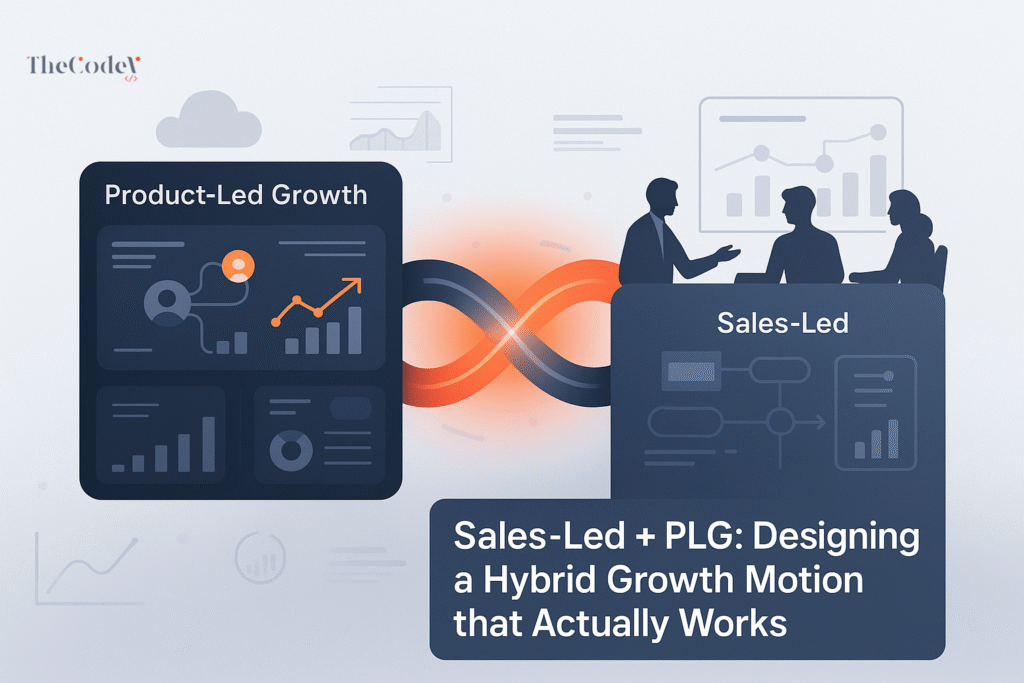
Designing a Hybrid Growth Motion That Actually Works
The story of SaaS growth has evolved dramatically over the past decade. It began with the sales-led era, where enterprise relationships, demos, and negotiations defined success. Then came the Product-Led Growth (PLG) revolution—where self-serve trials, viral loops, and user experience redefined how software scaled. Now, the industry stands at a powerful intersection: the hybrid growth model, where the efficiency of PLG meets the strategic depth of sales-led engagement.
This evolution reflects a deeper shift in buyer behaviour. Modern decision-makers expect immediate value, autonomy, and transparency. PLG fulfils those expectations—lowering acquisition costs, shortening sales cycles, and empowering users to experience impact firsthand. Yet as products mature and customer bases diversify, the need for human relationships resurfaces. Enterprise accounts still value trust, security, and long-term alignment—all areas where sales teams excel.
Why the Hybrid Model Wins for B2B Startups
For B2B startups, combining the precision of PLG with the personal touch of sales-led growth creates unmatched scalability. PLG drives discovery, engagement, and initial adoption; sales-led motions amplify expansion, compliance, and strategic partnerships. Together, they form a growth loop where product data informs human outreach, and sales insights refine product experience.
According to McKinsey & Company, B2B companies that integrate digital product experiences with traditional sales generate up to five times higher revenue growth than peers relying on a single channel. The takeaway is clear: digital-first does not mean people-last. The most effective SaaS organisations know when to let the product lead—and when to let the people close.
At TheCodeV, this philosophy is woven into every SaaS product we build. From analytics-driven onboarding flows to usage-based upsell triggers and CRM integrations, our engineering and strategy teams design ecosystems that scale from freemium adoption to enterprise expansion.
TheCodeV’s Expertise in Hybrid Growth Frameworks
We’ve helped SaaS founders across industries transition from sales-heavy dependency to hybrid PLG architectures that self-sustain growth. Our full-cycle development model—covering UX design, backend infrastructure, product analytics, and automation—ensures that every feature contributes to measurable outcomes.
Whether you’re launching a new product or modernising an existing one, our experts craft roadmaps that connect product engagement metrics with revenue impact. Through behavioural data, smart automation, and targeted onboarding, we enable startups to move beyond linear scaling into continuous, compounding growth.
Explore how we build growth-ready software through our Services page or connect with us directly via the Contact page to discuss your project goals.
Your Next Move: Build the Future with TheCodeV
The future of B2B SaaS belongs to those who merge the best of both worlds—the product that sells itself and the team that builds lasting relationships. If you’re ready to create a system where your product drives demand and your sales team accelerates impact, now is the time to act.