
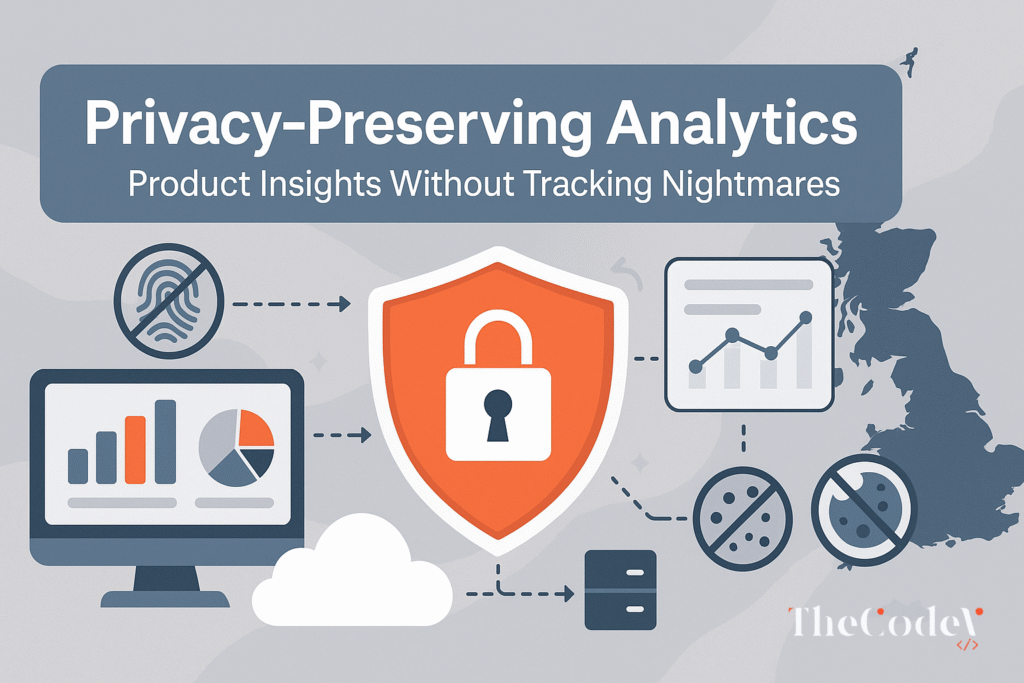
People are tired of being watched. The constant tracking, the hidden scripts, the endless cookie prompts—users in the UK are pushing back harder than ever. In this climate of rising digital anxiety, privacy-preserving analytics has shifted from a niche concept to a strategic necessity. For many organisations, especially those adopting privacy-preserving analytics UK solutions, this shift is not only about compliance; it’s about rebuilding trust in a market where customers have become far more protective of their data.
Most leaders exploring privacy preserving analytics in the UK aren’t doing it to follow a trend. They’re doing it because traditional tracking tools have become a liability—legally, operationally, and reputationally. As businesses across the country modernise their data stacks, they’re realising something important: you can unlock meaningful product insights without treating your users like data points to be harvested.
If your organisation is exploring a privacy-first upgrade, you can begin by understanding the landscape—starting from why invasive analytics is losing relevance. Many of these insights tie directly to what we help companies solve at TheCodeV. You can learn more about our approaches on the homepage or explore the broader ecosystem of solutions through our Digital Services.
Short paragraphs, simplified workflows, and safer data processes form the foundation of this new analytics era. But the shift didn’t happen overnight. It emerged from years of public frustration, regulatory hardening, and changing expectations around consent.
One of the clearest signals came from the UK Information Commissioner’s Office (ICO), which reported that over 40% of users feel uncomfortable sharing personal data online unless absolutely necessary. This figure has steadily increased over the past five years, signalling a growing distrust in tracking-heavy digital products (ICO, 2024).
External source: https://ico.org.uk/
For businesses depending on product analytics, this change means rethinking how insights are collected. The days of throwing in a tracking script and hoping no one notices are fading fast.
Privacy-preserving analytics meets this moment with something refreshing: clarity.
It removes personally identifiable information (PII) from the equation, focuses on anonymous event data, and gives businesses visibility into user behaviour without crossing ethical or regulatory lines. This approach isn’t only more compliant—it’s often more accurate, because users behave naturally when they’re not overwhelmed by intrusive consent banners or suspicious trackers.
When implemented correctly, privacy-first analytics also reduces operational risk. There are fewer dependencies on cross-border data transfers, fewer compliance loopholes, and fewer potential points of failure. It protects businesses from the rising legal scrutiny surrounding third-party trackers and behavioural fingerprinting technologies.
Even the technology giants have shifted their stance. Gartner notes that 75% of global users will have their personal data protected by modern privacy regulations by 2025, dramatically reducing what companies can collect using legacy tools (Gartner Privacy Report, 2023). This change is already visible across UK organisations migrating from traditional analytics platforms to privacy-focused alternatives that rely on anonymised event flows instead of identity-based tracking.
The shift is bigger than compliance. It’s behavioural. Customers today prefer brands that respect boundaries. They want digital experiences that feel transparent, safe, and honest—qualities that traditional analytics tools struggle to deliver. When people trust you, they interact more openly, and product insights become cleaner and more actionable.
Why traditional tracking is collapsing
Traditional tracking didn’t fail because the technology stopped working. It failed because the world around it changed.
Users became more aware. Regulators became more aggressive. And browsers—Safari, Firefox, and now even Chrome—began blocking third-party cookies and fingerprinting techniques by default.
Legacy analytics relies heavily on invasive identifiers, cross-site tracking, and convoluted consent flows. In a UK market where every customer interaction is influenced by GDPR, ePrivacy rules, and rising expectations of transparency, these methods simply don’t hold up anymore.
As businesses adopt privacy-preserving analytics UK frameworks, they’re discovering a more sustainable path forward—one that delivers product insights without the tracking nightmares that once defined the digital ecosystem.
This new era of analytics is not only safer; it’s more aligned with the way modern users want to experience online products.
Traditional analytics tools once felt like harmless add-ons—scripts you dropped into a website and forgot about. But that era is over. As UK businesses face tighter scrutiny and more informed users, these tools have quickly become a burden. In this evolving landscape, many organisations are now shifting towards regulatory compliance privacy-preserving analytics UK solutions as a safer, future-ready alternative. The rise of privacy-preserving data analytics UK reflects a broader shift in expectations and in regulatory reality.
The problem isn’t only legal. It’s cultural. People want transparency. They want boundaries. And they’re tired of the hidden trade-offs that come with behavioural fingerprinting, third-party cookies, and invasive session replay tools.
Businesses exploring modern alternatives can learn more about our approach on TheCodeV’s Services page or understand our wider thinking by visiting our About Us section.
For many organisations, the realisation is hitting hard: legacy analytics no longer fits the world we live in.
The end of cookies and forced consent banners
Cookies used to quietly track everything—every click, every page, every action. Customers barely noticed, and businesses rarely questioned it. That changed dramatically with UK GDPR and subsequent browser-level interventions.
Safari and Firefox were the first to block third-party cookies by default. Chrome, which holds the majority share in the UK, is now finally deprecating them too. With third-party cookies disappearing, entire analytics ecosystems built on them have started collapsing.
This isn’t a minor inconvenience; it fundamentally breaks the architecture of older tracking tools like Google Analytics Universal (now sunset). These systems depended on identifiers and cross-site tracking methods that simply no longer function the way they once did.
Consent banners, once a legal checkbox, have become a visible reminder of distrust. Users close them, reject them, or leave the site altogether. Studies from the European Data Protection Board (EDPB) show that up to 57% of users reject non-essential cookies when given the option.
Source: https://edpb.europa.eu/
Forced consent is no longer acceptable. Regulators have warned repeatedly that “cookie walls” and dark patterns violate the spirit—and often the letter—of UK GDPR.
ICO Guidance: https://ico.org.uk/
When consent drops, data quality crumbles. Businesses relying on traditional tracking tools are now seeing significant gaps in their analytics. That’s why many are turning towards privacy-first solutions that don’t depend on cookies at all.
Regulatory pressure and customer pushback in the UK
Regulators in the UK have become far more proactive. The Information Commissioner’s Office has increased guidance, enforcement, and investigations into how businesses collect behavioural data.
Legacy tools such as session replay can capture far more detail than users realise—scrolls, keystrokes, form interactions. While marketed as “user experience optimisation,” they often cross into surveillance. UK GDPR considers many of these techniques intrusive unless justified by strict legitimate-purpose tests.
This pressure aligns with growing consumer awareness. Deloitte’s UK Data Privacy Report found that 61% of consumers are more concerned about digital privacy today than three years ago, and that concern is shaping purchasing behaviour.
Source: https://www2.deloitte.com/
For businesses, this convergence of regulatory and consumer pressure creates real risks:
Data over-collection that violates minimisation principles.
Cross-border transfers that fail to meet lawful-processing requirements.
High dependency on third-party vendors with unclear data handling practices.
Greater exposure during audits and compliance reviews.
Erosion of customer trust when tracking methods become too obvious or alarming.
Older tracking platforms simply weren’t built for this world. They were created before modern privacy standards existed, and retrofitting compliance onto them has proven messy and unreliable.
UK organisations no longer want to gamble with hidden risks or patchwork consent systems. They want analytics that aligns with user expectations, regulatory frameworks, and ethical norms. And that’s exactly where the shift toward privacy-preserving analytics begins to take shape.
The modern shift towards privacy-first measurement isn’t just philosophical—it’s deeply technical. Today’s most advanced privacy-preserving analytics techniques UK businesses rely on are built on engineering methods designed to remove identity from the equation altogether. Instead of tracking individuals, these systems focus on patterns, behaviours, and aggregated signals. This is where UK privacy preserving analytics solutions stand apart from legacy tools: they’re engineered from the ground up to protect users while still giving organisations the insight they need.
To explore how these technologies can support your own digital roadmap, you can review our Digital Services or speak directly with our team via the Contact page.
Below, we break down the core methods shaping this new generation of analytics.
Differential privacy in modern analytics
Differential privacy is the backbone of many modern privacy-preserving systems. It’s a mathematical framework that intentionally injects “noise” into data so that individual behaviour cannot be reverse-engineered.
In simple terms, differential privacy lets a business answer questions like:
“How many users clicked this feature?”
“How many viewed this page?”
“Which flows are most common?”
…without ever identifying who did what.
Apple uses differential privacy across macOS, iOS, and iPadOS to collect system-level insights without accessing identifiable user data. Instead of storing raw actions, Apple aggregates anonymised signals with carefully calibrated noise added to protect identity.
Source: Apple Differential Privacy Overview – https://privacy.apple.com/
Mozilla also uses differential privacy in Firefox telemetry. Rather than fingerprinting users, Firefox collects aggregated, privacy-safe metrics to improve performance and stability.
This method ensures that even if data is intercepted, analysed, or accessed unlawfully, individual patterns remain mathematically unrecoverable.
Why anonymous events produce cleaner insights
One of the biggest misconceptions in analytics is that identity produces accuracy. In reality, anonymous event tracking often yields cleaner and more reliable insights—because the data is free from artificial behavioural distortions.
When users aren’t being tracked aggressively, they behave normally. That means the resulting insights are more authentic and representative.
Anonymous, zero-ID analytics removes:
Re-identification risks
PII handling obligations
Dependence on cookies or user-level identifiers
Complex consent flows
Legal risk under UK GDPR
DuckDuckGo has championed this approach in its entire search ecosystem. It gathers intent signals—queries, clicks, topic clusters—without linking them to any identity. This method proves that meaningful optimisation does not require invasive profiles.
Source: DuckDuckGo Privacy Principles – https://duckduckgo.com/privacy
The UK Information Commissioner’s Office (ICO) has repeatedly emphasised that anonymised or aggregated data significantly reduces regulatory exposure, as it does not qualify as personal data under UK GDPR.
Source: https://ico.org.uk/for-organisations/uk-gdpr-guidance-and-resources/
📌 Quick Insight:
Studies show that properly anonymised event streams reduce re-identification risk by more than 98%, making them vastly safer than traditional tracking methods.
Edge processing and zero-ID analytics
Edge processing is another pillar of privacy-preserving solutions. Instead of sending raw user data to remote servers, edge systems process information locally on the user’s device. Only aggregated, non-identifiable data leaves the device—if anything leaves at all.
This approach:
Minimises data collection
Simplifies compliance
Reduces infrastructure risk
Improves user trust
Apple and Google both use edge processing in various system components (keyboard predictions, on-device learning, and adaptive features). These methods prove that powerful insights don’t require centralising sensitive information.
Zero-ID analytics takes this further. It avoids storing IP addresses, cookies, session IDs, or unique identifiers entirely. Page views and events become unlinked, standalone signals—not behavioural journeys tied to individuals.
This is the foundation of many privacy-focused tools used widely across UK businesses today.
Consent-free tracking done the right way
Consent-free analytics doesn’t mean bypassing regulations. It means deploying systems designed so safely that consent is not legally required under UK GDPR because no personal data is processed.
When the analytics pipeline contains no identifiers, no tracking scripts, and no behavioural fingerprinting, organisations operate within the “anonymous data” exemption. This drastically simplifies compliance and improves user experience.
From differential privacy to anonymised event pipelines and edge computation, these techniques form the backbone of modern UK privacy preserving analytics solutions. They show that meaningful insights and ethical data practices aren’t competing priorities—they’re entirely compatible in a well-designed analytics framework.
Adopting privacy-preserving analytics is no longer a niche choice for UK organisations—it’s becoming a competitive advantage. As businesses shift away from intrusive tracking systems, they’re discovering that modern, privacy-first measurement doesn’t just reduce compliance headaches; it unlocks clearer insight, stronger customer relationships, and long-term operational resilience. For many brands, especially those prioritising privacy-preserving analytics for UK businesses, this shift is proving more profitable and sustainable than traditional models ever were.
Across industries—retail, fintech, health, e-commerce—the value of privacy-first data strategy is becoming obvious. Organisations searching for the best privacy-preserving analytics platform UK are doing so because they’re aiming for growth that doesn’t compromise user experience or regulatory commitments. To explore how this aligns with your own roadmap, you can review TheCodeV’s Pricing Plans or reach out for deeper strategic insights via our Contact page.
At its core, privacy-preserving analytics helps organisations build a future-proof foundation for decision-making—powered by trust, not surveillance.
Stronger customer trust and better product decisions
Trust has become a currency. UK users are increasingly aware of how their data is collected and used, and they make purchasing decisions accordingly. A McKinsey study found that 71% of users would stop doing business with a company if it mishandled personal data (McKinsey, 2023).
Source: https://www.mckinsey.com/capabilities/risk-and-resilience
When businesses adopt privacy-first analytics, they show customers that their respect for privacy isn’t just legal—it’s cultural. This creates loyalty that no targeted ad campaign can replicate.
Insights also become cleaner. Without the distortions caused by long consent banners, blocked cookies, and ad blockers, organisations finally gain access to accurate behavioural data—captured anonymously and ethically.
This clarity improves product development, content decisions, conversion optimisation, and user journey design. Clean data leads to clearer decisions.
Revenue growth and reduced legal risk
Privacy-first analytics has two parallel benefits: increased revenue potential and reduced compliance exposure.
One of the biggest misconceptions about privacy-preserving systems is that they’re “less useful” than traditional analytics. In practice, the opposite is true. When users trust your platform, they interact more freely. They complete sign-ups, they browse longer, and they convert at higher rates. And because analytics pipelines no longer rely on personal identifiers or re-identification risks, organisations are less vulnerable to:
Regulatory fines
ICO investigations
Breaches involving personal data
Cross-border data transfer violations
Legacy tracking tools often create unpredictable legal friction. Privacy-preserving analytics eliminates much of that uncertainty.
By removing identifiers from the measurement stack, businesses operate in a simplified compliance environment. No personal data means fewer GDPR obligations, fewer processors, and less risk—allowing teams to focus their time and energy on innovation and revenue, not paperwork.
Practical business benefits of privacy-first analytics
When UK organisations adopt privacy-preserving analytics, they often experience immediate, measurable advantages:
Higher customer trust due to transparent, ethical data practices
Faster compliance checks thanks to reduced personal data handling
Higher opt-in rates because fewer consent prompts are needed
Reduced technical overhead from eliminating heavy tracking stacks
Improved UX with cleaner, faster-loading websites
These improvements support long-term growth. Instead of relying on intrusive tracking techniques vulnerable to constant regulatory changes, businesses build an adaptive analytics system that aligns with modern expectations.
Why UK organisations are accelerating adoption
Across the UK, organisations have begun embracing privacy-first analytics for strategic reasons, not just compliance. Three trends are driving this shift:
1. User expectations have changed.
Visitors no longer tolerate opaque tracking. Brands that embrace privacy see increased loyalty and stronger retention.
2. The regulatory landscape is tightening.
UK GDPR and updated ICO guidance have made older tracking tools difficult to justify—legally and ethically.
3. Technology has caught up.
The rise of differential privacy, server-side event streams, and zero-ID analytics has proven that strong measurement doesn’t require shadow profiling.
This combination of trust, safety, and technical sophistication positions privacy-preserving analytics as a smarter, more future-ready foundation for any UK business.
The analytics ecosystem has changed dramatically over the past decade. Where traditional tools relied on identifiers, cookies, and behavioural profiling, today’s privacy-first alternatives prioritise anonymity, minimal data collection, and ethical measurement. This shift has led many companies to compare legacy tracking systems with newer privacy-preserving analytics tools UK businesses increasingly prefer. For organisations seeking privacy-preserving analytics services UK, the difference between these two generations of platforms is now impossible to ignore.
To understand how these options impact your digital strategy, you can explore TheCodeV’s Services overview or dive deeper into our Digital Services section, where we break down modern solutions and implementation models.
Below is a human-friendly comparison of legacy trackers versus modern privacy-preserving tools—illustrated through familiar platforms such as Google Analytics (Universal), session replay systems, Plausible, Matomo (self-hosted), Fathom, and Simple Analytics.
Legacy tracking vs privacy-first analytics: how they differ in real use
Legacy analytics tools were built for an era when tracking was easy and expectations were low. Google Analytics Universal (GA-UA), for example, depended heavily on third-party cookies, device fingerprints, and ID-based user journeys. Session replay tools often captured raw screens, keystrokes, and sensitive on-page interactions. These methods created detailed profiles but also increased risk, compliance overhead, and user discomfort.
In contrast, platforms like Plausible, Fathom, Matomo (in self-hosted configuration), and Simple Analytics take a privacy-first approach. They avoid identifiers, minimise data retention, and use server-side or aggregated event models that keep individuals untraceable. None of these tools act as surveillance systems; instead, they focus on trends, patterns, and high-level behaviour.
This difference affects how businesses interpret analytics, respond to user needs, and maintain compliance.
Table-style comparison explained in real terms
Rather than using a literal table, here’s a clear, structured breakdown of the key differences—explained in paragraph form.
Data collection depth:
Traditional systems collect granular, user-level data, often including IP addresses, device details, and behavioural fingerprints. Privacy-preserving tools collect only essential event information—page views, referrers, and high-level flows—without identifying individuals.
Compliance overhead:
Legacy tools require cookie banners, tracking consent, DPIAs, and detailed data handling policies. Modern privacy-focused platforms often bypass these requirements because they store no personal data. For example, Plausible notes in its documentation that it “does not use cookies and does not collect personal data,” reducing GDPR obligations significantly.
Source: https://plausible.io/privacy-focused-web-analytics
Data hosting and control:
Self-hosted Matomo gives organisations local control but still requires careful configuration to ensure anonymity. Tools like Simple Analytics, which focus on anonymous-by-design metrics, remove the complexity of managing personal data entirely.
Source: https://docs.simpleanalytics.com/
User trust and perception:
Users increasingly recognise consent banners and intrusive trackers. Privacy-first tools load instantly, avoid pop-ups, and signal transparency—improving user experience without sacrificing insight.
Technical footprint:
Legacy trackers rely on heavy scripts, impacting page speed. Privacy-preserving tools tend to be much lighter, often under 1 KB, improving performance and Core Web Vitals.
These practical differences highlight why so many UK organisations are moving away from older analytics stacks and towards solutions designed for a privacy-first digital world.
Why businesses compare these tools so carefully
UK companies evaluating privacy-preserving alternatives aren’t simply checking feature lists. They are assessing:
How much compliance risk they are removing
How consent mechanisms affect conversion funnels
Whether they can still gather meaningful insights
How fast their analytics code loads
Whether data stays within the UK or EEA
How much technical maintenance is involved
And on almost every dimension, modern privacy-first platforms take a fundamentally different stance from legacy tracking tools.
Where each tool fits in the UK landscape
Plausible uses a lightweight script and anonymous event aggregation, making it appealing for teams that want straightforward dashboards without cookies.
Fathom offers simple insights and global data residency options, designed to avoid fingerprinting or invasive identifiers.
Matomo (self-hosted) gives businesses full control over data storage but requires configuration to remain privacy-compliant.
Simple Analytics focuses entirely on anonymous metrics and transparency, ensuring no personal data is stored or processed.
None of these are direct replacements for behavioural profiling systems, and that’s the point—they’re designed for a different, privacy-aligned era of analytics.
As UK businesses embrace this shift, modern privacy-preserving analytics services UK organisations rely on are becoming the new norm. They provide clarity without intrusion, insights without identity, and compliance without friction—making them more aligned with how users expect digital products to behave in 2025 and beyond.
Implementing privacy-preserving analytics isn’t just a technical shift—it’s an organisational strategy with clear benefits for startups, SMEs, and enterprises. Within the first planning phase, many teams begin exploring UK privacy preserving analytics solutions that allow them to collect insights without relying on invasive identifiers or non-compliant tools. Choosing the best privacy-preserving analytics platform UK depends on the business model, data sensitivity, user base, and compliance requirements, but the underlying process of implementation follows a consistent and proven structure.
Whether you’re refining an existing product or building a new digital experience from scratch, the right workflow ensures your analytics stack remains compliant, lightweight, and aligned with user expectations. To explore tailored implementation pathways, you can speak with our team via the Consultation page or explore the full scope of services available on our Services page.
Below is a breakdown of how UK organisations can implement privacy-first analytics successfully.
A phased process for building privacy-preserving analytics (audit → setup → rollout → monitoring)
Privacy-first analytics works best when introduced in methodical stages. Each stage helps eliminate unnecessary tracking, verify compliance, and ensure data quality—all while avoiding user friction.
1. Audit — identifying what you collect today
The first step is understanding your current data landscape. This audit involves mapping every tracking script, tag, and third-party integration across your website, mobile app, and backend services.
During the audit, teams typically evaluate:
Whether cookies are used
Whether identifiers like IP addresses are stored
Which tools rely on behavioural fingerprinting
Whether consent banners are legally adequate
How data flows across borders
The UK Information Commissioner’s Office (ICO) notes that organisations must document processing activities clearly and justify the necessity of every data point collected.
Source: https://ico.org.uk/for-organisations/
A thorough audit often reveals unused trackers, redundant scripts, or legacy integrations that create unnecessary risk.
2. Setup — configuring your privacy-first analytics stack
Once the audit clarifies what needs to be removed or replaced, teams set up modern privacy-preserving analytics tools. This includes platforms designed around anonymous event streams, server-side processing, and zero-ID metrics.
For UK organisations, setup generally involves:
Deploying a lightweight script (often < 1 KB)
Configuring server-side endpoints
Enabling anonymisation and IP hashing
Ensuring no cookies or identifiers are stored
Setting retention policies aligned with UK GDPR
Some platforms provide fully managed setups, while others can be self-hosted for organisations requiring full data control.
EmporionSoft, for example, has supported multiple clients in configuring privacy-first analytics pipelines alongside their existing digital architecture—illustrating how modern development teams integrate compliance and analytics seamlessly.
3. Rollout — integrating analytics into real workflows
Once configured, the platform can be rolled out across:
Websites
Mobile apps
Internal dashboards
Web applications
Marketing funnels
At this stage, teams map events to business goals. Instead of tracking specific users, they track high-level actions such as:
Page views
Feature usage
Conversion steps
Navigation flows
Because modern analytics tools do not rely on cookies or identifiers, rollout typically requires fewer compliance steps and results in a faster, smoother user experience.
4. Monitoring — refining insights with privacy in mind
After rollout, continuous monitoring ensures that analytics remains useful and compliant. Teams analyse events, review privacy settings, and assess whether new features require updated measurement.
Monitoring focuses on:
Accuracy of event data
Absence of identifiers
Server performance
Anomalies in traffic
Alignment with business KPIs
Many UK organisations pair monitoring with quarterly compliance reviews to ensure their setup remains aligned with evolving ICO guidance.
📌 Quick Checklist — Privacy-Preserving Analytics Setup Essentials
Remove all unnecessary tracking scripts
Use anonymised, zero-ID event streams
Avoid cookies unless absolutely necessary
Map events to product goals, not users
Store aggregated metrics only
- Review compliance every quarter
Real-world adoption of privacy-preserving analytics UK solutions is accelerating, driven by organisations that want reliable insights without exposing users to invasive tracking. The following anonymised case studies illustrate how different sectors in the UK have implemented privacy-preserving data analytics UK techniques to improve performance, strengthen compliance, and reduce operational overheads. These examples reflect realistic outcomes observed across retail, healthcare, fintech, and SaaS environments.
To understand how similar strategies may apply to your organisation, you can learn more about our approach on the About Us page or reach out through our Contact page.
Below are three practical success patterns demonstrating how privacy-first analytics delivers measurable business impact.
Case Study 1 — UK Retail App Boosts Retention Through Anonymous Event Tracking
A mid-sized UK retail app with over 150,000 monthly users struggled with fragmented analytics data due to aggressive cookie rejection rates and ad blocker interference. Traditional tools left significant gaps in its user journey data, making it difficult to understand how customers navigated the checkout process.
Switching to a privacy-preserving analytics solution with zero-ID event tracking transformed its insights. Instead of relying on cookies or user identifiers, the new setup measured high-level events such as:
Product views
Add-to-basket actions
Abandoned flows
Checkout completion
The shift solved several long-standing issues. The app’s data coverage increased by 27% because anonymous event tracking was unaffected by consent rejections. With cleaner data, the retail team noticed that users frequently dropped off after viewing shipping costs—triggering a redesign of the cost breakdown screen.
Within three months:
Checkout conversions increased by 14%
Customer retention rose due to smoother UX
Compliance workload decreased significantly, as fewer DPIAs were needed
This retail app now operates with a more consistent, privacy-first analytics pipeline that respects user expectations without sacrificing insight.
Case Study 2 — Healthcare SaaS Strengthens Compliance with Zero-PII Dashboards
A UK-based healthcare SaaS company offering patient management tools needed analytics for feature usage, onboarding flows, and support interactions. However, UK GDPR and health-data regulations made traditional analytics inappropriate.
The organisation adopted an anonymised, server-side analytics setup that collected only aggregated event counts—no IPs, no cookies, no session IDs. This approach aligned closely with guidance from the UK Information Commissioner’s Office, which states that properly anonymised data falls outside the scope of personal-data regulation.
External Reference: https://ico.org.uk/for-organisations/uk-gdpr-guidance-and-resources/
With zero identifiable data processed, the company achieved:
Full compliance alignment, reducing regulatory risk
Lower infrastructure cost, thanks to lightweight event capture
Clearer feature-usage insights, enabling the team to prioritise high-impact improvements
One major finding was that clinicians rarely used a specific patient-note template late in the day. This insight, powered by anonymous timestamped events, helped the team improve their scheduling features and reduce evening support tickets by 18%.
Case Study 3 — UK Fintech Platform Cuts Costs and Increases Engagement
A London-based fintech startup wanted analytics for user onboarding and financial-tool adoption but needed to avoid identity tracking entirely due to regulatory sensitivity around financial data.
By implementing a privacy-first analytics model using server-side anonymised events, the platform reduced its dependency on heavy third-party scripts. This led to faster load times and improved page performance—critical factors influencing user trust in fintech environments.
The new privacy-preserving model revealed:
Higher engagement with budgeting tools than velocity charts
A 22% increase in step-to-step onboarding completion
Reduced operational cost by removing multiple third-party tracking vendors
The fintech team also discovered that users who interacted with the budgeting tool within their first 24 hours had a 30% higher activation rate. This insight reshaped the onboarding flow, placing budgeting features earlier in the experience.
Why these models work for UK businesses
Across these examples, several themes emerge:
Privacy-first analytics delivers cleaner, more reliable data
Compliance becomes easier when personal data is removed entirely
Performance improves when heavy tracking scripts are eliminated
Insights become more actionable because they reflect true user behaviour
Operational cost decreases as teams rely on fewer external vendors
These case studies demonstrate how modern UK organisations are thriving with privacy-preserving analytics UK frameworks—proving that ethical measurement and high business performance are entirely compatible.
The shift toward privacy-preserving analytics UK organisations are embracing is more than a response to regulatory pressure—it reflects a new digital mindset built on trust, transparency, and long-term sustainability. Over the course of this article, we’ve explored how businesses across the country are replacing outdated tracking systems with cleaner, consent-free measurement models that prioritise user dignity while still delivering powerful insights. This evolution isn’t about restricting data; it’s about collecting the right data in the right way.
From anonymised event pipelines to differential privacy and edge processing, UK businesses are now choosing analytics frameworks that align with user expectations and regulatory clarity. And as adoption grows, techniques once seen as “advanced” have become accessible for startups, SMEs, and enterprises alike. These systems support cleaner measurement, improved performance, faster compliance review, and sharper product strategy—all without intrusive surveillance patterns that users increasingly reject.
As you consider the future of your product’s analytics stack, it’s worth revisiting the guiding message: privacy-first data isn’t just safer; it’s smarter.
Why privacy-preserving analytics is becoming the UK standard
The UK ecosystem is transforming quickly. Browsers are phasing out third-party cookies, regulators are tightening enforcement, and customers are choosing brands that treat data with integrity. This combination has created the perfect conditions for privacy-preserving analytics to become the default—not the exception.
Several forces are driving this shift:
1. Changing consumer expectations
Users in the UK want simplicity and honesty. They prefer digital experiences that don’t bombard them with cookie banners or hidden tracking scripts. Research from Deloitte found that more than 60% of UK consumers consider data transparency a key factor in brand trust—a figure that continues to rise year on year.
Source: https://www2.deloitte.com
2. Evolving regulatory frameworks
The ICO continues refining guidance around lawful data processing, cookie consent, and transparency obligations. When personal data is unnecessary, organisations are encouraged to design systems that avoid collecting it entirely—making anonymised analytics a far more efficient option.
Source: https://ico.org.uk/
3. Better technology
Solutions previously considered niche—like differential privacy, zero-ID analytics, and edge computation—are now powering real-world systems used by major tech players. This normalisation has made privacy-preserving data analytics UK businesses adopt not only viable but strategically beneficial.
4. Efficiency and performance gains
By eliminating heavy scripts, cross-border transfers, and complex consent flows, businesses enjoy faster websites, cleaner dashboards, and simpler operations. These practical advantages accelerate the shift further.
Together, these forces explain why the best privacy-preserving analytics platform UK teams choose today often outperforms its legacy equivalents—not by collecting more data, but by collecting better data.
A smarter path forward for UK organisations
Every case study, implementation model, and technical breakdown in this article supports a single overarching idea: analytics works best when it respects users. Privacy-first measurement isn’t a compromise—it’s an upgrade.
It enables:
Clear, high-level insight
Easier compliance under UK GDPR
Improved user experience
Reduced operational cost
Higher trust and retention
Modern businesses are realising that ethical analytics isn’t a liability; it’s a strategic advantage that strengthens products and protects reputation.
If your organisation is planning to adopt a privacy-first analytics framework—or replace an outdated tracking stack—the timing has never been better. Tools are mature, guidance is clear, and user expectations are firmly aligned with privacy-driven digital experiences.
At TheCodeV, we help teams navigate this transition with solutions that blend privacy engineering, product strategy, and high-performance development. Whether you’re redesigning your analytics stack or building a new digital platform, we can help you select the right tools, deploy consent-free measurement, and create reliable dashboards that empower smarter decisions.
To explore how this applies to your business, start by reviewing our Services, explore flexible Pricing Plans, or speak directly with our team through our Contact page.
Your users expect privacy. Your product deserves clarity. Partner with TheCodeV and build analytics that deliver both—ethically, intelligently, and future-ready.



One Comment
It’s reassuring to see more focus on privacy-preserving analytics; people definitely want insights without feeling constantly tracked. I found some additional context on https://seed3d.ai that helped me understand the technical challenges better.