
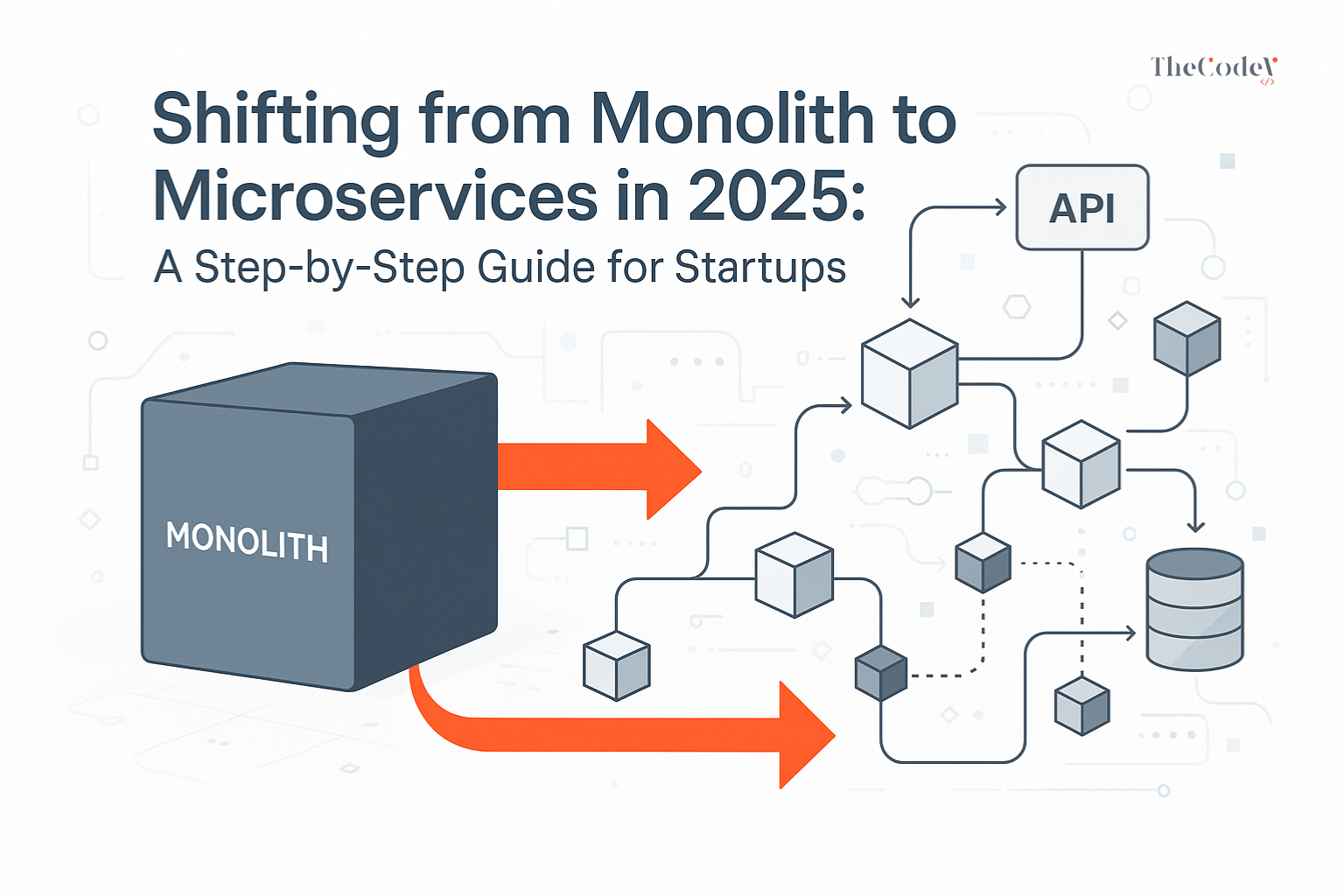
Why Startups Are Prioritising Shifting from Monolith to Microservices in 2025
The pressure to scale fast has never been more intense, and that’s why monolith to microservices migration has become one of the defining engineering strategies for startups in 2025. When product growth accelerates, a rigid monolith can turn from a launchpad into a bottleneck, slowing delivery, limiting scalability, and creating unnecessary operational risk.
Modern founders are discovering that surviving in competitive markets means making architectural decisions that support agility, speed, and resilience from day one. Microservices aren’t just a trend. They’re a structural shift in how digital products are built, deployed, and scaled.
The Rise of Distributed Architectures in 2025
The global tech ecosystem has shifted towards distributed, event-driven systems because users expect flawless performance and instant responsiveness. Whether a startup is building a marketplace, SaaS platform, on-demand service, or AI-powered tool, growth often exposes the limits of monolithic structures.
A monolith concentrates logic, data, and workflows in a single deployable unit. That simplicity is appealing in the early stages, but it rarely survives the demands of scale. As teams expand and product scope evolves, modules become tightly coupled, releases slow down, and dependencies multiply.
This is where monolithic architecture to microservices refactoring enters the picture. Refactoring allows organisations to break complex systems into modular, independently deployable services that move at the speed modern markets require.
Industry research reinforces this shift. Gartner predicts that by 2027, over 75% of global enterprises will run production workloads using microservices and container-based architectures, driven by the need for rapid innovation and operational efficiency (Gartner, “Cloud-Native Architecture Trends”). This same trend is now cascading into the startup world.
Why Monoliths Are Becoming a Growth Barrier
Many early-stage teams adopt monolithic design because it’s faster to build and easier for a small team to manage. The problem arises when the product takes off.
Typical issues include:
Release cycles slow dramatically
Minor code changes cause unexpected breakage
Scaling one feature requires scaling the whole system
Onboarding new engineers becomes harder
Outages affect the entire platform
Technology upgrades become risky and time-consuming
These pain points intensify as customer expectations climb and competition accelerates.
As a result, founders and CTOs increasingly explore monolith to microservices migration strategy options long before failure begins to show up in the metrics.
Shifting Engineering Mindsets
Startups are adopting a more mature mindset around system design. Instead of viewing microservices as “enterprise architecture,” teams now see them as an enabler of:
Faster feature delivery
Independent team ownership
Continuous deployment
Improved performance under load
Reduced risk through isolation and decoupling
This mindset aligns well with modern development practices championed by leaders across the industry. Thoughtworks, for example, continues to advocate for evolutionary architectures and domain-driven design to support long-term scalability in digital products (Thoughtworks Technology Radar).
2025: The Year of Strategic, Incremental Migration
The shift is not about rewriting everything overnight. Instead, startups are increasingly migrating monolithic application to microservices through targeted, incremental approaches that preserve product continuity.
Many teams begin by extracting a single service such as payments, notifications, authentication, or search. This reduces risk while giving engineering teams real-world experience with distributed systems.
This incremental strategy allows businesses to:
Avoid downtime
Maintain user experience
Reduce engineering disruption
Improve delivery pipelines one service at a time
More importantly, it ensures the team is strategically aligned with the future of the platform — not trapped in the limitations of the past.
The Strategic Advantage for 2025 Startups
Microservices unlock flexibility for startups who want to ship faster, iterate without technical friction, and scale without architectural pain. As competition intensifies across digital products, an adaptable system becomes a core business advantage.
For founders exploring this journey, understanding the why is the first step. The next is designing a structured, realistic migration plan — and that begins with examining the monolith itself.
Understanding the Monolith: When Your Product Outgrows Its Foundations
Every startup reaches a moment when its once-simple architecture starts feeling painfully restrictive, and this is often the earliest signal that a monolith to microservices migration may be on the horizon. What once worked beautifully during the early product phase begins to strain under the weight of new users, features, integrations, and team members.
What a Monolithic Architecture Really Looks Like
A monolithic system is typically built as a single, unified codebase where all modules—authentication, payments, search, dashboards, notifications, admin panels—live together, share the same runtime, and are deployed as one block.
In the beginning, this simplicity is a gift. It reduces cognitive load, speeds up development, and allows small teams to iterate fast. Many iconic startups, from early-stage fintech platforms to SaaS tools, launched with monoliths because they provide a straightforward path to MVP.
The trouble arrives when success introduces scale, complexity, and unpredictability.
Common issues include:
Minor updates triggering full-system redeploys
Small bugs causing platform-wide outages
Performance bottlenecks that can’t be isolated
Tight coupling between modules that blocks experimentation
Slow onboarding as the codebase becomes harder to navigate
These challenges compound with growth, affecting both product velocity and engineering morale.
Key Warning Signs That It’s Time for Monolith to Microservices Migration
Startups rarely wake up and decide to migrate out of curiosity. They migrate because the symptoms become too disruptive to ignore.
Symptom 1 — Feature Releases Slow Down Dramatically
If a team struggles to ship updates without breaking unrelated parts of the system, the monolith is no longer supporting innovation—it’s obstructing it. This often shows up as long QA cycles, repeated hotfixes, and dependency conflicts.
Symptom 2 — Scaling Becomes Expensive or Inefficient
A monolithic system typically scales vertically. That means adding more CPU or RAM to the entire application even if only one feature is under strain. It’s a costly, imprecise solution, especially for high-growth sectors like e-commerce or mobility platforms.
Symptom 3 — Teams Trip Over Each Other’s Work
As engineering squads grow, working inside a monolith creates friction. Merging branches becomes painful. Testing becomes unpredictable. Ownership becomes murky. These day-to-day frustrations are early indicators that monolith decomposition into microservices may be necessary.
Symptom 4 — Reliability Starts Becoming a Business Risk
When a single failure can take down the whole product, customers notice. Investors notice. Internal teams worry. A real-world example is a startup in the logistics sector where peak-hour traffic repeatedly caused cascading failures because one overloaded module froze the entire monolithic process.
Technical and Organisational Limitations That Hold Startups Back
Even before exploring migration opportunities, startups face a number of blockers that expose deeper architectural limitations.
Technical Limitations
Shared database schemas that make refactoring risky
Complex interdependencies that developers fear touching
Lack of modular boundaries leading to unpredictable results
Slow test suites that balloon as the codebase grows
These technical signals are often the first motivators for incremental monolith to microservices migration, allowing teams to migrate one component at a time instead of rewriting everything.
Organisational Limitations
Growing teams struggle to take ownership of isolated domains
Context-switching fatigue sets in when developers navigate massive files
Cross-team coordination problems multiply
Product roadmaps slow down because engineering becomes a bottleneck
These issues impact culture just as much as code. A strained monolith can frustrate developers, slow hiring, and complicate onboarding.
Early Blockers That Often Delay Migration
Despite clear warning signs, many startups hesitate.
Common early blockers include:
Fear of downtime
Limited in-house distributed systems experience
Tight deadlines leaving no room for architectural improvements
Pressure to deliver features rather than invest in infrastructure
Concerns about cost and operational risk
Martin Fowler notes that evolutionary architecture depends on teams embracing change as a continuous process rather than a single decision point (Martin Fowler, Microservices). This mindset is often the differentiator between startups that scale smoothly and those that struggle.
Real Startup Scenarios That Highlight the Shift
A travel-tech startup experiencing seasonal demand spikes found their search module crashing repeatedly because everything relied on the same synchronous process. Another AI-powered SaaS platform struggled because every model update required redeploying the entire monolith.
Both cases illustrate the same truth: monoliths eventually become barriers to scalability, experimentation, and reliability.
Understanding these s
The Core Migration Patterns Every Startup Must Understand for Monolith to Microservices Migration
Successful migrations don’t happen by chance—they follow proven architectural patterns that reduce risk and create a controlled, predictable transition path. This is why understanding the main monolith to microservices migration patterns is essential for any startup planning to modernise its systems in 2025. These patterns offer structure, clarity, and operational safety when handling complex, interdependent legacy systems.
Startups working with older architectures often assume that migration requires a complete rewrite, but the industry’s most trusted approaches prove the opposite. True transformation happens incrementally, strategically, and with minimal disruption.
Monolith to Microservices Migration Patterns That Define Modern Architecture
H3: The Strangler Fig Pattern — Gradual, Low-Risk Migration
One of the most respected approaches in the industry is the strangler fig pattern microservices migration, inspired by how a strangler fig tree grows around an existing structure. Instead of rewriting the entire application, teams gradually build new microservices around the monolith, replacing components piece by piece.
This pattern is particularly useful for legacy monolith to microservices migration, where the existing system is too critical or fragile to be replaced in one step.
Real startup example:
A fintech startup handling payment processing couldn’t disrupt its core system. Using the strangler pattern, they extracted one service at a time—starting with authentication—routing traffic to the new components while keeping the monolith intact. Over time, the monolith shrank naturally.
This approach reduces downtime, avoids full-system failures, and preserves business continuity.
Event-Driven Decomposition — Building Independent, Reactive Services
Event-driven decomposition is the backbone of modern distributed systems. Instead of relying on synchronous calls, microservices communicate through asynchronous events, allowing each service to operate independently.
This pattern is ideal when dealing with microservices decomposition legacy system scenarios, especially where workflows are tightly coupled inside the monolith.
For instance, a logistics startup discovered that every update to delivery status triggered multiple internal operations within the monolith. By introducing an event bus, they decomposed those workflows into independent microservices. Each service listened to relevant events—order created, driver assigned, delivery updated—resulting in faster development and higher resilience.
Event-driven systems also support scalability and fault tolerance, making them a top choice across cloud-native platforms. The Microsoft Architecture Centre highlights event-driven systems as a key design foundation for scalable microservices (Microsoft Learn: Cloud-native Architecture Guide).
API-First Migration Workflows — Creating a Unified Interaction Layer
Before decomposing services, startups need a clear and consistent interface for communication. This is where API-first migration shines. Instead of directly refactoring internal modules, engineering teams create well-defined APIs that act as the single gateway for both the monolith and emerging microservices.
This API layer becomes a contract that establishes:
Clear boundaries between functionalities
Predictable communication
Easier testing and debugging
A roadmap for gradual replacement
A marketplace startup used this approach to isolate its product-search functionality. By first building an API layer, the team ensured that when the search module became a standalone microservice, nothing broke internally or externally.
API-first workflows drastically reduce migration complexity and improve long-term maintainability.
Domain-Driven Design Concepts — Structuring Services Around Business Logic
Domain-driven design (DDD) helps teams identify natural boundaries within the system, making it easier to plan microservice extraction. Instead of slicing by technical layers, startups decompose their monolith according to business domains such as:
Payments
Orders
Notifications
User management
Analytics
This method is essential for planning monolith to microservices migration patterns, ensuring services are cohesive, loosely coupled, and aligned with real business workflows.
DDD also helps teams avoid one of the biggest pitfalls in migration: creating accidental micro-monoliths that still rely heavily on each other.
A SaaS analytics company used DDD to separate their reporting engine from the user onboarding flow. This allowed the analytics pipeline to scale independently during peak usage, improving performance without rewriting the entire system.
Strategic Support for Modern Startups
These migration patterns form the backbone of modern software transformation. Whether a startup embraces the strangler fig pattern, event-driven workflows, or domain-driven boundaries, each method reduces risk and accelerates modernisation.
To explore expert-led migration services, startups can review TheCodeV’s digital engineering expertise:
https://thecodev.co.uk/digital-services/
For tailored migration guidance, consultation options are available at:
https://thecodev.co.uk/consultation/
ymptoms is the first step to planning the journey ahead.
A Practical Step-by-Step Monolith to Microservices Migration Workflow
If startups want real transformation, they need a migration process they can trust—one that breaks the work into manageable, low-risk stages. This section outlines a practical, monolith to microservices step by step workflow designed for modern engineering teams who need clarity, speed, and predictable outcomes. The goal is not just migration, but building a scalable foundation for the next decade of product growth.
This is where monolith to microservices migration becomes more than theory. It becomes a structured, operational plan.
Step 1 — Assess the Monolith with Precision
Before deciding how to migrate monolith to microservices, teams must understand what their monolith currently looks like under the hood.
This assessment phase includes:
Mapping dependencies and data flows
Identifying modules with the most change activity
Evaluating performance bottlenecks
Reviewing shared database schemas
Documenting risks and constraints
A startup in the health-tech space used this phase to uncover that 70% of outages originated from one tightly coupled notification module. This finding shaped their migration priorities and prevented unnecessary over-engineering.
Pro tip: Use architecture visualisation tools and automated code scanning platforms to expose hidden dependencies.
Step 2 — Identify Bounded Contexts Through Domain Analysis
Bounded contexts form the foundation of clean microservice boundaries. They define what each part of the system owns, what it depends on, and how it communicates.
Typical bounded contexts in startups include:
Payments
Orders
Authentication
User management
Notifications
Analytics
This step prevents teams from creating microservices that overlap or rely excessively on each other.
Domain-driven design, highlighted extensively in the AWS Well-Architected Framework, encourages teams to align services with real business workflows, not arbitrary technical layers.
Step 3 — Create Service Boundaries and Migration Priorities
Once the bounded contexts are clear, engineering teams decide which services to extract first. Choosing the right sequence is one of the best practices monolith to microservices transitions.
Ideal first candidates include:
High-change modules
Features requiring independent scaling
Components with well-defined inputs and outputs
Workflows that frequently cause monolith instability
Some teams start with authentication. Others begin with search, notifications, or payment processing. The key is to extract a service that:
Reduces monolith complexity
Can be isolated with minimal disruption
Improves deployment velocity
Step 4 — Set Up CI/CD Pipelines for Distributed Systems
Microservices rely on automation. Without strong pipelines, migration slows down and deployments become chaotic.
Your CI/CD workflow should include:
Automated testing (unit, integration, contract testing)
Containerisation using Docker
Kubernetes or ECS orchestration
Automated rollback mechanisms
Canary deployments for safer releases
Google SRE emphasises automation as a core pillar of reliable service delivery, noting that manual processes introduce risk and increase operational fatigue.
This stage ensures the foundation is strong enough to support multiple independently deployable services.
Step 5 — Run the Migration in Parallel with the Monolith
Parallel migration is essential to reducing downtime and keeping product development on track.
This workflow typically involves:
Building new microservices alongside existing monolith code
Routing specific functionality to the new services
Keeping fallbacks to the monolith until stability is achieved
Gradually shifting traffic to the new services
This technique aligns with the strangler pattern even when not used explicitly. It also helps avoid the dangers of a “big bang” rewrite.
During this phase, monolith to microservices migration tools such as API gateways, service meshes, and monitoring systems become vital.
Step 6 — Strengthen Observability, Testing, and Gradual Rollout
A distributed system needs deep visibility.
Key observability practices include:
Centralised logging (e.g., ELK stack, Datadog)
Tracing tools to follow requests between services
Real-time metrics for latency, failure rates, and throughput
Health checks and circuit breakers
Teams should roll out each microservice gradually:
First to internal teams
Then to a small percentage of users
Finally to full production load
This helps catch edge cases early and ensures a smooth transition.
Supporting Engineering Teams Through Migration
Startups often seek external guidance to fast-track architectural planning, stabilize distributed operations, or accelerate service extraction. For example, TheCodeV’s engineering support services can assist with domain modelling, container orchestration, CI/CD automation, and migration execution:
Explore engineering services: https://thecodev.co.uk/services/
Request expert review: https://thecodev.co.uk/consultation/
Mastering Data, Observability, and Deployment During Monolith to Microservices Migration
Distributed systems introduce one of the hardest engineering puzzles: managing data across multiple independent services without losing consistency, performance, or reliability. This is where many teams underestimate the complexity of modern architecture. A thoughtful approach to data and observability can make or break a monolith to microservices migration project, especially as systems scale and services evolve independently.
Getting this layer right requires discipline, strategy, and an understanding of how data behaves when it no longer lives inside a single shared database.
Database Decomposition — Breaking the Monolith at Its Core
One of the biggest challenges in monolith to microservices database migration is dismantling the shared schema that underpins the monolith. A single database often acts as the central nervous system, connecting every module tightly together. Splitting it without compromising integrity requires careful planning.
Teams typically follow three phased approaches:
Logical Decomposition:
Identify tables or collections that belong to specific bounded contexts.
Example: separating user profiles from order history or billing data.Physical Decomposition:
Move those logical groups into separate databases owned by each microservice.
Ownership prevents accidental coupling and ensures autonomy.Data Ownership Enforcement:
A microservice must be the only writer for its database, reducing sync conflicts.
PostgreSQL and MongoDB both publish extensive guidance on database decomposition for service-based systems (PostgreSQL Docs – Designing for Distributed Architectures).
This process unlocks true independence but must be handled with extreme care to avoid data loss or inconsistent state.
Data Synchronisation — Getting Services to Agree Without a Shared Database
Once databases are split, services still need to exchange data or react to changes elsewhere. This is where synchronisation strategies become essential.
Key approaches include:
Change Data Capture (CDC):
Tools like Debezium stream real-time changes from one service to another.Event Propagation:
Services publish events when updates occur, allowing others to react asynchronously.Materialised Views:
Services maintain cached copies of data they need for quick reads.
A typical example is a subscription billing platform where the pricing microservice emits events whenever a plan is updated. The user service listens and updates its internal data model accordingly—no shared database required.
CDC and event-based sync reduce the risk of circular dependencies while supporting high-scale systems.
Event Sourcing — The Backbone of Auditability and Reliable State
Event sourcing captures every change as an immutable event rather than overwriting state. This technique is extremely powerful for regulated industries, high-volume platforms, and systems requiring historical accuracy.
Benefits include:
Full audit trails
Ability to rebuild service state from event logs
Improved system resilience
Easier debugging and replaying scenarios
While event sourcing adds operational overhead, it is a strategic advantage for long-term scalability and speed.
Observability — Seeing Across Distributed Boundaries
Once a startup moves into microservices, the monolith-era debugging experience disappears. Logs are spread out, services operate independently, and failures happen in unexpected places.
This is why observability becomes a critical pillar.
Core practices include:
Centralised logging using tools like ELK or Datadog
Distributed tracing to follow requests between services
Metrics and dashboards for latency, throughput, and errors
Automated alerts for anomalies or degraded performance
Datadog highlights that over 60% of distributed system failures originate from unseen inter-service interactions (Datadog, State of Observability). Having observability from day one prevents blind spots during and after migration.
Deployment Options — Choosing the Right Execution Environment
The migration isn’t complete until services are deployed in an environment that supports autonomy and scalability. Three deployment models dominate the 2025 landscape:
1. Kubernetes (K8s)
Ideal for teams needing extreme flexibility, autoscaling, and powerful orchestration.
Supports blue-green deployments, canary rollouts, and service meshes.
2. Serverless (AWS Lambda, Cloud Functions)
Great for microservices with unpredictable traffic.
Removes server management and scales instantly.
Perfect for event-driven architectures.
3. Container Platforms (Docker, ECS, Azure Container Apps)
Simplest step for teams moving from monolith environments.
Lightweight, predictable, and cost-effective.
Choosing the right option is integral to a solid monolith to microservices migration strategy, as deployment governs reliability, cost efficiency, and long-term performance.
For deeper engineering support or architectural guidance, startups can explore:
Services: https://thecodev.co.uk/services/
Contact: https://thecodev.co.uk/contact/
The Real-World Challenges Startups Face During Monolith to Microservices Migration
Every startup dreams of smoother releases, faster performance, and scalable architecture—but few fully anticipate how difficult monolith to microservices migration can be in practice. The process introduces new risks, new tooling, and entirely new engineering expectations. These challenges don’t mean teams should avoid migration; instead, they highlight the importance of planning, patience, and precision.
Cost and Timeline Risks That Catch Startups Off Guard
One of the biggest monolith to microservices migration challenges is the sheer unpredictability of cost and timelines. Migrating a live monolithic system often requires:
Refactoring legacy code
Redesigning data models
Adding observability
Rebuilding CI/CD pipelines
Training or hiring engineers
Startups with lean budgets sometimes underestimate how long it takes to extract just a single service. What appears simple on paper—such as splitting billing from user management—may introduce cascading dependencies that must be untangled first.
A well-known insight from Red Hat’s microservices research shows that over 60% of organisations underestimate the time required to fully stabilise new services (Red Hat: Microservices Adoption Report). This is especially true for smaller teams with limited migration experience.
Skill Gaps and the Need for New Engineering Mindsets
Migrating monolithic application to microservices requires skills beyond standard full-stack development. Engineers must understand:
Distributed tracing
Event-driven patterns
Container orchestration
Cloud-native deployment
Domain-driven boundaries
Startups often face a steep learning curve. Developers who excel in monolithic workflows may struggle initially with concepts like eventual consistency or service resilience. This learning gap can slow progress unless the team invests in training or partners with experienced architects.
For expert assistance, teams can explore TheCodeV’s engineering support:
https://thecodev.co.uk/services/
Operational Complexity Increases Before It Declines
Many founders assume microservices automatically simplify everything. The truth is more nuanced. Operational complexity increases dramatically during the first phase of incremental monolith to microservices migration.
Teams must now manage:
Multiple repositories
Independent deployments
Service discovery mechanisms
API gateways
Logging and monitoring stacks
Cross-service communication
A monolith has one deployment pipeline. Microservices may have dozens. Without strong automation and observability, complexity can overwhelm teams, slowing migration and increasing downtime.
Performance Issues from Network Overhead and Poor Boundaries
Performance bottlenecks are another common challenge. In a monolith, function calls happen in memory, but in microservices they often happen over the network.
This shift introduces new issues:
Increased latency
Failed API calls
Retry storms
Cascading failures
The risk is higher when service boundaries are poorly defined. For example, if a microservice requires calling five others just to serve one request, the architecture becomes fragile. Performance tuning is an ongoing process, not a one-time fix.
Choosing the Right Tools, Frameworks, and Techniques
Startups must navigate a flood of tooling options across categories like:
API gateways (Kong, NGINX, Apigee)
Service meshes (Istio, Linkerd)
CI/CD systems (GitHub Actions, GitLab CI, ArgoCD)
Observability tools (Datadog, New Relic, Prometheus)
Selecting the wrong tools early can lead to unnecessary cost, operational friction, or vendor lock-in. That’s why teams often begin with minimal tooling and scale complexity only when needed.
External consulting can help reduce the risk of tool sprawl and architectural misalignment:
https://thecodev.co.uk/consultation/
Vendor Neutrality as a Strategic Priority
Once startups enter cloud-native territory, vendor dependency becomes a real concern. Proprietary features from cloud providers—like messaging services, serverless runtimes, or monitoring tools—can create hidden long-term constraints.
Vendor neutrality ensures:
Easier cloud migration in the future
Lower operational costs
Greater architectural flexibility
Reduced risk of being locked into one provider
This is especially relevant when teams design event buses, data pipelines, or observability solutions. CNCF (Cloud Native Computing Foundation) strongly advocates for open standards and portable architectures to future-proof microservices ecosystems (CNCF Landscape Report).
Building With Awareness
Understanding these challenges is essential for designing a migration strategy that avoids unnecessary friction. Startups that anticipate cost, complexity, tooling choices, and skill gaps are far more likely to succeed in the journey from monolith to microservices.
A Startup’s Journey from Monolith to Microservices — A Realistic Case Study
The turning point arrived on a Friday evening, just as the product team at SwiftBasket, a fictional yet realistic on-demand grocery startup, prepared for their biggest marketing campaign of the year. Traffic spiked, orders poured in, and within minutes their monolithic application buckled under the pressure. The checkout module froze, the search engine lagged, and support tickets doubled. It was a harsh reminder of the limits built into their architecture—limits they could no longer ignore.
Their experience reflects the challenges many growing startups face when navigating monolith to microservices migration challenges. At the time, SwiftBasket was scaling aggressively, but their architecture had not evolved with the business.
Pain Points That Triggered Their Migration Decision
SwiftBasket’s monolithic system had served them well in the early days. Their small team moved quickly, shipping features weekly. But as their customer base expanded, cracks began to show.
1. Scaling Bottlenecks
During peak hours, certain functions—especially order placement and live delivery tracking—caused the entire application to slow down. They couldn’t scale individual components, meaning the whole monolith had to scale vertically, resulting in unnecessary infrastructure cost.
2. Slow Development Cycles
Developers were constantly stepping on each other’s toes. A simple update to a pricing rule required retesting multiple unrelated modules. Deployments became risky, unpredictable, and stressful.
3. Fragile Reliability
A small bug in the notifications module once took down the entire platform. That’s when the team realised that migrating monolithic application to microservices wasn’t optional—it was essential for survival.
4. Data Complexity
The shared relational database had grown into an unmanageable spiderweb of foreign keys. Extracting a single feature felt like surgery with no anaesthetic.
These challenges are common across high-growth digital platforms, and they signalled that an incremental monolith to microservices migration was overdue.
How the Migration Unfolded
SwiftBasket began with a precise migration roadmap inspired by proven industry principles.
Step 1: Identifying Bounded Contexts
Using domain-driven design, they mapped their platform into business domains:
Checkout
Catalogue
User Accounts
Delivery Tracking
Promotions
This approach helped them locate natural seams in the monolith for extraction.
Step 2: Extracting the First Service
They chose to extract the checkout service first since it was both high-impact and well-defined. The team used the strangler pattern to route checkout traffic to the new service while the rest of the monolith remained intact.
Step 3: Modernising Data Ownership
As part of the migration, each service received its own database. This eliminated dangerous cross-dependencies and allowed the checkout system to scale independently during peak demand.
Step 4: Implementing Observability
Distributed tracing, centralised logs, and dashboard metrics were introduced to monitor service performance. Before this, debugging production issues took hours. After observability was implemented, issues were identified in minutes.
Step 5: Accelerating Deployment Velocity
Once services became independent, the engineering team unlocked parallel development. Instead of one risky weekly release, they deployed enhancements multiple times per day.
The transformation was dramatic. Page load speeds improved. Downtime decreased. Developer morale soared. Customer satisfaction increased.
Partners That Shaped Their Transformation
Migration at this scale requires expertise. SwiftBasket collaborated with EmporionSoft to validate their architectural blueprint and stress-test their deployment strategy. Their consultation ensured that service boundaries were clear, scalable, and future-ready.
But implementation is where they needed deeper, hands-on engineering support.
This is where TheCodeV entered the picture.
TheCodeV acted as a modern engineering partner, helping SwiftBasket refine service boundaries, containerise workloads, establish CI/CD pipelines, and deploy microservices using cloud-native tooling. Their expertise in distributed systems allowed SwiftBasket to move faster, reduce risk, and modernise without disrupting day-to-day operations.
For businesses undergoing similar challenges, TheCodeV’s specialised digital engineering services are available here:
https://thecodev.co.uk/services/
For collaborative architectural assessments or technical discussions, teams can reach out directly at:
https://thecodev.co.uk/contact/
Why Monolith to Microservices Migration Sets Startups Up for Long-Term Success
The journey from a monolithic system to distributed services is never simple, yet it becomes increasingly essential as digital products scale. This is why monolith to microservices migration remains one of the most important architectural decisions a startup can make in 2025. The shift demands patience, clarity, and discipline, but the long-term rewards—speed, resilience, scalability, and innovation—are well worth the effort.
Startups that embrace this evolution early often discover that modern engineering isn’t just a technical upgrade. It’s a catalyst for business growth.
Reflecting on the Migration Journey
Across this guide, we explored the entire lifecycle of a successful migration:
Understanding the monolith and recognising early signals that it can no longer support rapid scale.
Identifying bounded contexts to create clean, future-proof service boundaries.
Using proven migration patterns such as the Strangler Fig approach and event-driven decomposition.
Executing a step-by-step blueprint for extracting services, establishing CI/CD pipelines, and adopting strong observability.
Addressing real-world challenges including cost risks, team skill gaps, operational complexity, and tooling decisions.
Examining a real case study, showing how a fictional startup transformed performance, reliability, and engineering velocity through a structured migration journey.
Every stage of the process reinforces the same truth: startups that modernise early build more competitive, durable, and scalable products.
The Long-Term Value for Startups
Microservices do more than solve immediate scaling problems. They create an engineering environment where teams can:
Deploy features faster and more safely
Scale individual components instead of the entire platform
Adopt new technologies without rewriting the system
Improve resilience and fault isolation
Build specialist teams that own independent services
Reduce long-term maintenance cost
Innovate without architectural constraints
This future-ready model allows startups to grow without fearing their infrastructure. When architecture becomes an enabler rather than a blocker, founders and CTOs gain the freedom to focus on the product and the market—not firefighting technical debt.
Making the Shift with Confidence and the Right Partner
A monolith to microservices migration is a defining moment in a startup’s evolution. It requires technical maturity, careful planning, and ongoing execution. But you don’t need to take this journey alone.
This is where TheCodeV becomes a strategic ally.
As a modern engineering partner, TheCodeV helps startups:
Define migration roadmaps
Decompose monolithic systems
Establish microservice boundaries
Build cloud-native CI/CD pipelines
Implement observability and distributed tracing
Deploy microservices using Kubernetes, containers, or serverless
Improve system reliability and performance
Scale engineering teams with expert guidance
Their digital engineering expertise spans multiple industries and technologies, ensuring that your migration strategy aligns with long-term product goals.
Whether you are planning your first service extraction or scaling an existing ecosystem, TheCodeV’s team provides hands-on support backed by real-world experience.
Explore their capabilities here:
https://thecodev.co.uk/services/
Or start a conversation about your architecture:
https://thecodev.co.uk/contact/
And if you’re new to TheCodeV or exploring what they do, you can learn more about their approach and ethos on the homepage:
https://thecodev.co.uk/
A Final Word for Founders, CTOs, and Startup Teams
Your architecture is the backbone of your product. If it cannot scale with your vision, it will eventually slow you down. The move to microservices is not just a technical decision—it’s a strategic investment in your company’s freedom to innovate, expand, and compete.
If you’re ready to modernise your platform, reduce technical debt, and empower your engineering team, now is the right moment to take the first step.
Choose an architecture that grows with your ambitions. Choose a partner that understands your journey. Choose TheCodeV.



One Comment
Okay, W500, might as well check it out. Someone told me they had a good bonus going on. I’ll update if I try it, but if bonuses are your style w500.