
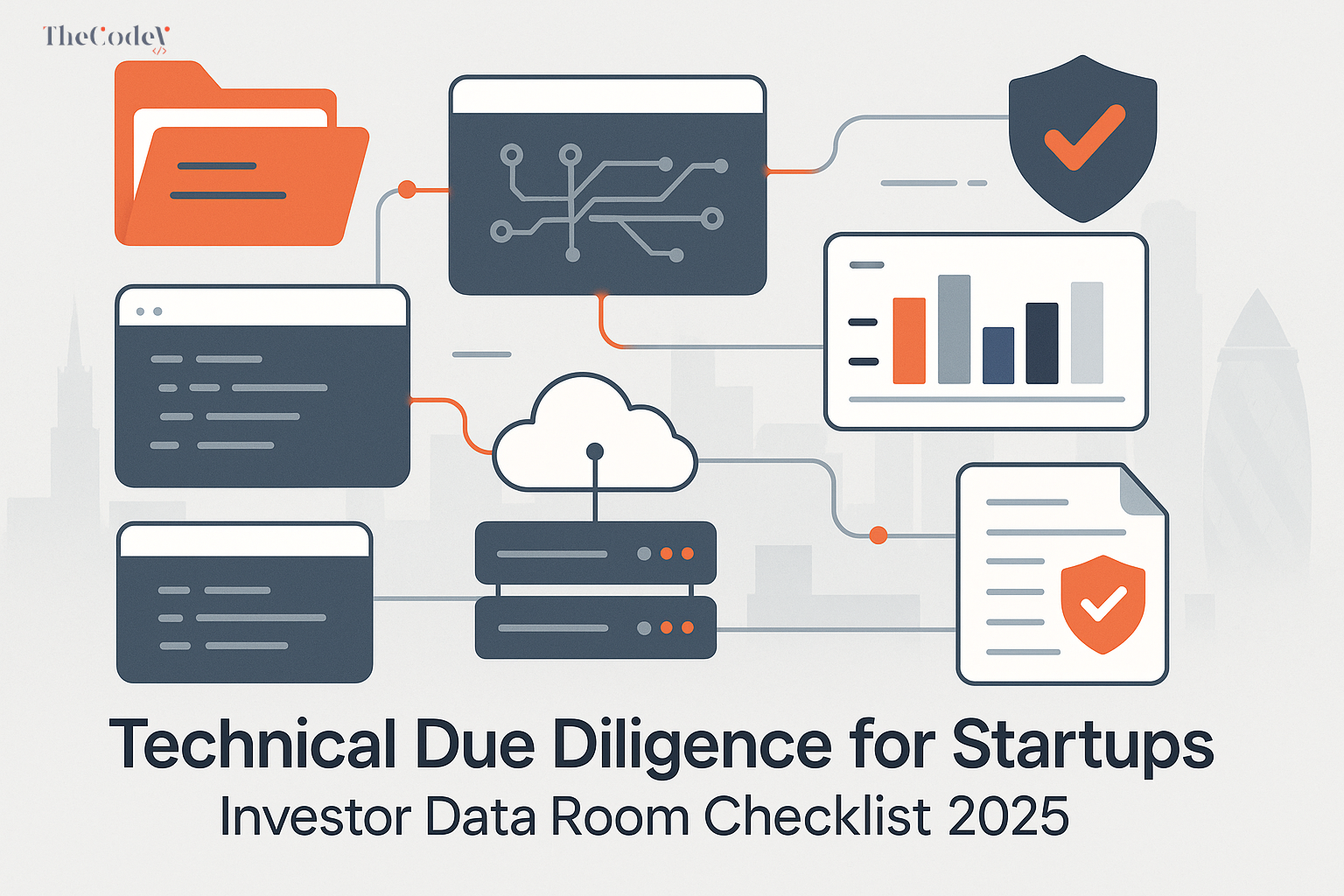
Investor Data Rooms for Seed–Series A: Technical Due Diligence for Startups Checklist
What Is Technical Due Diligence for Startups — and Why Investors Care
Raising Seed–Series A funding in the UK has become far more competitive, and investors now expect founders to demonstrate maturity in how they build, secure, and scale their product. That’s why technical due diligence for startups has moved from a “nice-to-have” to a decisive filter during early-stage investment rounds. Search interest for terms like technical due diligence for startups and tech due diligence services UK continues to rise across Google Trends and Ahrefs, reflecting how essential this process has become in the modern startup environment.
Technical due diligence examines the real state of a company’s technology—architecture, codebase quality, infrastructure, security posture, processes, and the strength of the engineering team. In practical terms, it tells investors whether your product can scale, whether it’s secure, and whether your roadmap is achievable with the technology you already have.
Understanding Technical Due Diligence for Startups UK
For UK founders—particularly those targeting angel rounds, VC backing, or SEIS/EIS-eligible investment—technical due diligence is more than a formality. It provides investors with a structured method to reduce technology risk and validate that the product story presented in the pitch aligns with the underlying engineering reality. It sits alongside financial and legal checks, forming a key part of due diligence for startup investments UK.
A poorly prepared founder loses leverage when technical due diligence uncovers issues they should have addressed months earlier.
Technical due diligence ensures the product is not only well-built today but also maintains capacity to evolve safely as the business scales. This is one of the core reasons behind why technical due diligence is important for startups aiming for meaningful traction and long-term growth.
What an Investor Data Room Really Is
An investor data room is a structured, secure digital space where founders present essential documents and artefacts required for Seed–Series A evaluation. It typically includes architecture diagrams, repository access, technical documentation, platform metrics, security policies, GDPR evidence, and details of third-party dependencies. A clean, organised data room signals a disciplined founding team and gives investors confidence that your internal processes are mature enough for significant capital.
For UK ventures preparing for SEIS/EIS, the British Business Bank and HMRC provide guidance on what constitutes a well-prepared investment case—underscoring that clarity, documentation, and transparency heavily influence investor confidence. These principles also extend directly into technical due diligence for startups.
Why UK Investors Depend on Technical DD in Seed–Series A
Angels, family offices, and early VC funds use technical due diligence to understand whether your platform can support rapid growth. They want assurance that:
Your architecture won’t collapse under scale.
Your codebase won’t require a costly rebuild post-investment.
Your DevOps and security practices comply with expectations, especially for regulated markets.
Your engineering team can actually deliver the roadmap promised in the pitch deck.
A sound technical foundation supports long-term scalability, improving your chances of converting due diligence into a term sheet.
What Technical Due Diligence for Startups Reveals to Investors
When investors evaluate a young company, they’re not only backing an idea — they’re backing the technology that will deliver it. That’s why technical due diligence for startups is now a central part of early-stage investment, especially across the UK. Whether the review is conducted by angels or through a structured technical due diligence for investors UK process, the goal remains the same: determine whether the product is robust, scalable, secure, and aligned with the commercial vision in the pitch deck.
Larger VC funds and private equity groups often rely on specialist tech due diligence services UK to conduct these assessments, especially in competitive tech hubs such as London. Even a light-touch technical due diligence London review can reveal critical gaps or validate that a startup is genuinely ready to scale.
Investors use technical due diligence to separate polished pitches from technology that can deliver long-term commercial impact.
Below, we explore the core pillars investors evaluate and the questions they typically ask when reviewing early-stage companies. These questions reflect what you’d expect to see in a VC technical due diligence checklist UK, helping founders prepare strategically.
Architecture and Infrastructure
Investors want clarity on how your product is built and whether the architecture can handle meaningful growth. They assess cloud choices, integrations, database structure, and infrastructure resilience.
Typical investor questions include:
Does the architecture support predictable scaling over the next 12–24 months?
Are there single points of failure across cloud or data layers?
Are third-party integrations reliable and properly documented?
Is observability in place to detect failures early?
This level of scrutiny helps validate whether your technology can support the commercial outcomes pitched during fundraising.
Code Quality and Technical Debt
This stage of software due diligence for startups focuses on the maintainability, readability, and stability of the codebase. Investors want to know whether the product can evolve without disproportionate engineering cost.
Key questions investors ask:
Is the repository structured logically and consistently?
How significant is the current technical debt?
Are there automated tests covering critical logic?
Does documentation reflect the current state of the system?
If investors detect unmanaged technical debt early, it may indicate future delivery risks — a major concern in due diligence for startup investments UK.
Scalability and Performance
Even strong engineering teams struggle when scaling is an afterthought. That’s why technical due diligence for venture capital UK places heavy emphasis on scalability fundamentals.
Investor questions include:
Can the platform support 5x–10x traffic growth with predictable cost?
What performance metrics or load-testing results exist today?
Where are the current bottlenecks in the application?
Are caching, CDNs, and load balancing used effectively?
Demonstrating a clear path to scale reassures them that the technology can grow with user demand.
Security, Data Protection and Compliance
Security failures erode investor confidence faster than any other technical issue. Compliance expectations are especially high for UK startups handling personal or financial data.
Typical investor questions:
Are access controls enforced consistently across environments?
How is sensitive data stored and encrypted?
Is the team following recognised security standards?
Are GDPR responsibilities documented and actively managed?
Investors need to know that security isn’t a box-ticking exercise but a foundational part of how the business operates.
Team Capability, Process and Delivery Maturity
A strong team can fix technical weaknesses, but a weak team can’t deliver even the best architecture. This pillar evaluates the people and processes behind the product.
Investors usually explore:
Does the engineering team have the skills to deliver the roadmap?
Is there a clear, repeatable DevOps pipeline?
How effective is the release process, testing discipline, and documentation?
Can the team operate without relying on one or two “hero” engineers?
When gaps appear, investors often recommend partnering with an experienced software development company such as TheCodeV (https://thecodev.co.uk/services/) to strengthen delivery capability.
Some founders also benefit from a full digital services team (https://thecodev.co.uk/digital-services/) during growth phases or while preparing for due diligence. Those looking to refine their outsourcing strategy can explore guidance like choosing the right software development company (https://thecodev.co.uk/choose-the-right-software-development-company/).
A Wider Context: Technical DD Within Investor Review Frameworks
Technical due diligence sits alongside commercial, legal, and financial evaluations. Resources such as the Startup Due Diligence Checklist from the British Business Bank or Kauffman Fellows VC Due Diligence Framework demonstrate how investors combine multiple assessment lenses — with technology forming a crucial segment of risk evaluation.
How to Build an Investor Data Room for Technical Due Diligence
By the time a startup reaches Seed–Series A, investors expect a clean, structured, and comprehensive data room that supports technical due diligence for startups. This single space becomes the backbone of investor confidence, helping them validate technology decisions, review documentation, and ensure that the engineering reality matches the pitch. For many founders preparing for pre-investment technical due diligence UK, getting the data room right can significantly accelerate a deal.
A well-organised data room follows a consistent technology due diligence framework UK, avoids unnecessary clutter, and presents technical evidence in a way that investors can navigate easily. It signals maturity and reduces uncertainty for anyone using an investor tech due diligence template to review your materials.
Core Folders to Include
An investor-ready data room brings structure to complexity. While every startup is unique, most Seed–Series A investors expect to see the same foundational categories that appear in any strong technical due diligence checklist for startups or startup technical audit UK process.
Here’s a simple structure you can adopt:
Architecture diagrams and infrastructure documentation
Code repository overviews and engineering documentation
Product roadmap, backlog, and release notes
Security policies, incident logs, and access control lists
Data protection, GDPR, and compliance evidence
IP ownership, licences, and third-party dependency records
These folders provide investors with a reliable baseline for evaluating whether your technology can support growth and withstand scrutiny during buy side technical due diligence UK or future sell side technology due diligence UK events.
Managing Access and Permissions
A data room is only useful when managed correctly. Startups should apply clear naming conventions, maintain version control, and assign ownership to a single team member who ensures consistency. Read-only permissions should be standard for external stakeholders, and sensitive assets should be shared only when essential.
Investors reviewing technical due diligence for startups expect transparency without compromising security. Maintaining a changelog also helps investors trace updates over time, especially when multiple specialists or firms contribute to due diligence.
When founders need to streamline documentation or contracts, tools for standardising contracts and e-signing can help ensure consistent processes. You can explore this approach via TheCodeV’s solution here:https://thecodev.co.uk/e-contract/
Keeping Your Data Room Deal-Ready
Data rooms work best when treated as living assets rather than last-minute exercises. For most startups, reviewing documentation quarterly helps prevent outdated diagrams, inconsistent versioning, and misaligned roadmaps.
This process becomes even more important when scaling, preparing for M&A, or responding to repeat investor checks. A strong data room is also a strategic asset during operational planning, especially when working with a digital services partner to improve architecture or delivery processes:https://thecodev.co.uk/digital-services/
Founders wanting deeper technical context can explore technical guides and insights to improve data room readiness:https://thecodev.co.uk/blog-page/
Pro tip: Update your investor data room every quarter, not only when fundraising. It keeps documentation aligned and reduces deal friction later.
The Core Technical Due Diligence Checklist for Startups
A well-prepared technical review gives investors the confidence that your product can scale, remain secure, and support long-term commercial growth. This is where technical due diligence for startups becomes a decisive factor. Investors, advisors, and even technical due diligence experts London rely on structured frameworks to investigate how your technology is built and how it will behave under pressure.
This section breaks down the core pillars examined during software due diligence for startups, helping founders understand what belongs in the data room — and what questions investors will inevitably ask.
Strong technical foundations reduce risk, accelerate term sheets, and strengthen investor trust across every future round.
Architecture and Infrastructure
Architecture is the first lens of any software architecture review for investors. It shapes investor understanding of how your product behaves today and how it might perform when user demand increases.
Investors typically review:
Cloud provider decisions and how they influence cost and resilience.
Multi-region or multi-zone strategies for availability.
Data flows, integrations, and dependency mapping.
System observability and monitoring maturity.
A common investor question is: “What happens if this grows 10x next quarter?”
Your architecture diagrams should answer this before the question arises.
For clarity, founders can explore cloud providers comparison for scalable architectures to support decision-making:https://thecodev.co.uk/cloud-providers-comparison-2025/
In your data room, investors expect:
Updated system architecture diagrams.
Infrastructure-as-code samples (if used).
Integration maps and dependency lists.
These artefacts help validate structural integrity and scalability alignment.
Code Quality and Technical Debt
Code quality determines how fast a startup can ship features and fix issues. During technical due diligence for startups, reviewers dive into repository structure, branching discipline, test coverage, and documentation quality.
Key investor examination points include:
Repository layout and naming patterns.
Automated testing coverage and reliability.
Use of linters, style guides, and CI checks.
Documentation clarity and accuracy.
Uncontrolled debt can derail future delivery, which is why a technical debt assessment for startups is so impactful. Investors look for signs of mounting debt, such as inconsistent patterns, duplicated logic, or brittle legacy components.
In the data room, reviewers expect:
A clear README and setup guide.
Test coverage reports.
Documentation outlining major technical decisions.
Scalability and Performance
For many teams, this is where red flags appear. A strong scalability assessment for startup technology examines the behaviour of your platform under growth pressure.
Investors typically review:
Load-testing reports and capacity metrics.
Known bottlenecks and remediation plans.
Caching strategies for performance stability.
Database scaling approaches and read–write separation.
This is especially important for companies approaching repeatable revenue, where scaling failures can damage customer trust. For growing companies or tech due diligence for scaleups UK, scalability maturity is non-negotiable.
Founders building SaaS applications can learn more about scaling considerations in SaaS development for entrepreneurs:https://thecodev.co.uk/saas-development-for-entrepreneurs/
In your data room, investors expect:
Performance benchmarking results.
Load-testing outputs.
Monitoring dashboards or screenshots showing system health.
DevOps, Release Process and Reliability
A startup’s ability to ship reliable updates is a major signal of operational maturity. This part of the technical due diligence for startups checklist confirms whether your team can deliver consistently and recover quickly from incidents.
Investors will assess:
CI/CD pipelines and automation levels.
Rollback and hotfix procedures.
On-call workflows and incident response.
Documentation for reliability practices.
A smooth release cycle reduces operational risk and aligns engineering capability with commercial priorities.
In your data room, investors expect:
CI/CD configuration samples.
Runbooks for incident handling.
Uptime history or SLO/SLA definitions.
If your team works with external specialists or uses custom software development in the UK, this documentation becomes even more important for clarity and continuity.
What Investors Want to See — At a Glance
Here are the core artefacts most investors expect in a well-prepared technical data room:
Architecture diagrams
Test coverage and quality reports
Performance and load-testing results
Security and incident response documentation
Release process and DevOps runbooks
Security, GDPR and IP: Non-Negotiables in Technical Due Diligence for Startups
Security, compliance, and intellectual property form some of the most heavily scrutinised elements of technical due diligence for startups. As cyber incidents rise across the UK, investors now expect founders to demonstrate mature controls, documented processes, and clear ownership of the technology they are building. Specialist teams conducting cyber security due diligence for startups UK often uncover issues that can delay or completely block investment, especially in regulated or data-sensitive sectors.
This section breaks down the critical areas investors investigate when assessing risk, compliance, and long-term defensibility.
Investors move away fast when a startup cannot demonstrate control over data, access, and intellectual property.
Cyber Security
Security is now a board-level concern. Investors and consultants performing cyber security due diligence UK regulations checks examine whether your systems can prevent, detect, and respond to threats.
They assess:
Access control policies and authentication mechanisms.
Encryption standards for data in transit and at rest.
Logging and monitoring coverage across environments.
Incident management processes and historical breach reports.
Most UK investors expect alignment with the National Cyber Security Centre’s (NCSC) small business guidance:
https://www.ncsc.gov.uk/collection/small-business-guide
Strong documentation in this area reassures investors that your platform is protected against avoidable vulnerabilities.
GDPR & Data Protection
Data protection failures are among the most common reasons early-stage deals stall. For data protection and GDPR due diligence UK startups, investors verify whether your organisation has lawful, transparent, and documented data practices.
They review:
Records of processing activities.
Data Protection Impact Assessments (DPIAs).
Privacy notices and consent flows.
Data retention and deletion policies.
Third-party processor agreements.
Accessible and accurate privacy documentation is crucial. Founders should maintain a clear and compliant privacy policy:https://thecodev.co.uk/privacy-policy/
Guidance from the Information Commissioner’s Office (ICO) remains the gold standard for GDPR compliance:
https://ico.org.uk/for-organisations/
IP & Licensing
Ownership and licensing are central to ip due diligence for tech startups UK. Investors want to know exactly who owns the code and whether any external dependencies create legal or operational risk.
Key checks include:
Agreements confirming founders and contractors assigned full IP rights.
Licences for third-party tools and libraries.
Open-source compliance and tracking.
Documentation showing no hidden liabilities.
This is closely linked with broader legal due diligence for startups UK, ensuring long-term defensibility and clarity around core assets.
Founders should also maintain up-to-date legal documents, including terms & conditions, which help establish fair risk allocation:https://thecodev.co.uk/terms-conditions/
SEIS/EIS Readiness and Investor Protection
For many early-stage companies, s/eis investor due diligence UK startups is a parallel thread that intersects with technical review. Investors check whether the business meets eligibility requirements and whether its technical practices align with long-term compliance expectations.
Private equity and venture firms performing technology due diligence for private equity UK often examine:
Governance maturity.
Business continuity plans.
Evidence that technical practices support future regulatory compliance.
Government guidance via HMRC or British Business Bank can also influence investor expectations, especially for businesses planning rapid scale.
Security & Compliance Artefacts Investors Expect
A well-organised data room should include:
Data Protection Impact Assessment (DPIA)
Incident and vulnerability register
Access control and security policy
Processor agreements and Data Processing Addendums (DPAs)
Privacy notice and GDPR compliance documents
IP assignment contracts
Open-source licence audit
Business continuity and disaster recovery plans
When founders work with secure development partners or a digital services team (https://thecodev.co.uk/digital-services/), these artefacts become easier to maintain and update.
Why Startups Fail Technical Due Diligence — and How to Prepare
Even strong founding teams can be caught off guard by technical due diligence for startups. The problem is rarely bad intent. It is usually rushed preparation, hidden technical debt, or a gap between the narrative and the reality of the stack. Investors use structured technology due diligence framework UK approaches to surface these risks quickly.
Handled well, technical review becomes a trust-building moment. Handled badly, it turns into a list of reasons to walk away.
Technical due diligence is not an exam to fear, but a spotlight you can shape in your favour.
Common Failure Modes
There is a pattern to startup failed technical due diligence reasons. Once you understand these patterns, you can design your roadmap around them.
1. No documentation and chaotic repos
Many teams arrive with no architecture diagrams and messy repositories. Reviewers see this as a direct execution risk. It suggests the company will struggle to onboard engineers and maintain velocity under pressure.
2. Unmanaged technical debt and untested critical paths
Ignoring a technical debt assessment for startups is expensive later. When core user journeys lack tests or resilience, investors question whether the product can support real-scale customers.
3. Security gaps and poor GDPR posture
Basic security controls, access management, and GDPR evidence are sometimes missing entirely. This undermines technical due diligence to reduce investment risk, especially for sectors handling personal or payment data.
4. Over-reliance on one or two key engineers
If only one person understands the architecture, the bus factor is effectively one. Investors worry about continuity, hiring, and crisis response, especially for distributed teams.
5. Mismatch between deck narrative and codebase reality
Investors also perform a tech risk assessment for startup investment. When the pitch promises AI-driven automation and the code is a fragile prototype, trust disappears quickly.
These themes appear in many investor playbooks and advisory reports on why technical due diligence fails. They form the backbone of most structured risk frameworks used by funds and consultancies.
Preparation Roadmap
Founders often ask how to prepare for technical due diligence without losing focus on growth. The answer is to work in phases, starting three to six months before a planned raise.
Run an Internal Technical Health Check
Begin with a startup technical health check checklist. Review architecture, code quality, security, documentation, and delivery practices. Capture findings in a simple internal report.
This can be done in-house or via a technical due diligence consultancy UK. Some teams also run a light external review in cities like London or through specialists offering technical due diligence Birmingham support to widen perspective.
Clean Up Repositories and Documentation
Next, organise your repos and write the missing basics:
Clear README files.
Setup instructions.
High-level architecture diagrams.
Comments for complex modules.
This step aligns your day-to-day practices with any technology due diligence framework UK an investor may use.
Run a Security and GDPR Review
Then run a focused security and data protection pass. Close easy wins first:
Harden access control.
Review secrets management.
Validate logging and monitoring.
Refresh GDPR documentation and links to policies.
This work strengthens your position when investors examine cyber risk and operational resilience.
Align the Technical Story with the Pitch
Finally, rehearse your “technical story”. Ensure your deck, roadmap, and engineering reality match. Your explanation of trade-offs and priorities should feel honest, confident, and consistent with what reviewers will see in the data room.
This story is a crucial part of technical due diligence for startups, as investors listen closely for gaps between words and implementation.
Working with External Experts
Some founders choose to bring in external partners before opening the data room. A senior partner like TheCodeV can help you book a technical consultation with TheCodeV to shape the roadmap and prioritise remediation work:https://thecodev.co.uk/consultation/
Others also work with specialist implementation teams, such as EmporionSoft, to execute refactors, harden infrastructure, or accelerate delivery under guidance. Strategy and architecture can sit with TheCodeV, while implementation support comes from a trusted technical ally.
Aligning scope, budget, and timelines against investor expectations is easier when supported by transparent pricing plans:https://thecodev.co.uk/pricing-plans/
For earlier-stage teams, a structured project questionnaire can kick off discovery and highlight risk areas before investors see them:https://thecodev.co.uk/questionnaire/
Many of these approaches mirror industry frameworks published by major advisory firms and venture funds on how they structure technical risk assessments.
Top 5 Actions to Take in the Next 90 Days
To turn preparation into momentum, focus on these five moves:
Run a lightweight internal technical audit and capture key risks.
Produce clean architecture diagrams and tidy your repositories.
Address obvious security and GDPR gaps with documented fixes.
Document your delivery process, from planning to release and incident response.
Rehearse a clear, honest technical narrative that matches the codebase.
Taken together, these steps transform technical due diligence for startups from a stressful unknown into a controlled, strategic exercise that supports your next funding round.
Turning Technical Due Diligence into a Strategic Advantage
A well-prepared startup doesn’t fear investor scrutiny — it uses it to stand out. When founders treat technical due diligence for startups as a continuous discipline, it transforms fundraising from a stressful obligation into a competitive advantage. A robust data room, clear documentation, and mature engineering practices signal that your team can scale responsibly, deliver reliably, and protect investor capital.
Strong preparation reduces uncertainty, accelerates legal and technical review, and strengthens your negotiation position. These same foundations also support later opportunities, including technical due diligence for M&A UK, cross-border expansion, and larger Series rounds. Whether you’re approaching angels, private equity firms, or teams specialising in technical due diligence for venture capital UK, readiness demonstrates credibility.
As investors increasingly use structured frameworks and government-backed guidance (such as NCSC and ICO recommendations), startups that invest early in security, compliance, and architecture resilience consistently outperform those that rush last-minute fixes.
From Risk Checklist to Growth Lever
Due diligence is not only an audit — it’s a signal of operational maturity. With the right technical groundwork, it becomes a springboard for better valuations and cleaner deals. The same principles apply whether you’re facing buy side technical due diligence UK, preparing for sell side technology due diligence UK, or seeking support from technical due diligence experts London during a complex round.
Founders in fast-moving tech hubs such as London, Manchester, Birmingham, Cambridge, and Edinburgh increasingly recognise that excellence in due diligence is a long-term investment, not a one-off effort. Even implementation partners like EmporionSoft often step in to support delivery work, but strategic direction, architecture planning, and investor-readiness remain where TheCodeV excels.
Here are the three biggest benefits of building due diligence readiness early:
Faster funding cycles and reduced investor hesitation.
Higher confidence in scalability and long-term platform integrity.
Stronger valuation and negotiation position during Seed–Series A and exit events.
How TheCodeV Helps You Stay Investor-Ready
A partner like TheCodeV supports founders through every stage of the journey. Our team helps you build scalable architecture, strengthen code quality, and implement secure-by-design development practices. We also help you establish a repeatable process for investor data rooms — ensuring consistency, clarity, and confidence across every round.
Founders exploring how to prepare for sustained growth can start with our dedicated digital services (https://thecodev.co.uk/digital-services/) or discover what’s possible through our broader services offering (https://thecodev.co.uk/services/). If you’re planning a raise or technical review, you can also book a consultation (https://thecodev.co.uk/consultation/) to discuss your architecture, roadmap, or platform challenges.
For general enquiries or to begin scoping your next major build, reach out directly through our contact page:https://thecodev.co.uk/contact/
Your technology tells a story — make sure it’s one investors want to believe in. The strongest founders don’t wait for due diligence; they prepare for it long before the deal.
Start shaping that story today with TheCodeV:
👉 Explore our capabilities at thecodev.co.uk (https://thecodev.co.uk/)
👉 Begin your investor-readiness journey with a consultation
👉 Build a scalable, secure, investment-ready platform that grows with your ambition



One Comment
[…] Governance also needs to mature alongside deployment capability. As products grow, so do regulatory, security, and availability expectations. Zero downtime deployment provides a foundation for meeting these demands, but only when deployment controls are visible and auditable. This is often where external reviews or technical due diligence exercises become useful, such as those described in technical due diligence for growing technology companies. […]