AI Procurement Guide for UK SMEs (Vendor & Risk Checklist)
AI procurement UK decisions should start with risk, not demos. A strong SME buying process defines the business problem, checks data and security exposure, tests operational fit, and negotiates clear vendor obligations before signing. The right vendor is not the most impressive one. It is the one your team can govern, deploy, and exit safely.
Why AI procurement is now a board level SME decision
AI buying used to look like ordinary software procurement. For many SMEs, it no longer does. An AI tool may process customer data, generate decisions that affect workflows, change team responsibilities, and introduce a new dependency on external models or platforms.
That shifts procurement from an isolated IT purchase into a management issue. Finance cares about spend certainty. Operations cares about process reliability. Security cares about data exposure. Leadership cares about reputation, accountability, and whether the purchase creates a durable advantage or a fresh layer of complexity.
The pace of adoption also changes the stakes. Teams can subscribe to AI products quickly, often without the discipline normally applied to enterprise software. That speed is useful, but it also makes informal procurement more dangerous. When a tool moves from experimentation into production, the costs of weak due diligence become visible very quickly.
For UK SMEs, the board level dimension usually shows up in five places:
- the AI system touches sensitive customer, employee, or commercial data
- the tool influences decisions, recommendations, or client facing output
- the vendor becomes part of a core delivery workflow
- implementation requires integration work across internal systems
- the contract creates ongoing dependency on one provider, model, or cloud platform
This is why a buying conversation needs more than a product owner and a sales call. Someone must own risk acceptance. Someone must own delivery. Someone must own the renewal decision twelve months later, when the early excitement has faded and the real operating cost is clear.
A practical board level lens also improves the quality of the business case. Instead of asking, “Can this AI tool do something impressive?”, leadership asks better questions. Which workflow becomes faster, cheaper, or more reliable? What data leaves the organisation? What controls remain with us? What happens if the supplier changes pricing, service levels, or model access?
The strongest procurement teams define value in operational terms. That means a measurable reduction in manual work, faster handling times, better service coverage, improved quality control, or more scalable internal processes. It also means accepting that many AI purchases are not about outright automation. They are about augmented work, better retrieval of internal knowledge, and controlled decision support.
If your organisation is still shaping its AI posture, AI in business UK 2025 provides useful context on where adoption is heading, while AI governance for startups UK helps frame ownership and accountability. Those governance questions matter before procurement, not after.
A mature buyer treats AI procurement as a portfolio decision. Some tools will remain lightweight and tactical. Others will become part of how the company serves clients, secures information, or manages internal operations. The closer a tool gets to those functions, the more senior the procurement conversation needs to be.
Where UK SMEs go wrong when buying AI tools
Most failed AI procurements do not fail because the technology is useless. They fail because the buying process is shallow. The organisation purchases a capability before it defines the operating context.
The first common mistake is buying the demo. AI vendors are often very good at showing a controlled example. That does not prove the system will perform well with your documentation, your workflow volume, your customer language, or your error tolerance. A compelling demo is evidence of potential, not proof of fit.
The second mistake is starting with the tool instead of the use case. Teams often say they want an AI assistant, an AI agent, or an AI knowledge base. Those are product labels, not procurement requirements. The better starting point is the business problem. What delay, bottleneck, service issue, or repetitive workload are you trying to change?
The third mistake is ignoring the data path. Many SMEs underestimate where the AI system gets its inputs, how those inputs are retained, whether prompts are logged, which third parties are involved, and how generated outputs are reviewed. That gap becomes serious once the system handles internal policies, client records, financial information, or commercially sensitive material.
The fourth mistake is failing to price the full operating cost. Subscription fees rarely tell the whole story. Integration work, workflow redesign, testing, prompt or knowledge engineering, user training, monitoring, and support can exceed the licence cost over time. How much does AI software cost? is useful here because it breaks cost thinking away from headline vendor pricing.
The fifth mistake is weak ownership. An SME may buy an AI tool through one enthusiastic team, but no one owns rollout standards, quality thresholds, incident handling, or renewal criteria. This is where experiments drift into hidden risk. Someone needs authority to decide where the tool may be used, what data it may access, and how its performance is reviewed.
The sixth mistake is skipping the exit question. AI suppliers evolve quickly. Pricing changes, models improve or degrade, platforms merge, and product roadmaps shift. If the vendor becomes embedded in your workflow, the cost of switching later can be high. Procurement should therefore test not only adoption friction, but also disengagement friction.
The seventh mistake is treating AI as a bolt on instead of part of a system. A useful AI product normally depends on data quality, permissions, APIs, process design, and user behaviour. That means the value of the tool depends as much on your implementation discipline as on vendor capability. Startup scaling mistakes tech makes a similar point in a broader operational context.
A better buying habit is to assume that every AI purchase touches four layers at once:
- business objective
- data and security model
- implementation and integration effort
- supplier and contract risk
When SMEs review these layers early, they stop overpaying for novelty and start buying systems they can actually run. That is the difference between AI experimentation and useful procurement.
What UK constraints should shape AI vendor selection?
UK SMEs should select AI vendors against three practical constraints first: data protection, security assurance, and operating accountability. Sector specific requirements, such as fintech controls or NHS related standards, matter too, but they sit on top of those core constraints rather than replacing them.
The first UK constraint is data protection. If an AI system uses personal data, supports decisions about people, or analyses records that can identify individuals, the organisation must understand the lawful basis, the processing purpose, the data flow, and the impact on data subject rights. The ICO guidance on AI and data protection is useful because it connects AI use to accountability, fairness, transparency, and accuracy. The ICO AI and data protection risk toolkit is even more practical for risk review.
For procurement, this means asking specific questions. Does the vendor process personal data as a processor, or use it for broader product improvement? Can data residency be controlled? Are prompts retained? Can records be deleted? Is there a clear data processing agreement? A supplier that answers these vaguely is already telling you something important.
The second constraint is security assurance. AI systems introduce the same baseline security concerns as any cloud software, but often with a larger attack surface because they connect to documents, knowledge stores, APIs, and user generated instructions. The NCSC guidelines for secure AI system development make the point clearly: secure design, secure deployment, and secure operation matter across the life cycle. Internal reading on secure by design for startups and SOC 2 vs ISO 27001 can help your team interpret supplier security evidence more realistically.
The third constraint is operating accountability. UK businesses need to know who is responsible when the AI system behaves badly, produces poor output, or creates workflow disruption. This is not only a legal issue. It is a delivery issue. A procurement process should define who reviews outputs, who signs off on live use, who investigates incidents, and who can suspend the tool if risk increases.
Sector context adds another layer. In regulated environments, such as FCA adjacent fintech products, the standard of record keeping, oversight, explainability, and customer outcome scrutiny is typically higher. In health related settings, even where formal NHS clinical standards do not directly apply, the expectations around safety, governance, and change control are materially stronger. Buyers should avoid generic assurances and ask for evidence aligned to their own sector.
There is also a delivery model question. Some SMEs procure a tool and then hire contractors or consultants to integrate it. In that case, implementation risk does not sit only with the vendor. Commercial structure, responsibility boundaries, and status considerations matter, including where work is delivered through contractors. IR35 software contractors is relevant if your delivery model relies on external specialists rather than a full vendor managed rollout.
The Artificial Intelligence Playbook for the UK Government is written for the public sector, but its logic translates well to SMEs. It treats AI as a life cycle decision, not a procurement event. That is the right mental model. Selection should not focus only on capability. It should focus on whether your business can operate the capability responsibly once it goes live.
AI procurement UK risk checklist before you sign
A strong AI buying process uses a checklist not as bureaucracy, but as a test of whether the supplier is ready for real business use. The point is not to gather paper. The point is to reduce preventable surprises.
Start with data risk. Ask what data the system needs, where it comes from, where it is stored, and whether it is used to train or improve models outside your tenant. Confirm retention periods, deletion options, access controls, and whether the vendor uses sub processors. If the answers are unclear, treat that as a material risk, not a minor administrative gap.
Move next to model risk. Buyers should know whether the product uses the vendor’s own model, a third party model, or a mixture. That matters because it affects performance consistency, dependency, and future pricing. It also affects explainability, change management, and support. If the supplier changes the underlying model without meaningful notice, your outputs may change too.
Security risk comes after that. Ask for evidence, not slogans. A useful security pack may include policies, architecture summaries, encryption details, access control design, incident response process, vulnerability management practice, and independent assurance where available. OWASP API security is relevant because many AI tools expose or rely on APIs, and AI cybersecurity helps frame the wider risk picture.
Then review workflow risk. An AI system may be technically safe but operationally weak. Buyers should ask how the product handles errors, low confidence responses, audit trails, user permission levels, escalation, and human review. A tool that fits poorly into real work often fails regardless of model quality.
Contract risk is another major area. Review service scope, data usage rights, confidentiality, intellectual property treatment, service levels, support commitments, limitation of liability, breach notification, and exit terms. AI vendors sometimes use broad contractual language to protect flexibility. Procurement should narrow that flexibility where it would increase business risk.
Finally, review dependency risk. Ask what happens if you want to leave. Can you export prompts, knowledge assets, configuration, logs, and training data? How long does transition support last? Can the product operate with a different model provider if the vendor changes strategy? Exit planning is not pessimism. It is procurement discipline.
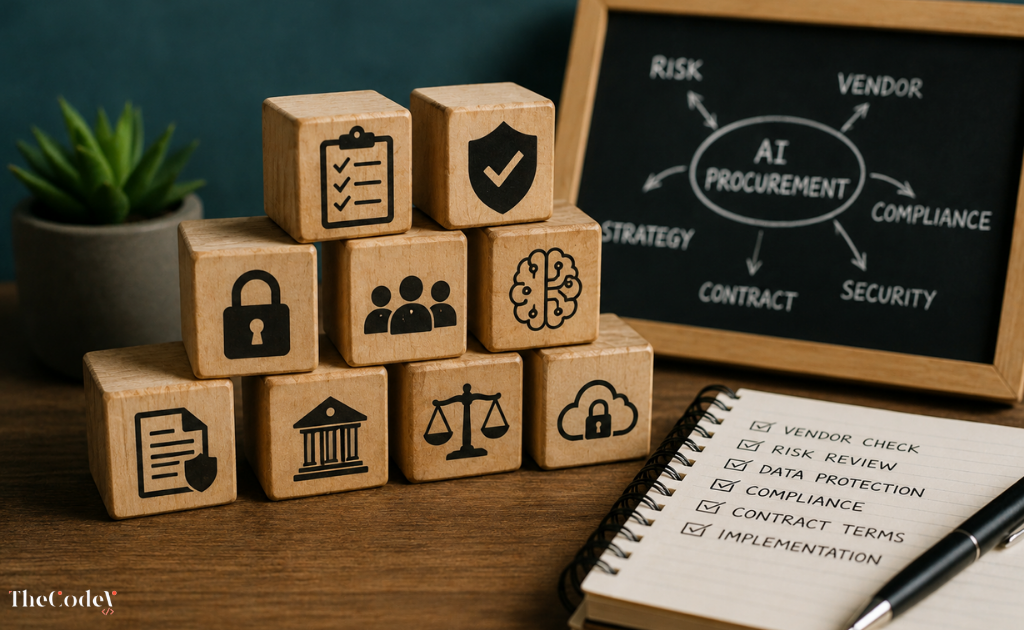
A practical checklist should cover at least these seven areas:
- Data handling
data types processed, retention, deletion, residency, sub processors, and training use - Model governance
model provider, update policy, evaluation method, fallback behaviour, and accuracy thresholds - Security controls
identity and access management, encryption, logging, monitoring, secure development, and incident response - Operational fit
integrations, workflow compatibility, permissions, supervision, and user experience - Commercial terms
pricing logic, usage caps, overage charges, service levels, and renewal mechanics - Legal protection
data processing terms, confidentiality, liability allocation, and notification obligations - Exit readiness
portability, migration support, deletion confirmation, and dependency management
For LLM based tools, buyers should also review the OWASP Top 10 for Large Language Model Applications. It highlights risks such as prompt injection, insecure output handling, and supply chain weaknesses. Those issues are not abstract. They affect whether your AI system can be trusted in production.
The purpose of this checklist is simple. If the supplier cannot explain how the system works, how it is secured, and how it is controlled, you are not buying confidence. You are buying opacity.
How to evaluate an AI vendor beyond the product demo
Most AI procurement errors happen because the vendor is evaluated as a product, not as an operating partner. A buyer needs to assess both the software and the supplier’s ability to support it in a live environment.
The first step is to separate claims from evidence. A vendor might say the system is secure, accurate, fast, and enterprise ready. That is marketing language until the supplier shows how those claims are supported. Procurement should ask what has been measured, what has been tested, and what assumptions sit behind the product’s best results.
Architecture matters here. Ask where the AI capability sits in the stack. Is the vendor wrapping a third party foundation model, or has it built proprietary retrieval, orchestration, evaluation, and control layers around it? That distinction matters because it affects defensibility, performance tuning, and resilience when third party providers change pricing or access policies.
You should also test evaluation discipline. Good AI vendors can explain how they judge output quality, reduce hallucination risk, and monitor performance over time. They should be able to describe test sets, failure scenarios, and the conditions where human review is required. Technical due diligence for startups is relevant because AI vendor review should feel more like due diligence than casual feature comparison.
Operational maturity is another differentiator. Ask how the supplier handles onboarding, implementation, permissions, change requests, and support. Who helps with configuration? Who owns integration issues? What level of monitoring exists post launch? LLMOps for startups is useful because it shows why a production AI system needs ongoing oversight rather than a one off deployment.
Reference checking is often overlooked. Buyers should speak to customers who resemble their own context, not just marquee logos. The useful questions are practical. What failed during rollout? How responsive was the supplier? Did usage expand or shrink after launch? Were cost expectations realistic? Would they buy the same product again?
A proof of concept can help, but only if it is designed properly. A weak proof of concept gives the vendor complete control over success conditions. A useful proof of concept uses your data, your workflow, and your acceptance criteria. It should test both quality and operational fit. It should also define what counts as failure.
When evaluating a vendor, look for strength in these six dimensions:
- Problem fit
the product clearly addresses a defined business issue - Technical fit
the architecture integrates with your systems and constraints - Risk fit
the supplier provides clear evidence on security, privacy, and governance - Operational fit
the product can be run by your team without hidden friction - Commercial fit
the pricing model aligns with expected usage and support needs - Strategic fit
the supplier’s roadmap matches where you need the capability to go
The best vendor is not always the one with the most advanced AI feature set. It is usually the one with the clearest delivery model, the most transparent risk posture, and the strongest fit with your operational reality. Procurement should reward that maturity.
Build, buy, customise, or integrate: which AI procurement route fits?
The right route depends on three factors: how distinctive the use case is, how sensitive the data is, and how much control your business needs over workflow, quality, and future flexibility. Most UK SMEs should not start by building from scratch, but many should avoid buying an inflexible black box.
This decision is where many teams drift into false simplicity. Buying a ready made AI tool looks faster. Building looks more flexible. Customising looks like a compromise. Integration looks cheap. In practice, each route changes cost, risk, speed, and governance in different ways.
A helpful starting point is Build vs buy framework. For AI specifically, the decision usually falls into four routes.
| Route | Best fit | Main strengths | Main risks | Typical buyer |
|---|---|---|---|---|
| Buy standard AI SaaS | common workflows, low differentiation | fastest deployment, lower upfront spend | limited control, vendor lock in, generic fit | small teams needing quick wins |
| Customise vendor platform | known workflow with moderate complexity | faster than custom build, better fit than pure SaaS | integration effort, variable roadmap control | growing SMEs with specific process needs |
| Integrate AI into existing systems | internal tools, knowledge workflows, automation | preserves current stack, better workflow continuity | architecture complexity, support burden | tech enabled SMEs with internal capability |
| Build custom AI solution | differentiated workflow or product feature | maximum control, strong strategic fit | higher delivery cost, governance burden, longer time to value | firms with unique requirements or regulated needs |
Buying standard AI SaaS makes sense when the workflow is common, the data is manageable, and the business wants speed. Examples include meeting summaries, internal search, support drafting, or basic document handling. The trade off is control. If the use case becomes core to your service model, a generic SaaS tool may become restrictive.
Customising a vendor platform works when the workflow is not fully standard but also does not justify a ground up build. This route often suits CRM assistance, case handling, internal knowledge retrieval, or structured content workflows. Procurement should test how much configuration is really possible and who owns the customisation logic.
Integration often fits better than many SMEs expect. If you already have strong internal systems, the highest value path may be to add AI into those workflows rather than replace them. This route often benefits from solid retrieval and orchestration design. RAG architecture best practices is especially relevant where business value depends on trusted internal knowledge rather than open ended generative output.
Custom build becomes attractive when the workflow is commercially distinctive, the compliance burden is high, or the AI capability will become part of your product itself. This is not only a technical choice. It is a strategic one. Custom software development UK gives a broader view of when bespoke delivery makes business sense.
The key is to avoid binary thinking. Many successful AI procurement strategies are hybrid. An SME may buy a foundation capability, customise part of the workflow, and integrate it into its own stack with careful controls. That often produces a better balance of speed and control than either pure SaaS or pure build.
How should UK SMEs run an AI procurement process?
UK SMEs should run AI procurement as a staged decision process: define the use case, set risk thresholds, shortlist suppliers, test with real data, complete due diligence, negotiate clear terms, and only then move into controlled rollout. Speed matters, but decision quality matters more.
A usable process does not need to be heavy. It needs to be structured. The mistake many teams make is compressing discovery, due diligence, and contracting into one sales cycle. A better process creates stage gates, each with a clear decision.
Here is a practical seven step model.
- Define the business case
Start with the workflow problem, expected outcome, and success measure. This could be reduced handling time, improved knowledge access, lower support cost, or better internal productivity. State what the AI system must do, and what it must not do. - Classify data and risk
Identify the information involved, the users affected, and the consequence of failure. If the system touches personal data, regulated processes, or commercially sensitive material, raise the due diligence threshold immediately. - Create a supplier scorecard
Use weighted criteria across capability, security, privacy, implementation fit, commercial terms, and support. This prevents the most persuasive demo from dominating the process. - Shortlist and test
Run a proof of concept or pilot with representative data and pre agreed acceptance criteria. Test not only quality, but also controls, user behaviour, and integration effort. - Complete due diligence
Review security evidence, privacy terms, architecture, subcontracting, resilience, support model, and exit mechanics. The GOV.UK guidelines for AI procurement are public sector oriented, but the discipline around supplier evaluation is still useful. - Negotiate contracts around real risk
Focus on data use, confidentiality, change control, service levels, notification obligations, and termination support. Do not let the contract assume generic software risk if the AI capability will influence material business decisions. - Launch with controls
Go live with defined permissions, user guidance, output review, monitoring, and named ownership. Procurement should not end at signature. It should hand over to an operating model.
For larger or more structured organisations, there is also a useful lesson in GOV.UK PPN 017 on transparency of AI use in procurement. It reinforces that AI related commercial decisions need clarity, disclosure, and scrutiny, especially where the technology affects evaluation or downstream services.
Internal delivery capability also matters. If your procurement route depends on custom integration or workflow engineering, make sure your implementation model is clear before contracting. Custom software development UK can help frame that delivery choice. If external specialists will be involved, think carefully about contractual structure and responsibility boundaries, including issues discussed in IR35 software contractors.
A simple process often beats a sophisticated one that no one follows. The goal is not ceremony. The goal is to make sure the AI system you buy can survive contact with real business use.
What responsible AI procurement looks like after purchase
The procurement decision is only the first half of the job. Responsible buying becomes visible after launch, when the system meets real data, real users, and real process pressure. This is where a mature buyer separates experimentation from operational capability.
Post purchase governance should answer four questions. Is the system delivering the expected business value? Is it staying within its approved risk boundaries? Is the supplier meeting its obligations? Is the organisation still comfortable with the level of dependency created?
That requires a light but deliberate operating model. Most SMEs do not need a large governance committee. They do need a named owner, a review cadence, and a clear set of triggers for escalation.
A sensible post purchase rhythm usually includes:
- monthly usage and outcome review
- incident and quality review
- security and privacy change review
- supplier roadmap and pricing review
- renewal or exit assessment before contract rollover
The review should not focus only on whether people like the product. It should examine whether the tool is improving the target workflow, where it fails, how often humans intervene, and whether new controls are needed. If the AI capability is moving closer to customer decisions or automated action, the review standard should become stricter.
This is also where supplier maturity matters. Some tools are excellent for early experimentation but weak for sustained production use. Others become more valuable over time because they support workflow refinement, retrieval quality, and governance. If your roadmap includes deeper automation, AI agents for operations is a useful next read because agentic systems introduce more responsibility, not less.
Commercial discipline matters too. Renewal should be earned. If usage is low, output quality is inconsistent, or support is poor, procurement should revisit the original case rather than defaulting into extension. Equally, if the tool is delivering value but the operating model is weak, the right response may be process improvement rather than replacement.
For SMEs that need a more tailored route, a consultative review can be more useful than a generic product comparison. If you are weighing vendor selection, custom integration, or a phased implementation model, TheCodeV consultation and TheCodeV services are relevant starting points. The useful outcome is not a bigger shortlist. It is a clearer decision path.
Responsible procurement ultimately means buying AI you can explain, monitor, and change when needed. That is the standard that protects budgets, data, and operational confidence.
What should an SME ask an AI vendor first?
Start with the data path, the intended workflow, and the control model. Ask what data is processed, whether it is retained or reused, how outputs are monitored, and what evidence supports security and reliability. Those answers tell you more than a feature tour ever will.
Do UK SMEs need a formal AI risk assessment before buying a tool?
Not always in a heavy enterprise format, but they do need a structured risk review. If the tool handles personal data, influences decisions, or becomes part of a core workflow, a documented assessment is sensible and often necessary for good governance.
Is SOC 2 or ISO 27001 enough to approve an AI vendor?
No. Those certifications or reports can support confidence, but they do not answer workflow fit, model behaviour, data usage rights, or exit risk on their own. They are part of the evidence pack, not the decision itself.
When should an SME build instead of buy AI?
Build when the workflow is commercially distinctive, the control requirement is high, or the AI capability becomes part of your product or service model. Buy or customise when speed matters more and the use case is relatively standard. The right answer depends on strategic value, not technical preference alone.