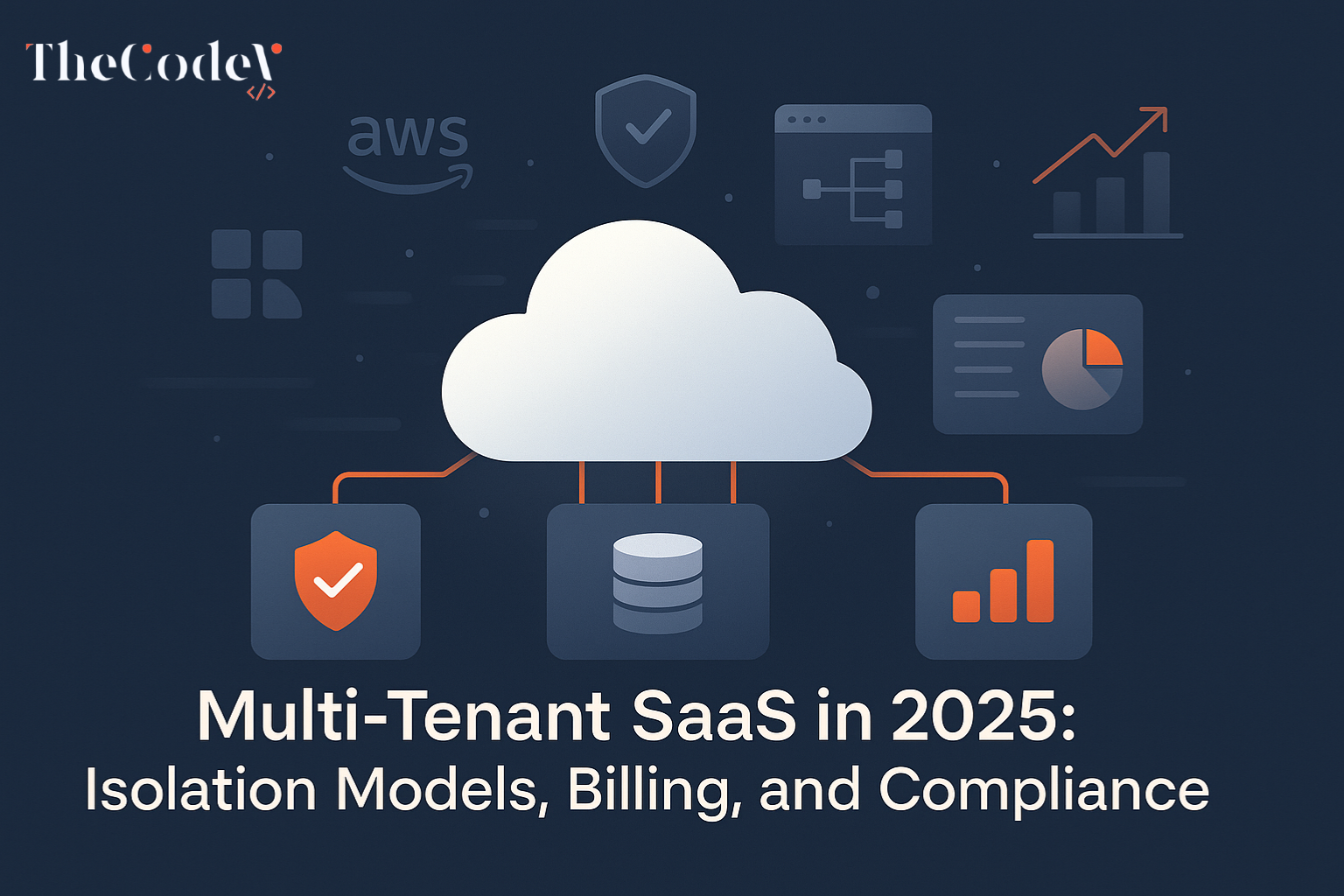
Multi-Tenant SaaS Architecture in 2025: The Foundation of Scalable Cloud Software
In 2025, multi-tenant SaaS architecture has become the backbone of scalable, cost-effective, and resilient software delivery. From emerging tech startups to established enterprises, the demand for smarter, more efficient cloud infrastructure is driving a new era of innovation. Companies across the UK are turning to this model to reduce operational costs, streamline deployments, and ensure that software performance scales seamlessly as customer bases grow.
At TheCodeV, our engineering teams are helping UK startups and enterprises transition to future-ready SaaS ecosystems that prioritise scalability, security, and compliance — transforming their business models for sustainable digital growth.
What Is Multi-Tenant SaaS Architecture?
A multi-tenant SaaS architecture is a software design approach where a single application instance serves multiple customers — known as tenants — while keeping each tenant’s data isolated and secure. This model contrasts with single-tenant architectures, where each customer has a separate instance of the software and database.
In multi-tenancy, tenants share infrastructure and codebase but experience complete logical data isolation. This architecture enables cloud providers and developers to deliver updates, patches, and new features globally, without downtime or manual configuration per client. It is the foundation of scalable SaaS solutions used by industry leaders like Salesforce and Microsoft 365.
Why Multi-Tenancy Matters in 2025
As cloud computing evolves, SaaS multi-tenancy architecture is becoming critical to business agility and competitiveness. Several key trends are driving its adoption in 2025:
Cost Efficiency and Resource Optimisation – Multi-tenant systems significantly lower infrastructure costs by sharing computing resources among multiple users. This efficiency allows SaaS vendors to offer more affordable pricing tiers and faster onboarding.
Rapid Deployment and Continuous Delivery – With a unified codebase, developers can roll out updates and new features to all tenants simultaneously. This makes maintenance and feature releases far more efficient than in single-tenant setups.
Enhanced Security and Data Isolation – Modern multi-tenant cloud software design incorporates advanced isolation mechanisms such as virtual private clouds (VPCs), encryption-at-rest, and identity-based access control, ensuring each tenant’s data remains private.
Compliance and Scalability – Multi-tenancy aligns naturally with SaaS scalability architecture principles, supporting global compliance standards such as GDPR and ISO 27001 while scaling effortlessly with business growth.
According to Gartner, nearly 85% of SaaS providers are expected to fully migrate to multi-tenant architectures by 2026, underscoring its role as the industry standard for flexibility and cost-effectiveness.
The Role of Cloud-Native Platforms (AWS & Azure)
Cloud giants such as AWS and Microsoft Azure have become the enablers of the multi-tenant SaaS revolution.
AWS offers architectural blueprints and managed services like Amazon RDS, ECS, and IAM that help SaaS providers isolate tenants while automating scaling and monitoring.
Azure supports multi-tenant SaaS applications through its App Service, Cosmos DB, and Azure Active Directory, ensuring secure, compliant identity and access management across tenant environments.
These cloud-native frameworks make it easier for developers to build and operate distributed SaaS applications with reliable uptime and global reach.
For UK businesses, this means reduced infrastructure overhead, compliance-ready systems, and faster go-to-market capabilities — all core advantages that TheCodeV’s Digital Services are designed to deliver.
How TheCodeV Empowers UK Startups with SaaS Innovation
At TheCodeV, we combine deep technical expertise with a consultative approach to help startups design, develop, and scale multi-tenant SaaS platforms that meet modern compliance and performance standards. Whether it’s building microservices-based infrastructure, managing tenant data isolation, or integrating AI-driven billing systems, our development teams ensure software agility and reliability across the board.
With a presence in the UK and global clientele, TheCodeV helps businesses embrace cloud transformation with precision, transparency, and innovation — turning SaaS ideas into scalable digital ecosystems.
Understanding SaaS Multi-Tenancy Models: Shared, Hybrid, and Isolated Architectures
In the evolving world of cloud applications, choosing the right SaaS multi-tenancy architecture model determines how effectively a business balances performance, security, and operational cost. Each design—shared, hybrid, and isolated—offers distinct trade-offs in terms of scalability and tenant isolation. For SaaS founders and CTOs, understanding these architectural models is key to building efficient, future-ready platforms.
At TheCodeV, our engineers help startups and enterprises evaluate these models to design cloud architectures that align with their growth, compliance, and security requirements.
What Is Tenant Isolation in SaaS?
Tenant isolation in SaaS ensures that data, configurations, and workloads belonging to one customer are securely separated from others — even though multiple tenants share the same underlying infrastructure. This principle is crucial to maintain privacy, performance stability, and regulatory compliance.
Effective tenant isolation can be achieved at multiple SaaS architecture layers:
Application Layer: Role-based access and logical partitioning ensure users only interact with their own data.
Database Layer: Separate schemas, databases, or clusters prevent data crossover.
Infrastructure Layer: Containerisation, virtual networks, and IAM policies further isolate compute and storage resources.
According to the AWS Architecture Blog, multi-tenancy models depend heavily on how data and compute layers are structured to optimise both cost and control.
Model 1: Shared Database Multi-Tenancy
In the shared database model, all tenants share the same database and tables, with tenant data differentiated by unique identifiers (e.g., tenant IDs).
Advantages:
Cost-efficient: Ideal for startups due to lower infrastructure overhead.
Easy to manage and deploy: Single codebase and shared schema enable rapid updates.
Challenges:
Limited data isolation: A misconfigured query or permission could potentially expose another tenant’s data.
Performance bottlenecks: High tenant traffic may affect shared database throughput.
Use Case Example:
Small SaaS platforms or MVPs often use Amazon RDS with a shared schema, where application logic enforces tenant-specific access. This model suits early-stage companies aiming for fast market entry with minimal infrastructure cost.
Model 2: Hybrid (Shared Application, Isolated Database)
The hybrid multi-tenancy model blends shared application layers with partially isolated databases. Each tenant may have their own schema or database instance while sharing common logic and APIs.
Advantages:
Balanced cost and security: Offers stronger data isolation than shared models while retaining operational simplicity.
Easier scalability: Databases can scale independently for high-value tenants.
Challenges:
Slightly higher infrastructure cost due to additional database instances.
More complex deployment pipelines compared to single shared environments.
Use Case Example:
A growing SaaS business might use Azure SQL Database Elastic Pools, where each tenant’s data resides in a dedicated schema, while shared containers handle API requests and scaling. Microsoft’s Learn Platform highlights this model as a balanced approach to scalability and compliance for medium-sized SaaS ecosystems.
Model 3: Fully Isolated Tenant Design
The isolated tenant model assigns each tenant their own dedicated application instance, database, and often virtual network. This approach provides maximum control, security, and performance, often used by enterprise-grade SaaS providers handling sensitive or regulated data.
Advantages:
Superior security: Complete separation of environments ensures maximum data protection.
Performance consistency: Each tenant’s workload runs independently, unaffected by others.
Compliance-friendly: Ideal for industries requiring ISO 27001 or GDPR-level isolation.
Challenges:
Higher operational cost: Each environment requires dedicated infrastructure and maintenance.
Complex scalability: Automation is essential to manage multiple isolated deployments efficiently.
Use Case Example:
Enterprise SaaS platforms often use AWS EKS (Elastic Kubernetes Service) or Azure Kubernetes Service (AKS) to deploy containerised environments per tenant. This guarantees full isolation while leveraging orchestration for automated scaling and monitoring.
Choosing the Right Model for Your SaaS
Selecting the ideal multi-tenant database design depends on your business goals, budget, and compliance needs.
Startups typically begin with shared or hybrid models to minimise cost and speed up delivery.
Mature SaaS providers adopt isolated or hybrid strategies to enhance performance and security.
The Cloud Native Computing Foundation (CNCF) emphasises modular microservices, containers, and orchestration tools as the foundation for flexible multi-tenant systems — allowing SaaS developers to evolve from shared to isolated models as demand grows.
At TheCodeV, we help clients architect, migrate, and optimise these environments using cloud-native tools, ensuring long-term scalability and compliance readiness across AWS, Azure, and beyond.
Designing Scalable Multi-Tenant SaaS Architecture: Best Practices for 2025
In today’s competitive digital landscape, scalability and reliability define the success of any SaaS product. A well-designed multi-tenant microservices architecture enables seamless growth, high availability, and efficient resource utilisation — crucial for UK startups aiming to serve global audiences.
At TheCodeV, our cloud architecture consultants help businesses design and implement scalable SaaS ecosystems built for performance, flexibility, and compliance. Drawing from real-world deployment experience across AWS, Azure, and Google Cloud, we follow proven patterns that have shaped the SaaS scalability architecture of 2025.
Microservices-Based SaaS Architecture
A microservices-based SaaS structure breaks down a monolithic application into smaller, independently deployable services. Each service handles a specific function — such as authentication, billing, or analytics — and communicates with others via APIs or event buses.
Benefits:
Enables independent scaling of critical components (e.g., user management, payment gateways).
Simplifies updates and deployments, reducing downtime during releases.
Improves fault isolation — a failure in one service doesn’t bring down the entire system.
This pattern also supports flexible SaaS solution architecture consulting, allowing startups to adopt the right cloud services for each microservice. As TechCrunch notes, microservices have become essential for agile software teams that need to innovate rapidly without compromising stability.
At TheCodeV, our architects specialise in microservices orchestration using Kubernetes and Docker, ensuring that applications scale horizontally and remain resilient under unpredictable workloads.
API Gateway and Load Balancing
An API gateway acts as the entry point for all tenant requests, routing them to the appropriate microservice or database. Coupled with load balancing, it ensures even distribution of traffic and prevents overload on any single node.
Core Functions of API Gateways:
Request routing and throttling
Authentication and authorisation
Tenant-aware caching and analytics
Version control for evolving APIs
This layer is a cornerstone of modern SaaS performance monitoring architecture, as it collects valuable metrics about API usage, response times, and error rates. Load balancers (like AWS Elastic Load Balancing or NGINX) further enhance system reliability by automatically scaling traffic across regions.
As detailed in the AWS Architecture Center, combining API gateways with serverless compute services like AWS Lambda helps achieve both performance optimisation and cost efficiency — a best practice TheCodeV applies in its UK SaaS solutions.
Event-Driven Communication
In large-scale SaaS systems, event-driven communication enables asynchronous data exchange across distributed services. Instead of direct API calls, components publish and subscribe to events through brokers like Kafka or Amazon SNS.
Why It Matters:
Reduces latency and dependency between services.
Supports real-time features such as notifications, analytics, and user activity tracking.
Enhances scalability during peak usage since events are processed in parallel.
As InfoQ highlights, event-driven systems represent the backbone of resilient multi-tenant platforms — where workloads fluctuate based on tenant demand.
At TheCodeV, our engineers design these event pipelines to ensure message reliability, replayability, and fault tolerance — key to supporting growing tenant bases without re-architecting the entire application.
Centralised Logging and Monitoring
No SaaS ecosystem can achieve true scalability without visibility. Centralised logging and monitoring form the operational backbone of modern multi-tenant systems. Tools like ELK Stack (Elasticsearch, Logstash, Kibana), Prometheus, and Grafana collect and visualise data from all architecture layers — helping teams identify issues before they affect tenants.
Key Practices:
Implement structured logging across all services.
Use tracing tools to monitor latency between microservices.
Adopt alerting systems to detect anomalies in real time.
These capabilities allow SaaS teams to maintain proactive reliability and compliance monitoring, aligning with SaaS performance monitoring architecture standards.
TheCodeV’s consultants implement full observability stacks as part of their Cloud Providers Comparison 2025 framework, enabling clients to choose the most cost-effective and performance-driven tools across AWS, Azure, and GCP.
TheCodeV’s Expertise in SaaS Scalability Architecture
Building scalable SaaS platforms isn’t just about adopting the latest technologies — it’s about designing systems that grow intelligently with business demand. TheCodeV provides end-to-end SaaS solution architecture consulting in the UK, helping startups:
Build cloud-native infrastructures with microservices and event-driven workflows.
Integrate robust monitoring and observability pipelines.
Optimise performance through adaptive scaling and intelligent load balancing.
Through data-driven design and cloud architecture excellence, TheCodeV empowers SaaS innovators to scale confidently while maintaining high availability, cost efficiency, and regulatory compliance.
SaaS Tenant Management and Billing Systems: Driving Efficiency in Multi-Tenant Cloud Design
Managing tenants efficiently is at the heart of any successful multi-tenant SaaS design. In 2025, UK-based software providers increasingly rely on automated SaaS tenant management and intelligent billing systems to balance user experience, operational cost, and profitability. Whether built on AWS, Azure, or hybrid cloud platforms, the right tenant and billing strategy transforms SaaS operations from merely scalable to truly sustainable.
At TheCodeV, we specialise in developing cost-effective SaaS architecture solutions UK — integrating automation, metering, and billing mechanisms that allow startups and enterprises to scale confidently while maintaining predictable margins.
Tenant Onboarding and Provisioning Workflows
The journey begins with tenant onboarding — the process of setting up new customer environments in a multi-tenant SaaS system. This includes provisioning user accounts, databases or schemas, storage quotas, and access roles automatically upon registration or subscription.
Key elements of automated onboarding include:
Identity management: Integration with SSO providers such as Azure AD or Auth0 for seamless user authentication.
Automated provisioning: Infrastructure-as-Code (IaC) tools like AWS CloudFormation or Terraform enable rapid deployment of tenant environments.
Lifecycle automation: Onboarding workflows trigger configuration, monitoring, and billing setup, ensuring a smooth handover from signup to live operation.
For growing startups, these workflows reduce manual labour, prevent misconfigurations, and guarantee consistent performance across tenants. AWS and Azure both offer automation templates for provisioning SaaS tenants, making scalability and governance achievable even for small teams.
Usage-Based Billing Models
In modern SaaS platforms, static pricing no longer fits dynamic usage patterns. Usage-based billing models — also known as metered billing — allow vendors to charge customers based on real consumption. This could be API calls, storage usage, compute time, or feature-level access.
Benefits include:
Fair cost distribution: Customers pay only for what they use.
Increased customer satisfaction and retention.
Predictable revenue scaling with usage growth.
Services like Stripe Billing (Stripe.com) simplify the integration of metered and recurring billing into SaaS platforms, supporting multi-currency payments and tax compliance. Many UK SaaS startups leverage Stripe’s APIs to automate invoicing, proration, and trial management — enabling frictionless financial operations at scale.
At TheCodeV, we architect SaaS billing systems that seamlessly integrate payment gateways with backend metering logic, ensuring data accuracy and transparency across the revenue cycle.
Multi-Tenant Cost-Sharing Mechanisms
A critical advantage of multi-tenancy lies in shared resource efficiency. Instead of each tenant requiring dedicated infrastructure, shared compute and storage resources are intelligently partitioned, significantly reducing total cloud expenditure.
Common cost-sharing techniques include:
Resource pooling: Virtualised compute nodes dynamically allocate resources based on tenant demand.
Storage tiering: Frequently accessed data sits on high-performance storage, while archived data moves to cost-efficient tiers.
Dynamic scaling: Orchestrators like Kubernetes automatically adjust capacity, optimising cost-to-performance ratios.
Implementing transparent cost tracking through observability tools like OpenTelemetry (opentelemetry.io) allows SaaS teams to measure resource usage per tenant, aiding both fair billing and system optimisation. This visibility also supports long-term planning and capacity forecasting — essential for sustainable growth.
Real-World Billing Systems on AWS and Azure
Both AWS and Microsoft Azure offer native support for multi-tenant billing and metering:
AWS Marketplace (aws.amazon.com/marketplace) allows SaaS providers to publish their software as metered listings, automating customer onboarding, usage tracking, and revenue collection. AWS Metering Service integrates with Lambda and CloudWatch to record tenant-specific metrics, ideal for usage-based billing models.
Azure SaaS Metered Billing APIs enable developers to report usage events and manage subscriptions programmatically, ensuring accuracy across distributed architectures. Combined with Azure Cost Management, it offers real-time cost insights and proactive spending alerts.
For businesses aiming to control SaaS architecture cost UK, leveraging these cloud-native systems ensures transparency and scalability while eliminating the need for manual reconciliation.
TheCodeV’s Approach to Scalable SaaS Management
As a trusted multi-tenant SaaS design agency UK, TheCodeV builds intelligent tenant management frameworks that integrate:
Automated onboarding pipelines for frictionless customer setup.
Adaptive billing models driven by data and cloud metering.
Optimised cost-sharing frameworks using Kubernetes and serverless functions.
Our cloud consultants design platforms where financial operations and technical scalability work hand in hand — ensuring your SaaS business remains competitive, compliant, and financially sustainable.
For startups and growing software firms looking to streamline their cloud infrastructure, explore our Pricing Plans to see how we deliver scalable architectures tailored for every business stage.
SaaS Security Architecture and Compliance in the UK: Ensuring Data Isolation and Trust
In the SaaS landscape, security and compliance are not optional — they are essential pillars that define customer trust and regulatory integrity. As multi-tenant systems scale across industries in 2025, SaaS security architecture UK focuses on ensuring robust tenant data protection, encryption, and identity management while meeting stringent compliance frameworks such as GDPR, ISO 27001, and SOC 2.
At TheCodeV, our architects design security-first multi-tenant platforms for UK businesses, integrating cloud-native protection mechanisms and compliance automation into every layer of the stack.
Multi-Tenant vs Single-Tenant SaaS: The Security Debate
A key consideration for SaaS providers is whether to adopt multi-tenant or single-tenant architectures.
Single-tenant SaaS offers complete isolation for each customer — separate instances, databases, and infrastructure. It maximises security but incurs higher operational costs and slower scalability.
Multi-tenant SaaS, on the other hand, allows multiple tenants to share the same infrastructure while maintaining logical data isolation. This approach delivers cost efficiency, agility, and scalability but requires meticulous architectural controls to ensure no data leakage occurs between tenants.
In regulated sectors such as finance, healthcare, and government, modern multi-tenant SaaS architecture UK solutions now achieve comparable security levels to single-tenant models — thanks to advanced isolation techniques and continuous compliance monitoring.
Compliance Frameworks: GDPR, ISO 27001, and SOC 2
UK-based SaaS companies must adhere to several compliance standards to maintain data integrity and customer trust:
GDPR (General Data Protection Regulation): Mandates strict data protection, transparency, and consent management. The UK’s Information Commissioner’s Office (ICO) oversees GDPR enforcement, making compliance vital for businesses handling EU and UK citizen data.
ISO 27001: Focuses on information security management systems (ISMS). It ensures that companies have formalised controls for data protection, incident response, and risk assessment.
SOC 2 (Service Organisation Control): Designed for service providers, SOC 2 audits a company’s security, availability, and privacy controls — often required by enterprise clients before SaaS adoption.
These frameworks collectively ensure that SaaS providers maintain continuous visibility and accountability over customer data, from infrastructure configuration to access management.
Best Practices for SaaS Tenant Data Isolation
Securing data within a multi-tenant SaaS environment demands multiple layers of protection. Some best practices include:
Encryption:
Use AES-256 encryption for data at rest and TLS 1.3 for data in transit.
Implement tenant-specific encryption keys managed through AWS KMS or Azure Key Vault.
Identity and Access Management (IAM):
Apply principle of least privilege for all user and system roles.
Use IAM roles and policies to segment access across tenants.
Employ federated identity management for secure authentication and SSO.
Network Segregation:
Use Virtual Private Clouds (VPCs) or Virtual Networks (VNets) to isolate tenant workloads.
Implement security groups, network access control lists (NACLs), and private endpoints to minimise exposure.
Apply zero-trust network policies and service meshes (e.g., Istio) to control east-west traffic between services.
These strategies collectively ensure best practices for SaaS tenant data isolation, protecting tenants from cross-access or compromise even in shared infrastructure environments.
AWS vs Azure: Comparing Isolation and Security Models
Both AWS and Azure have developed sophisticated frameworks for multi-tenant security and data segregation, making them the preferred platforms for SaaS security architecture UK projects.
AWS Multi-Tenant SaaS UK:
AWS provides dedicated services like AWS IAM, AWS KMS, and Amazon VPC for fine-grained access and encryption control.
The AWS Security Whitepaper outlines its shared responsibility model, ensuring customers retain control over data, keys, and application-level security.
AWS Shield and GuardDuty further protect against DDoS attacks and anomalous tenant activity.
Azure SaaS Architecture UK:
Microsoft Azure offers Role-Based Access Control (RBAC), Azure Policy, and Azure Sentinel for continuous compliance monitoring.
The Azure Security Documentation details multi-layer defences, from virtual network isolation to tenant-based key management.
Azure also integrates Microsoft Defender for Cloud, enhancing visibility across hybrid and multi-tenant workloads.
Both cloud providers meet global compliance certifications, including GDPR, ISO 27001, SOC 2, and CSA STAR, providing SaaS developers in the UK a strong security foundation for their platforms.
Building Security-Driven SaaS Systems with TheCodeV
Security is no longer a secondary concern — it’s a core architectural requirement. At TheCodeV, we design AWS multi-tenant SaaS UK and Azure SaaS architecture UK solutions that integrate security from the ground up. Our consultants implement data isolation, automated compliance checks, and encrypted pipelines to ensure your SaaS remains both scalable and secure.
For businesses navigating compliance or planning their next secure SaaS deployment, reach out via our Contact page to discuss tailored cloud security solutions designed for UK and global markets.
Performance Monitoring and Reliability in Multi-Tenant SaaS Architecture
High performance and reliability are the benchmarks of a well-engineered multi-tenant SaaS platform. In 2025, customers expect near-zero downtime, fast response times, and guaranteed SLAs — regardless of how many tenants share the infrastructure. Achieving this level of dependability requires a strong SaaS performance monitoring architecture, capable of observing every layer of the system in real time.
At TheCodeV, our engineers design and implement scalable multi-tenant SaaS design UK frameworks that integrate observability, fault-tolerant architecture, and intelligent monitoring systems. This ensures that applications perform consistently, scale predictively, and meet enterprise-grade uptime commitments.
Observability Stacks: Prometheus, Datadog, and Grafana
A modern SaaS architecture is built on multiple layers — infrastructure, services, APIs, and data pipelines. To keep these layers transparent and controllable, SaaS companies rely on observability stacks such as Prometheus, Datadog, and Grafana.
Prometheus collects metrics from containers, microservices, and databases at high granularity. These metrics track CPU utilisation, memory consumption, request rates, and latency — helping engineers pinpoint issues before they affect tenants.
Datadog (datadoghq.com) provides end-to-end visibility by unifying infrastructure monitoring, application tracing, and log analytics. Its AI-based anomaly detection enables proactive alerts, ensuring SaaS providers maintain SLAs even during unpredictable traffic spikes.
Grafana, often used alongside Prometheus, transforms performance data into intuitive dashboards, helping development teams visualise trends, capacity usage, and tenant-level resource consumption.
The Cloud Native Computing Foundation (CNCF) Observability Guide reinforces that true observability goes beyond logging — it integrates tracing, metrics, and alerts into a single operational model that empowers teams to diagnose performance degradations instantly.
Tenant-Specific Performance Tracking
In multi-tenant SaaS systems, every tenant has unique usage patterns and performance expectations. Tracking all tenants under a unified monitoring framework is essential for isolating performance anomalies and ensuring fairness in resource allocation.
Key practices for tenant-specific observability include:
Tagged Metrics: Label metrics by tenant ID, service, or region to monitor individual performance without impacting others.
Request Tracing: Implement distributed tracing (e.g., OpenTelemetry) to follow requests across services, identifying latency bottlenecks per tenant.
Custom Dashboards: Create per-tenant views in Grafana or Datadog for account managers and engineers to monitor SLAs in real time.
This granular visibility supports proactive maintenance — allowing TheCodeV’s clients to optimise database queries, scale infrastructure on demand, and maintain transparent performance reports for stakeholders.
By integrating observability across SaaS architecture layers, organisations gain actionable insights to continuously improve efficiency and reliability.
Load Testing and Resilience Design
Even the most efficient SaaS application can fail under unexpected load if not tested rigorously. Load testing and resilience design are fundamental components of SaaS performance monitoring architecture, ensuring the platform can handle peak usage and tenant surges without degradation.
Best Practices Include:
Synthetic Load Testing: Simulate tenant traffic using tools like k6 or Locust to evaluate throughput and latency across microservices.
Chaos Engineering: Introduce controlled failures to assess system behaviour under stress — a practice championed in the Google SRE Handbook.
Auto-Scaling Policies: Use Kubernetes Horizontal Pod Autoscaling (HPA) or AWS Auto Scaling groups to dynamically adjust capacity.
Failover and Replication: Maintain regional failover clusters and database replication to guarantee uptime and business continuity.
Resilience design isn’t just about redundancy — it’s about intelligent recovery. TheCodeV’s cloud engineers implement self-healing infrastructures that automatically recover from node failures, ensuring SLA compliance even in multi-cloud environments.
TheCodeV’s Approach to Scalable Monitoring and Reliability
At TheCodeV, we build observability-driven architectures that go beyond basic uptime checks. Our SaaS performance monitoring architecture integrates:
Centralised monitoring across microservices and containers.
Real-time alerting for tenant-specific anomalies.
Predictive scaling based on usage trends.
Continuous performance audits for long-term reliability.
Clients who work with TheCodeV benefit from proactive insights, optimised costs, and high-availability systems designed for growth. We don’t just monitor — we architect for resilience.
To explore how our team builds reliable, high-performance SaaS ecosystems, visit our Blog Page for case studies and technical insights from real-world cloud projects.
Building the Next Generation of Multi-Tenant SaaS with TheCodeV
The evolution of multi-tenant SaaS architecture represents one of the most transformative shifts in modern software development. In 2025, businesses across the UK and beyond are recognising that scalability, security, and cost efficiency are no longer competitive advantages — they are fundamental expectations. Whether optimising cloud infrastructure, ensuring data isolation, or managing thousands of tenants with zero downtime, multi-tenancy defines how digital platforms scale intelligently and securely.
At its core, modern SaaS architecture enables businesses to serve diverse customers through a single, resilient platform — balancing performance and compliance with continuous innovation. For UK enterprises and startups, this approach unlocks predictable growth and operational efficiency, helping them meet global demands without expanding infrastructure costs exponentially.
The Future: AI-Driven, Predictive, and Fully Compliant SaaS Systems
The next wave of SaaS innovation will be defined by AI-powered tenant management, predictive billing, and automated compliance. Artificial intelligence is already reshaping how SaaS platforms optimise resources — forecasting tenant usage patterns, dynamically scaling environments, and improving customer experience in real time.
Predictive billing systems, driven by machine learning, will further enable SaaS companies to forecast revenue streams and personalise pricing models. Meanwhile, compliance automation powered by AI will ensure that security and data privacy frameworks such as GDPR, ISO 27001, and SOC 2 are continuously enforced across distributed multi-tenant environments.
At TheCodeV, we’re already building this future in partnership with EmporionSoft, a trusted name in AI-enabled SaaS innovation. Together, we’re helping UK software companies adopt smarter architectures that merge automation with accountability — future-proofing their digital ecosystems for global success.
Why Partner with TheCodeV
As one of the leading SaaS architecture companies UK, TheCodeV provides full-spectrum consulting, design, and development for scalable cloud systems. Our team of expert multi-tenant SaaS developers UK specialises in:
Architecting secure, high-availability SaaS ecosystems for startups and enterprises.
Delivering SaaS solutions London that combine modern design with enterprise-grade security.
Offering tailored cloud architecture consultancy UK that aligns business goals with technology innovation.
Supporting long-term scalability through SaaS software development firms UK methodologies focused on automation and performance.
Every system we design is built to evolve — supporting continuous delivery, robust compliance, and seamless scalability across AWS, Azure, and multi-cloud infrastructures.
Ready to Build Your SaaS Future?
If your business is ready to scale with confidence, TheCodeV is here to guide you from concept to deployment:
Book a consultation to plan your next SaaS project: Book a Consultation →
Contact our team to discuss custom architecture and security solutions: Get in Touch →
Explore our digital services and discover how we can transform your SaaS idea into a market-ready product: Explore Services →